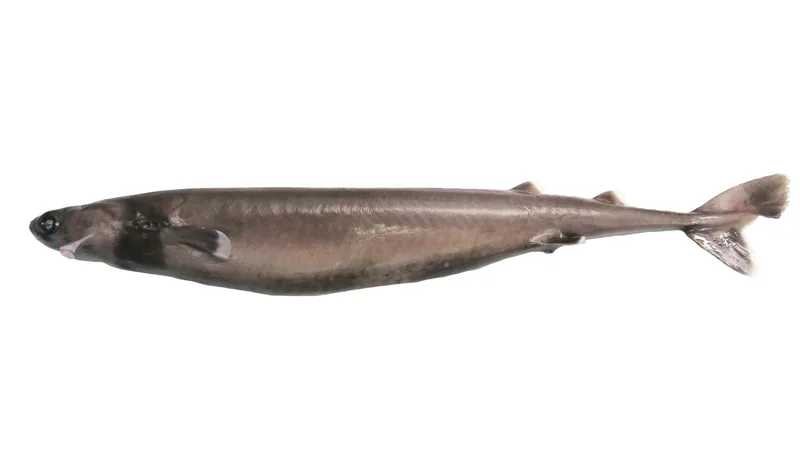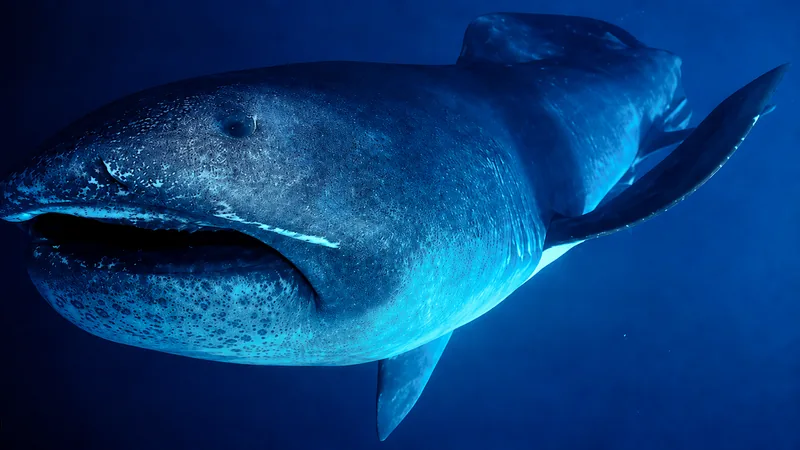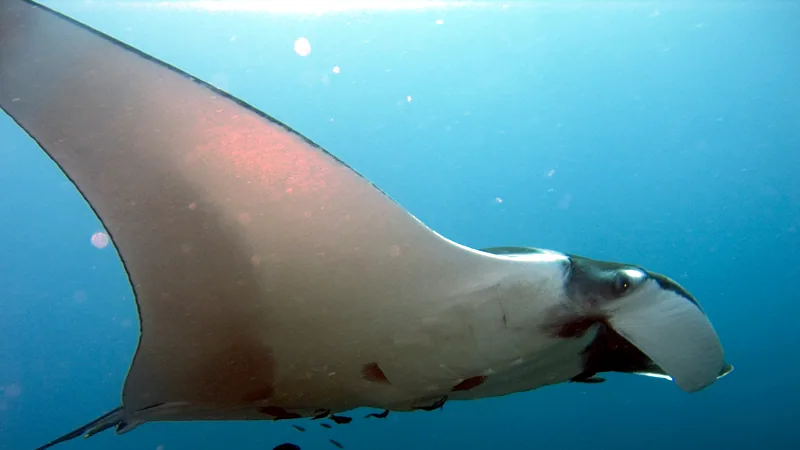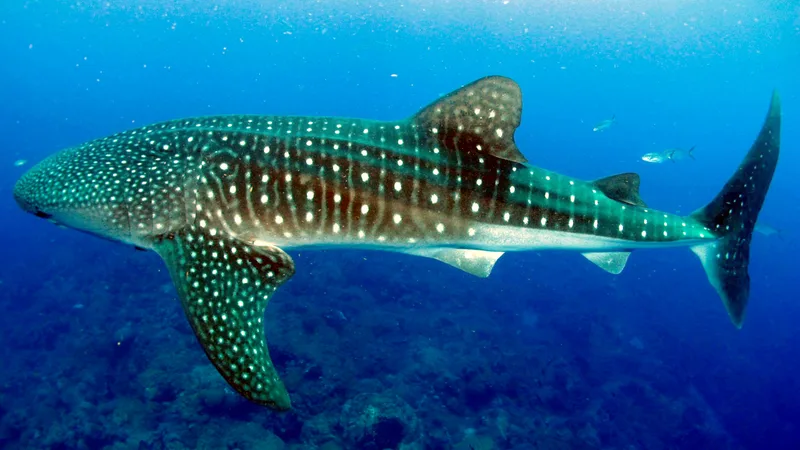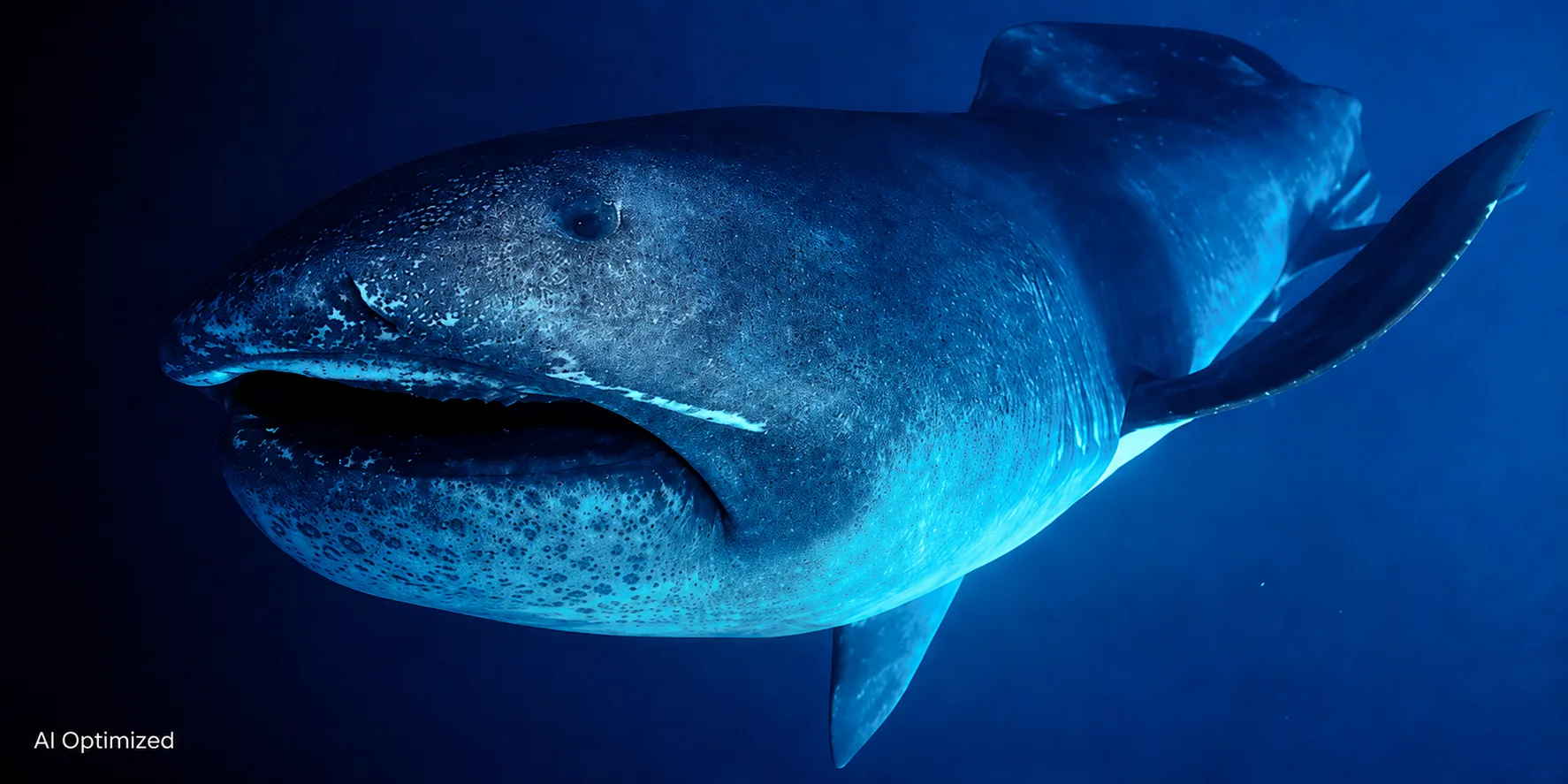
No freely licensed photo of a live megamouth exists, so this is an artist's illustration.
Field
notes
A shark found in a parachute
In November 1976, a research ship hauled in two parachute sea anchors off Hawaii and found a 4.46 m shark tangled in one. It was a new species. Scientists named it in 1983 and called it Megachasma, Greek for “yawning hole” or “open mouth”.
A mouth built to scoop
The mouth is very broad, and its corners reach back past the eyes. The jaws are huge and can slide forward. Scientists believe the shark swims slowly through a swarm of krill (small shrimp-like crustaceans) with its mouth open, pushes its jaws forward and expands its mouth cavity to suck the prey in. Then it shuts its mouth and squeezes the water out through its gills.
Its teeth are small. Each jaw has about fifty rows of small teeth, but only three rows are in use. Its prey includes krill, copepods (tiny crustaceans) and jellyfish.
Light trick A white band runs across the front of its snout. A 2020 study found no light organs in any of the skin it examined, strong evidence that the shark is not luminous. The band’s denticles, tiny tooth-like scales, may instead reflect glow from bioluminescent plankton.
Soft, slow and huge
A study of 27 megamouths caught off eastern Taiwan found they weighed 210 to 1,147 kg. FishBase gives a maximum length of 709 cm for a female, about 23 feet. This is a soft giant: its skin is very loose and its skeleton is soft and poorly calcified. The Florida Museum calls it a poor swimmer.
One tracked shark stayed at 12 to 25 m during the night, then dived to 120 to 160 m at dawn and returned to shallow water at dusk.
Spread across three oceans
The megamouth lives in the Indian, Pacific and Atlantic oceans, between about 40 degrees north and 40 degrees south. A 2021 study counted 261 landing and stranding records worldwide, with the majority from the western North Pacific. Animal Diversity Web names cookiecutter sharks as a predator, and in 1998 three sperm whales were seen attacking a 5 m megamouth in Indonesian waters.
The IUCN Red List rates it Least Concern, assessed in 2018, but a 2021 study notes that what is known of its biology and fisheries is still very limited.
Published
Traits
Intel
& FAQ
Guess
first
How big is a Megamouth Shark, really? Slide, lock in, and see what the sources say. Every answer is a figure from this page, quoted from where it came from.
Sources
- 01Kyne, Liu & Simpfendorfer (2019). Megachasma pelagios. The IUCN Red List of Threatened Species 2019: e.T39338A124402302.
- 02Duchatelet et al. (2020). The megamouth shark, Megachasma pelagios, is not a luminous species. PLOS ONE.
- 03Yu et al. (2021). Spatial-Temporal Distribution of Megamouth Shark, Megachasma pelagios, Inferred from over 250 Individuals Recorded in the Three Oceans. Animals.
- 04Liu et al. (2018). Genetic diversity and connectivity of the megamouth shark (Megachasma pelagios). PeerJ.
- 05Megachasma pelagios. Florida Museum of Natural History.
- 06Megamouth Shark, Megachasma pelagios. Australian Museum.
- 07Megachasma pelagios, Megamouth shark. FishBase.
- 08Megachasma pelagios (Megamouth Shark). Animal Diversity Web, University of Michigan.
What the sources say: 42 claims checked word for word against these sources →