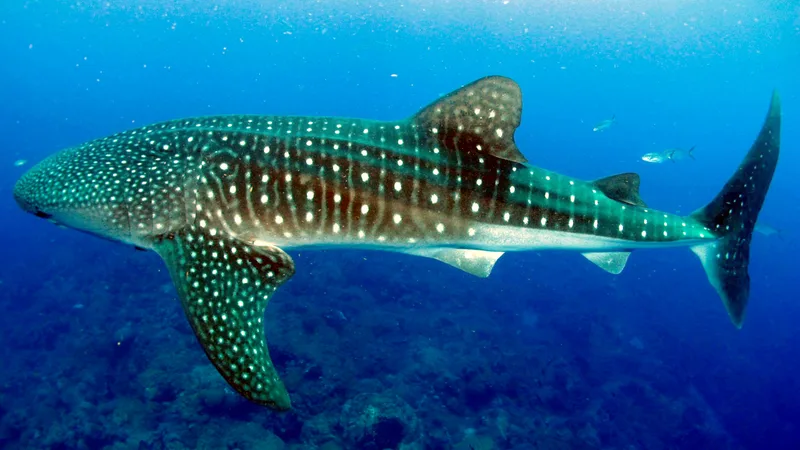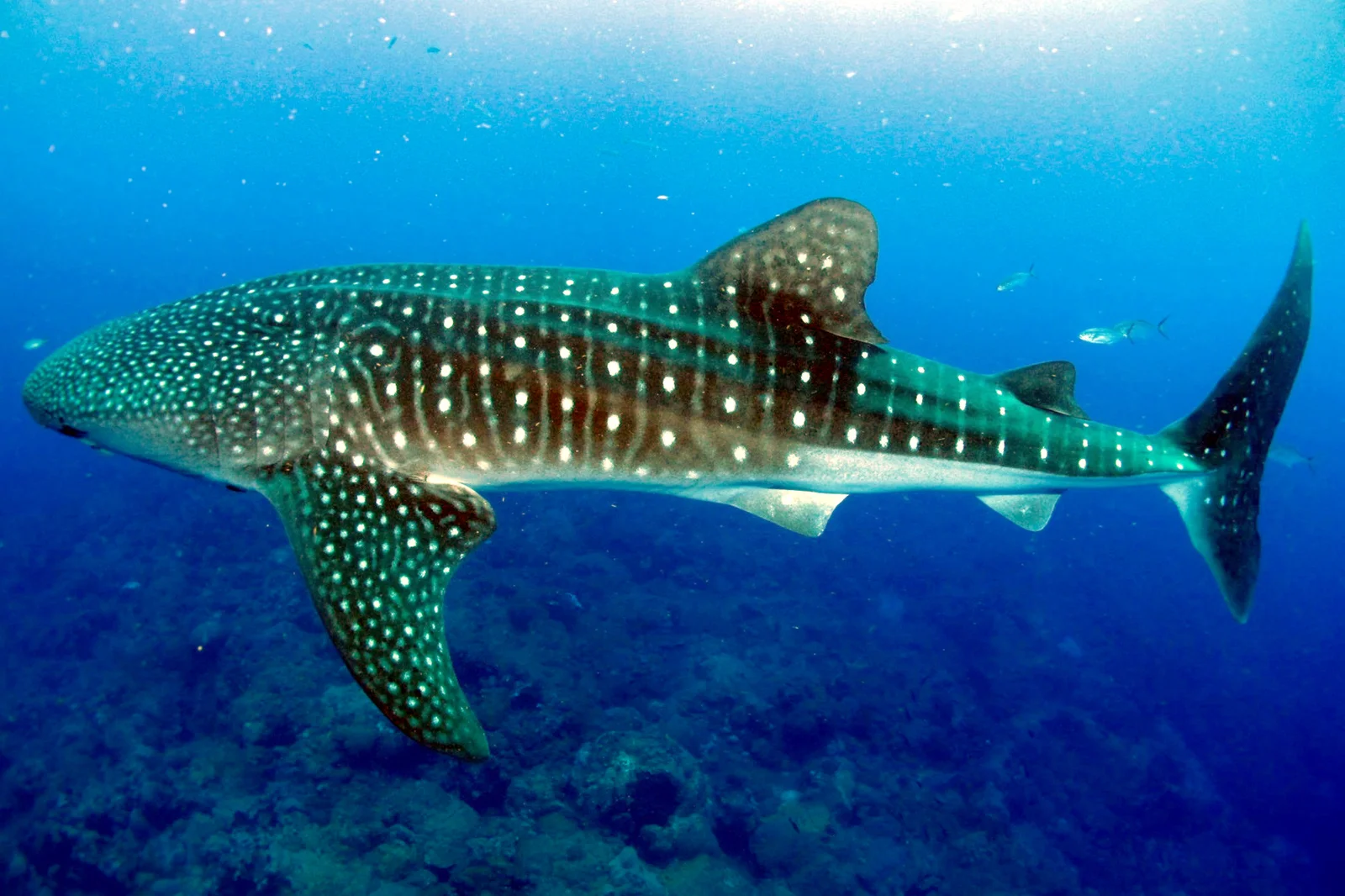
Adult whale shark (Rhincodon typus) gliding through Flower Garden Banks National Marine Sanctuary
Field
notes
Sizing Up a Giant
The whale shark (Rhincodon typus) is the largest fish alive. A current aquarium profile gives its common length as 18 to 32.8 feet (5.5 to 10 meters), and the largest measured at 61.7 feet (18.8 meters). It adds that a living whale shark is “very difficult to weigh accurately.” One 10-meter female, whose vertebrae were studied for a 2020 aging paper, had an estimated weight of about 7,000 kilograms (15,400 pounds). Its authors counted growth bands in the vertebrae of 20 sharks, used carbon-14 from 1950s and 60s nuclear bomb tests to confirm that each band marks a year, and estimated ages of up to 50 years. The bands narrowed in the oldest sharks but had not stopped forming.
Filtering the Sea
A whale shark’s teeth are tiny, point backward and are thought to play no role in feeding, though there are about 300 rows of them lining the inside of each jaw. Instead, water pours into a mouth up to four feet wide and through 20 filter pads meshed with holes averaging just 1.2 millimeters across. Cross-flow filtration helps keep that mesh from clogging: water drains out through the gills while plankton, which carries more momentum, keeps moving toward the back of the mouth. Off Mexico’s Yucatan Peninsula, researchers estimated that a shark about 6 meters long filters more than 600,000 liters of seawater an hour while ram feeding at the surface.
Armor Down to the Eyeballs
A whale shark’s skin is studded with dermal denticles, tooth-like scales that also cover its eyes. A 2020 study counted about 2,900 of these eye denticles around the iris of one shark’s eye, shaped differently from the denticles on the rest of the body in a way consistent with resisting abrasion. The same study observed three captive whale sharks pull their eyes back into their sockets in under a second when a diver approached, by up to about half the eyeball’s diameter. The authors knew of no other shark or ray with denticles on its eyes.
Wound Healing Researchers following injured whale sharks in photographs from two Indian Ocean aggregation sites estimated that the wounds reached 90 percent closure by about day 35 overall, 22 days for scrapes and 50 for cuts. One juvenile male, first seen in 2006 missing the tip of his first dorsal fin, appeared about five years later to have regrown it, which the authors called the first reported case of a shark or ray regrowing part of an appendage.
Into the Dark
Whale sharks also dive far below the surface. One tagged off Mozambique dove to 1,286 meters, deep into the mesopelagic and bathypelagic zones, while covering at least 1,200 kilometers of ocean in 87 days. The whale shark’s eye pigment, rhodopsin, absorbs light best at 478 nanometers, close to the light of about 480 nanometers that fades least in the deep sea. A 2023 study traced that tuning mostly to one spot in the pigment, site 94, the same site where, in humans, a mutation causes a form of night blindness. Whale sharks are now listed as Endangered on the IUCN Red List. Their threats include entanglement in fishing nets and boat strikes.
Published Updated
Traits
Intel
& FAQ
Guess
first
How big is a Whale Shark, really? Slide, lock in, and see what the sources say. Every answer is a figure from this page, quoted from where it came from.
Sources
- 01Rhincodon typus (whale shark). Animal Diversity Web, University of Michigan.
- 02Whale Shark. Georgia Aquarium.
- 03Pierce et al. (2025). Rhincodon typus. The IUCN Red List of Threatened Species 2025: e.T19488A126673248.
- 04Ong et al. (2020). Annual Bands in Vertebrae Validated by Bomb Radiocarbon Assays Provide Estimates of Age and Growth of Whale Sharks. Frontiers in Marine Science.
- 05Motta et al. (2010). Feeding anatomy, filter-feeding rate, and diet of whale sharks Rhincodon typus during surface ram filter feeding off the Yucatan Peninsula, Mexico. Zoology.
- 06Tomita et al. (2020). Armored eyes of the whale shark. PLOS ONE.
- 07Womersley et al. (2021). Wound-healing capabilities of whale sharks (Rhincodon typus) and implications for conservation management. Conservation Physiology.
- 08Brunnschweiler et al. (2009). Deep-diving behaviour of a whale shark Rhincodon typus during long-distance movement in the western Indian Ocean. Journal of Fish Biology.
- 09Yamaguchi et al. (2023). Whale shark rhodopsin adapted to deep-sea lifestyle by a substitution associated with human disease. Proceedings of the National Academy of Sciences.
- 10Arzoumanian, Holmberg & Norman (2005). An astronomical pattern-matching algorithm for computer-aided identification of whale sharks Rhincodon typus. Journal of Applied Ecology.
What the sources say: 66 claims checked word for word against these sources →