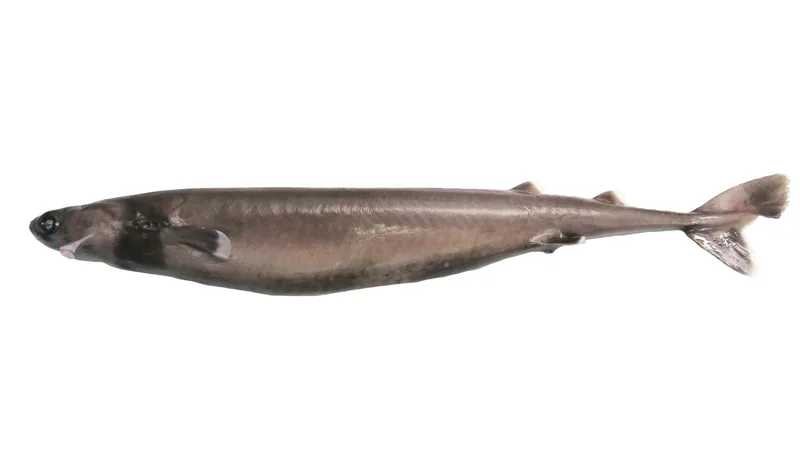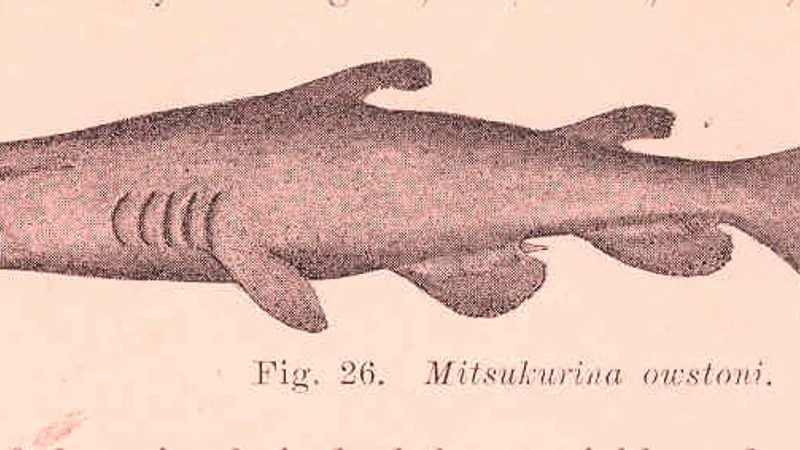
A goblin shark over the seafloor, from the US Fish and Wildlife Service.
Field
notes
Slingshot Jaws
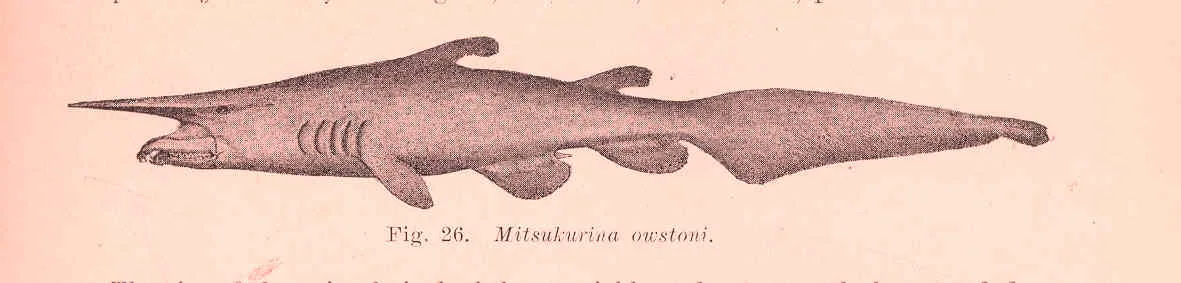
In the goblin shark (Mitsukurina owstoni), a double set of ligaments at the jaw joints thrusts the jaws forward, and while swimming it usually holds them tightly. Researchers filmed two goblin sharks, both about 1.3 metres long and caught by gill net in Tokyo Bay in 2008 and 2011, as they struck. The one recording that covered a whole strike, on a diver’s arm, showed the lower jaw shooting forward at up to 3.14 metres per second and travelling 9.4% of the shark’s total length, with the upper jaw travelling 8.6%. The researchers called it by far the fastest and greatest jaw protrusion among sharks. For comparison, the sling-jaw wrasse, a fish well known for rapid, extensive jaw protrusion, tops out at 2.31 metres per second.
How Big Does a Goblin Shark Get?
Goblin sharks were previously thought to reach only 300 to 400 centimetres, but more recent specimens suggest the species may grow larger. Regression analysis from photographs suggests lengths of 540 to 617 centimetres, roughly 18 to 20 feet, though the species’ true maximum size is still unknown. Mature male specimens have ranged from 264 to 384 centimetres and mature females from 335 to 372 centimetres. Size at birth isn’t known, but the smallest specimen ever collected measured just 107 centimetres.
Deep-water sharks and rays have poorly mineralised structures, so ageing them takes unconventional techniques. In one study, researchers stained a single vertebra from a male measuring 315.2 centimetres and aged it at a minimum of 27 years. Combining that with the lengths of the largest known males and the smallest free-swimming goblin sharks in a growth model, they estimated that males grow to about 374 centimetres, mature at around 16 years and live up to 60 years.
Hunting the Deep
Most known specimens come from bays of Japan, with the rest mostly found off New Zealand, southern Africa, and in the eastern Atlantic and Indian Oceans, plus records off California and in the northern Gulf of Mexico south of Mississippi. It is found along outer continental shelves and seamounts, and most specimens have been observed near continental slopes between 270 and 960 metres down. Its slender teeth suggest it mainly eats soft-bodied prey such as shrimp, octopus, fish and squid, and it is also thought to eat crabs, because of crushing teeth at the back of its jaws. In 2019 and 2024, scientists made the first observations of live goblin sharks in their own habitat, on a seamount near Jarvis Island and on the slope of the Tonga Trench. The sightings extended the species’ known depth range considerably, and the depth range of its whole order, the lamniform sharks, by 108 metres.
Pink Skin and a Sensing Snout
Blood vessels visible through the skin make a live goblin shark appear pinkish-white, while its fins appear bluish-grey. Young ones are a ghostly white, with the pink intensifying with age.
A snout that probably senses electricity. The exact purpose of the long, flat snout is unknown. It is not hard or sharp enough to pin or kill prey, so it is probably used to detect the faint electric signals other fish give off. It houses the ampullae of Lorenzini, electrical sensing organs attuned to catching otherwise undetectable prey in dark water or on the seafloor.
Published Updated
Traits
Intel
& FAQ
Guess
first
How big is a Goblin Shark, really? Slide, lock in, and see what the sources say. Every answer is a figure from this page, quoted from where it came from.
Sources
- 01Mitsukurina owstoni. Florida Museum of Natural History, Discover Fishes.
- 02Mitsukurina owstoni (elfin shark). Animal Diversity Web, University of Michigan.
- 03Nakaya et al. (2016). Slingshot feeding of the goblin shark Mitsukurina owstoni (Pisces: Lamniformes: Mitsukurinidae). Scientific Reports.
- 04Caltabellotta et al. (2020). Preliminary age and growth of the deep-water goblin shark Mitsukurina owstoni (Jordan, 1898). Marine and Freshwater Research.
- 05Judah et al. (2026). First in situ observations of the goblin shark Mitsukurina owstoni. Journal of Fish Biology.
- 06Finucci & Duffy (2018). Mitsukurina owstoni. The IUCN Red List of Threatened Species 2018: e.T44565A2994832.
What the sources say: 49 claims checked word for word against these sources →