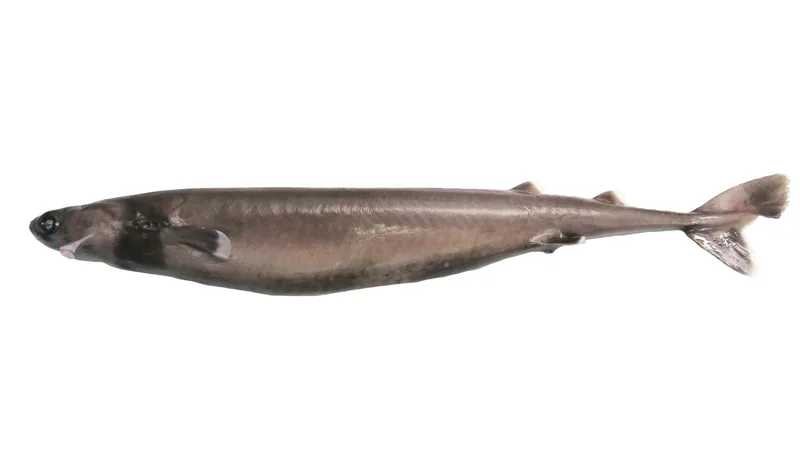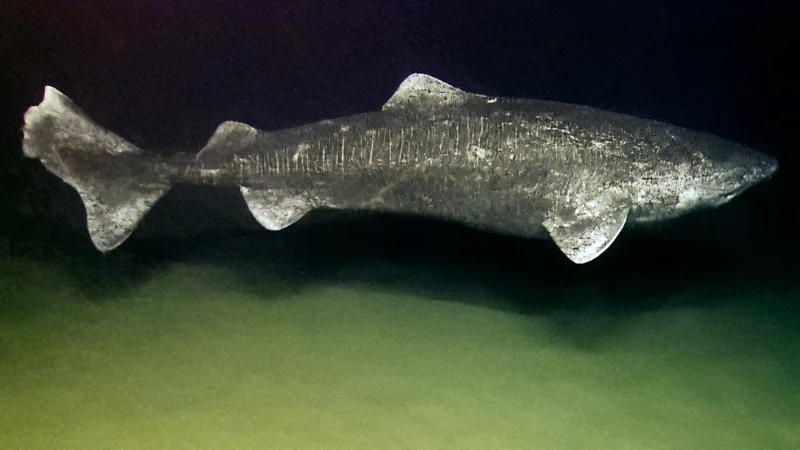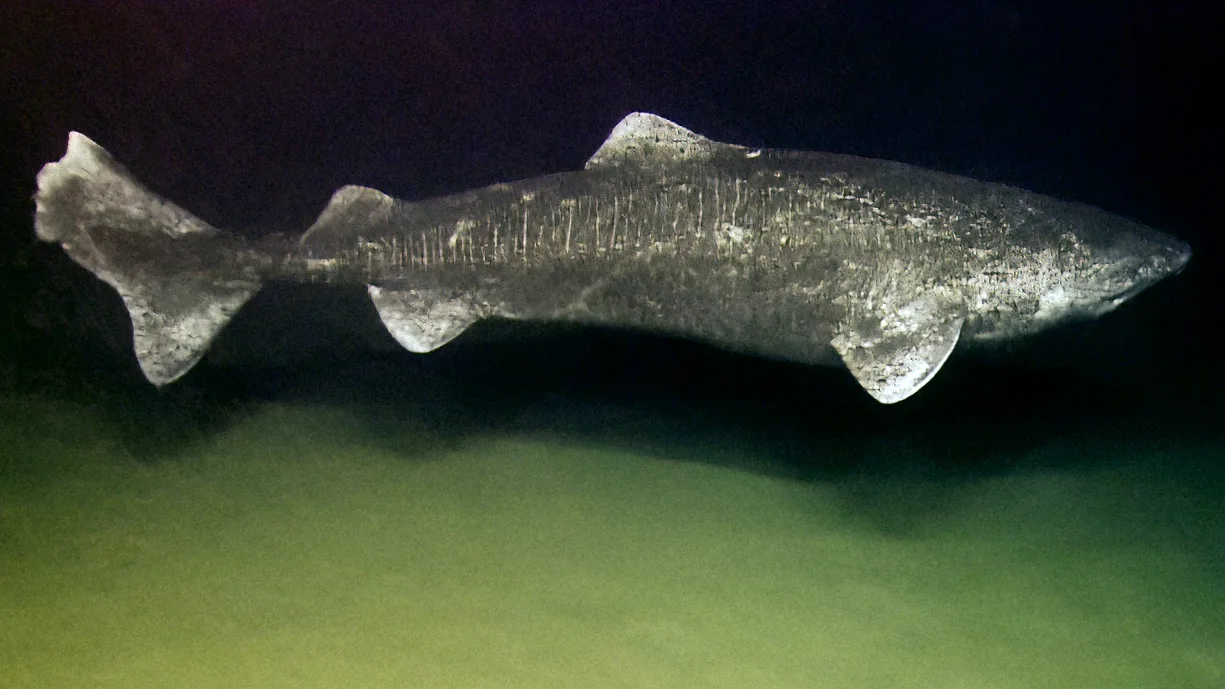
Adult Greenland shark cruising through deep Arctic waters (NOAA Okeanos Explorer)
Field
notes
Ancient by Definition
The Greenland shark (Somniosus microcephalus) cruises the deep, cold water of the North Atlantic and Arctic Ocean, and it does almost everything slowly: it grows slowly, swims slowly, and, by one study, lives longer than any other backboned animal known.
Its skeleton has no hard, calcified tissue to grow rings on, the way other sharks are aged. In 2016, researchers found a workaround: the center of a shark’s eye lens is made of proteins formed before birth that do not degrade with age. By radiocarbon-dating the eye lenses of 28 female Greenland sharks, a team calculated a lifespan of at least 272 years, making it the longest-lived vertebrate known. The largest shark in the study, a five-meter female, worked out to somewhere between 272 and 512 years old, and the same data put sexual maturity in females at no younger than 156 years old, give or take 22.
Life in Slow Motion
Greenland sharks average roughly 2.4 to 4.3 meters long, and the biggest reach about 6.4 meters. Females are the larger sex, and two in one study weighed 1,100 and 1,367 kilograms. A Greenland shark grows less than a centimeter a year, is known to dive as deep as 2,200 meters, and lives in water as cold as 1 degree Celsius. Researchers estimate a litter could hold up to 200 to 324 pups, depending on the mother’s size, each about 35 to 45 centimeters long at birth, though that estimate is still waiting to be checked against a pregnant shark. Slow does not mean picky: it eats cod, herring, skates, seals, and small whales, plus eels, flounders, and other small sharks. It is a slow swimmer that likely ambushes its prey, and it eats carrion too: drowned horses and reindeer have turned up in the stomachs of captured sharks.
A parasite on the eyeball Many Greenland sharks have a copepod, Ommatokoita elongata, attached to the cornea of one eye. It can scar the cornea and could lead to severe vision loss, possibly blindness, but that does not seem to harm the shark, since it does not rely on its vision.
Toxic Unless You Know What You’re Doing
Greenland shark flesh, especially fresh, is toxic to both dogs and people. It carries large amounts of trimethylamine oxide, and the poisoning symptoms appear to come from that chemical breaking down in the gut into trimethylamine. In Iceland, the flesh is traditionally cured into a fermented dish called hákarl instead of eaten fresh. The living shark is another matter: no attack on a person has been confirmed, and the International Shark Attack File lists only one reported attack.
Published Updated
Traits
Intel
& FAQ
Guess
first
How big is a Greenland Shark, really? Slide, lock in, and see what the sources say. Every answer is a figure from this page, quoted from where it came from.
Sources
- 01Somniosus microcephalus (Greenland shark). Animal Diversity Web, University of Michigan.
- 02How long do Greenland sharks live? National Ocean Service, NOAA.
- 03Somniosus microcephalus. Florida Museum of Natural History, Discover Fishes.
- 04Nielsen et al. (2016). Eye lens radiocarbon reveals centuries of longevity in the Greenland shark (Somniosus microcephalus). Science.
- 05Nielsen et al. (2020). Assessing the reproductive biology of the Greenland shark (Somniosus microcephalus). PLOS ONE.
- 06Anthoni et al. (1991). Poisonings from flesh of the Greenland shark Somniosus microcephalus may be due to trimethylamine. Toxicon.
- 07Borucinska, Benz & Whiteley (1998). Ocular lesions associated with attachment of the parasitic copepod Ommatokoita elongata (Grant) to corneas of Greenland sharks, Somniosus microcephalus (Bloch & Schneider). Journal of Fish Diseases.
- 08Osimani et al. (2019). Unveiling hákarl: A study of the microbiota of the traditional Icelandic fermented fish. Food Microbiology.
- 09Kulka et al. (2020). Somniosus microcephalus. The IUCN Red List of Threatened Species 2020: e.T60213A124452872.
What the sources say: 62 claims checked word for word against these sources →