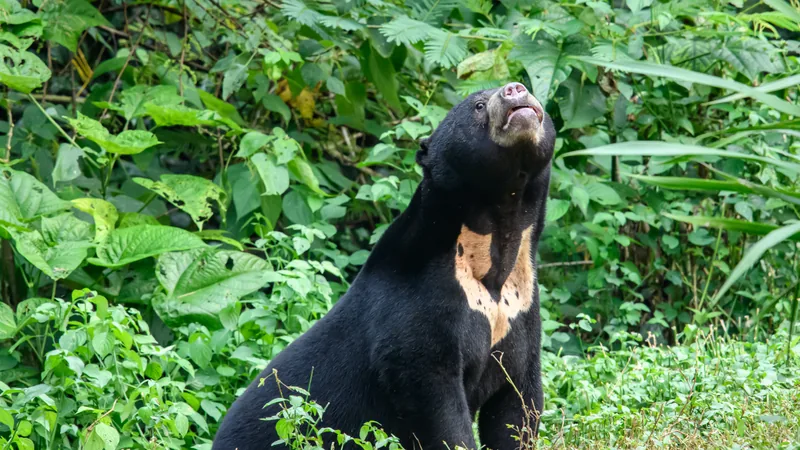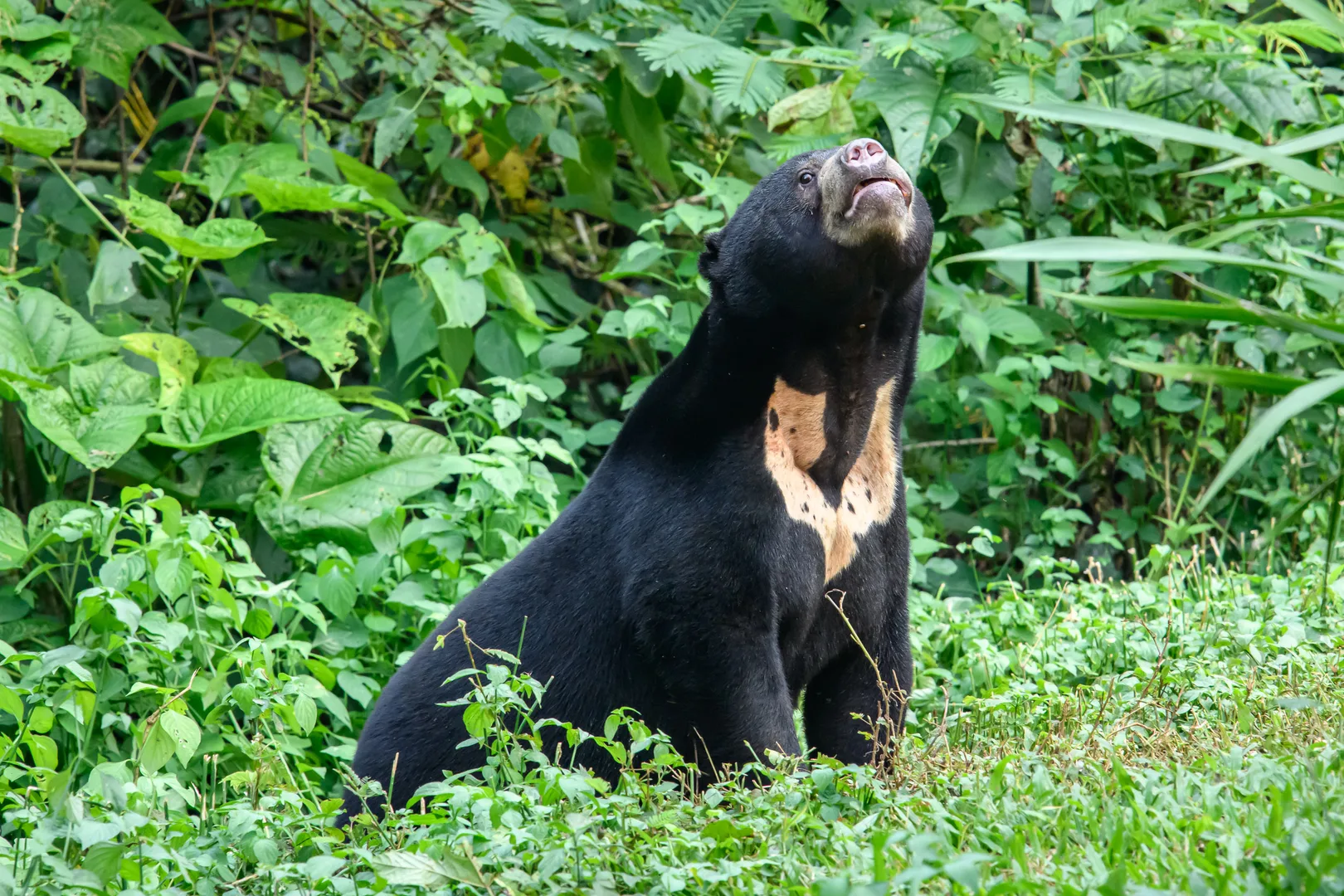
Sun bear in the wild, Kaeng Krachan National Park, Thailand
Field
notes
Small Bear, Giant Tongue
The sun bear (Helarctos malayanus) is the smallest of the world’s eight bear species, but it has the longest tongue. That tongue is perfect for reaching honey and insects inside trees and other tight places. Its front paws and long claws rip trees open in search of insects or sap. The claws are about 10 centimeters (4 inches) long. Its strong jaws and teeth can even open coconuts.
Sunrise on the chest Its name comes from the white or yellowish crescent on its chest, which many people think looks like the rising or setting sun. Each bear’s crest is unique, like a fingerprint. On some bears the patch is missing completely.
Built for the Treetops
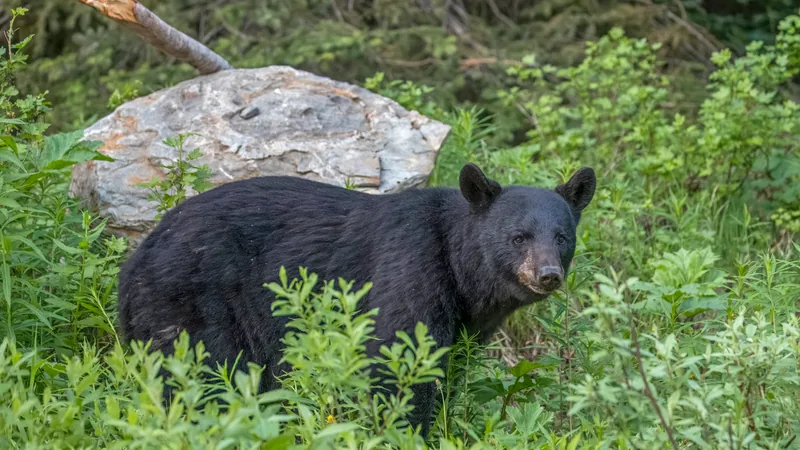
An adult sun bear weighs 23 to 65 kilograms (60 to 145 pounds) and is 1.1 to 1.4 meters long. Males are 10 to 20 percent larger than females. The species is about half the size of an American black bear.
In Malay, its name means “he who likes to sit high”. Big paws with hairless soles help it climb, and it walks pigeon-toed, which is an adaptation to life in the trees. If a predator grabs on, a sun bear can turn in its loose skin and bite back.
It lives in the dense lowland tropical forests of Southeast Asia, from as far north as Myanmar to the Indonesian islands of Kalimantan and Sumatra in the south. Its historic range was far larger, and today the bears live in more fragmented areas. One of its two subspecies is the Bornean sun bear. In eastern India it shares the forest with black bears and sloth bears, the only place where those three bears are known to live together today.
Honey, Termites and Tiger Leftovers
Sun bears rely mostly on fruit and insects, bees and termites among them. Honey, small birds, lizards and rodents are occasional extras, and when the chance comes up they scavenge tiger kills.
They do not hibernate, probably because their tropical forest has food year-round. San Diego Zoo Wildlife Alliance gives an average life span of 23 years for females. One captive bear in the AnAge database reached 35.9 years.
Vulnerable and Barely Studied
The IUCN Red List rates the sun bear Vulnerable. Nobody knows how many are left, because the bears are secretive and few studies have focused on them. Scientists think the population fell by more than 30 percent in 30 years, as farming and logging destroy forest and poachers hunt the bears for meat and medicines. Hunting them is illegal, but the laws are rarely enforced.
Published
Traits
Intel
& FAQ
Guess
first
How big is a Sun Bear, really? Slide, lock in, and see what the sources say. Every answer is a figure from this page, quoted from where it came from.
Sources
- 01Chauhan & Sethy (2011). Human-malayan Sun Bear Conflicts in Manipur State, India. Indian Forester.
- 02Sun Bear. San Diego Zoo Wildlife Alliance.
- 03Bies. Helarctos malayanus (sun bear). Animal Diversity Web, University of Michigan.
- 04Sun Bear. Oakland Zoo.
- 05AnAge entry for Helarctos malayanus. AnAge: The Animal Ageing and Longevity Database, Human Ageing Genomic Resources.
- 06Scotson et al. (2017). Helarctos malayanus. The IUCN Red List of Threatened Species 2017: e.T9760A123798233.
What the sources say: 53 claims checked word for word against these sources →