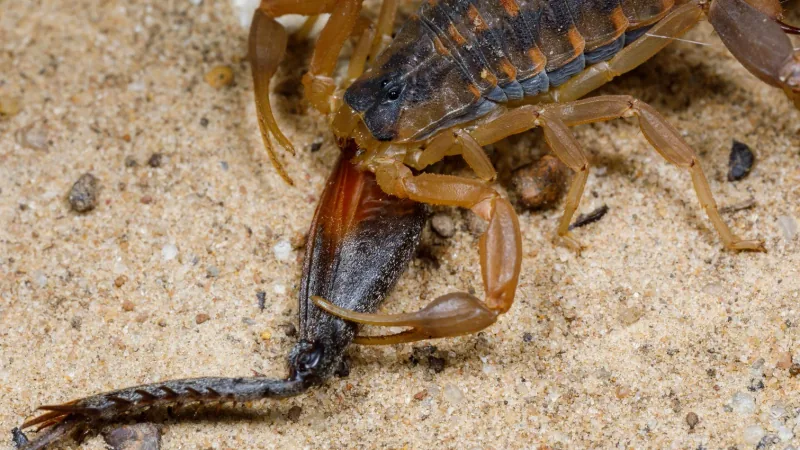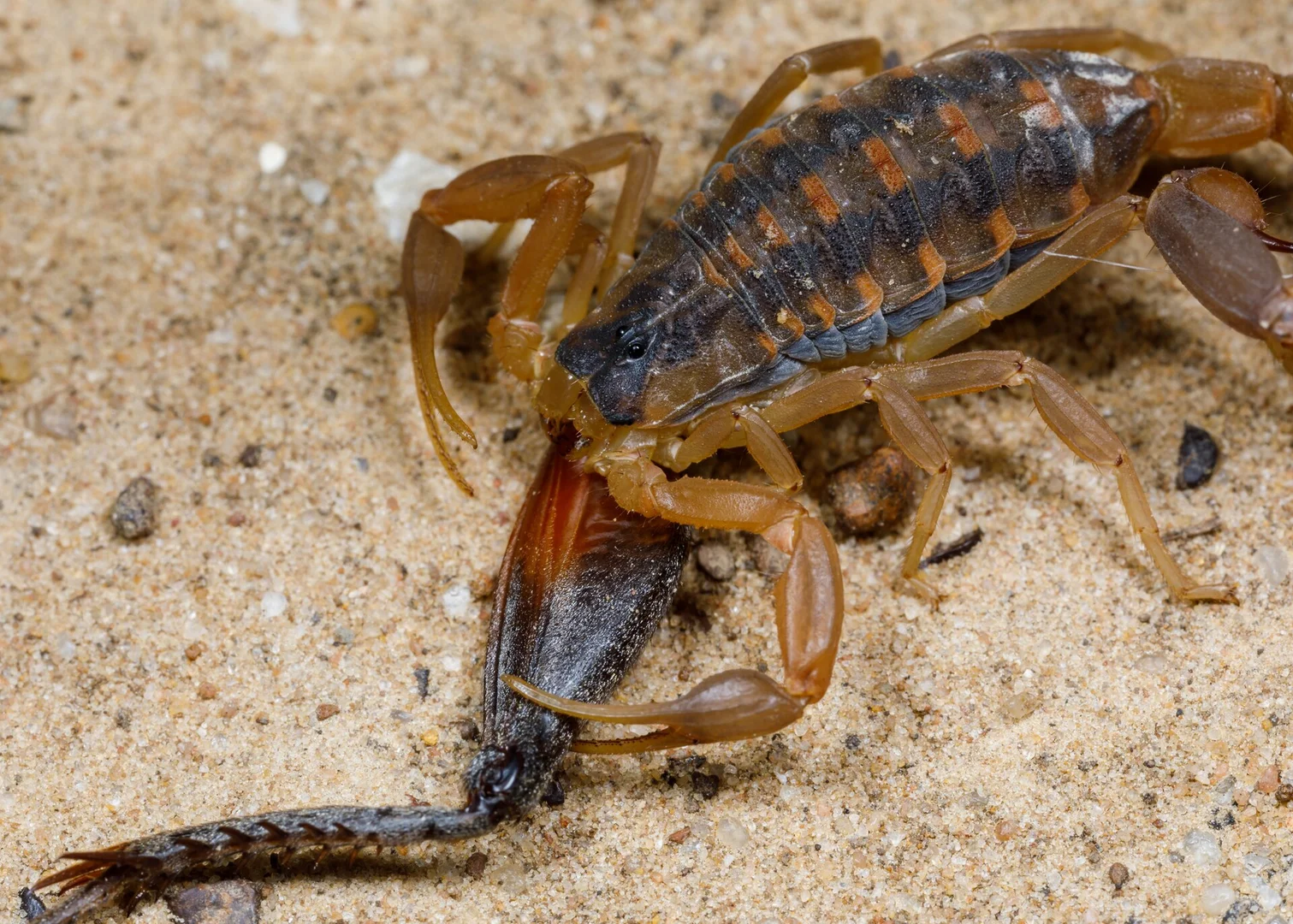
Striped bark scorpion eating a centipede
Field
notes
One of America’s Most Common Scorpions
Colorado State University Extension calls the Striped Bark Scorpion (Centruroides vittatus) one of the most common scorpions in the United States. Adults average about 2.5 inches fully stretched out, seldom more than 3 inches, and weigh 300 to 700 milligrams. The body is yellowish to tan, with two broad blackish stripes along the top of the abdomen and a V-shaped dark patch on the head around the eyes. Its range spreads outward from Texas into eleven other US states, from Colorado and Nebraska east to Tennessee, and into five states of northern Mexico; in Colorado, about Interstate 70 marks its northern edge. It takes 3 to 4 years to mature and can live another 2 to 3 years as an adult. It hides in damp, cool spots under rocks, boards, fallen logs, and dead vegetation, and inside homes.
Hunting by Touch and Smell
It stalks its prey mostly at night, by touch and smell. Comb-like chemical sensors on its underside touch the ground as it walks, which helps it track prey. Once its pincers grab hold, it curls its tail over its body and stings the prey, which jerks compulsively and is paralyzed by the venom; the scorpion then chews it into a semi-liquid state it can suck up.
A Slow-Closing Gate One of its venom peptides, CvIV4, slows the closing of Nav1.7, a sodium channel (a gate that lets sodium into a cell) carried by pain-sensing nerve cells, but it did not affect a second channel in those cells, Nav1.8.
A Sting Split by Sex
Bark scorpions roam rather than burrow, and rely more on fleeing than on fighting back. When researchers tested scorpions collected in New Mexico, the sexes defended themselves differently. Males sprinted faster, at 22.4 compared with 17.6 centimeters a second, while females stung faster, averaging 8.0 stings in two seconds against the males’ 6.5. Females of this species are gravid (carrying embryos) eight months of the year, and the researchers suggest that burden likely slows their sprint and may push them toward stinging instead, while male scorpions, known to be more mobile and to range farther, may rely on speed as their main defense. Colorado State University Extension says a sting from Colorado’s scorpions, this one included, is a sharp, often burning pain that usually fades within a few minutes to an hour and is no more painful than a bee or wasp sting, and that none of the state’s species has venom linked to dangerous complications.
Armed After the First Molt
Courtship starts when the female makes abrupt advances toward a potential mate and retreats. A receptive male answers with a back-and-forth rocking called “juddering,” and the two clasp claws for a “cheliceral massage,” which the Extension calls a scorpion version of a kiss. Young are born live and ride on their mother’s back through their first molt. That molt makes the metasoma, the tail-like rear section, relatively longer and turns the sting sharp and functional. Litter size varies, and 13 to 47 young have been reported for this species. The young leave their mother after about a week and forage on their own. Its venom differs with size too: in a test on crickets, venom from adults and near-adults was about 2.7 times as potent as venom from young scorpions.
Published Updated
Traits
Intel
& FAQ
Sources
- 01Centruroides vittatus. Animal Diversity Web, University of Michigan.
- 02Scorpions of Colorado. Colorado State University Extension.
- 03Carlson, McGinley & Rowe (2014). Meek Males and Fighting Females: Sexually-Dimorphic Antipredator Behavior and Locomotor Performance Is Explained by Morphology in Bark Scorpions (Centruroides vittatus). PLoS ONE.
- 04Rowe et al. (2011). Isolation and Characterization of CvIV4: A Pain Inducing α-Scorpion Toxin. PLoS ONE.
- 05Farley (2004). Developmental changes in the embryo, pronymph, and first molt of the scorpion Centruroides vittatus (Scorpiones: Buthidae). Journal of Morphology.
- 06McElroy et al. (2017). Differential toxicity and venom gland gene expression in Centruroides vittatus. PLOS ONE.
What the sources say: 48 claims checked word for word against these sources →