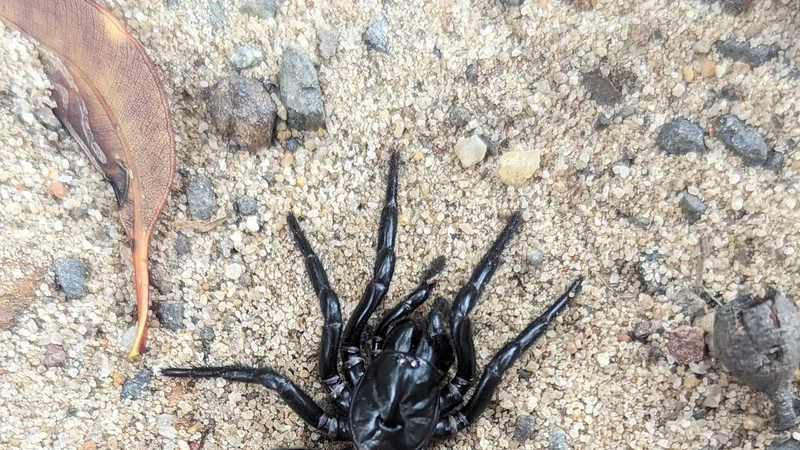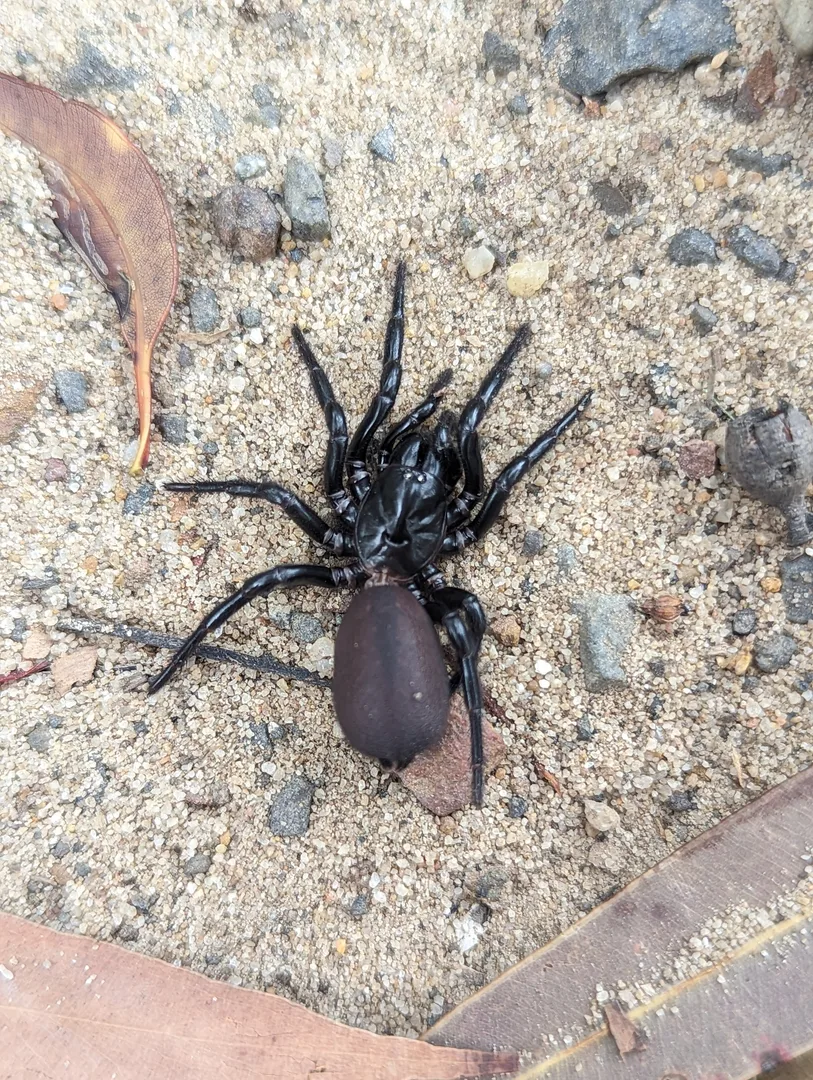
A Sydney funnel-web (Atrax robustus) rearing up with its fangs on show.
Field
notes
A Toxin Built for the Wrong Target
Only male Sydney funnel-webs (Atrax robustus) are known to make venom molecules that cause serious effects in humans. The key one, robustoxin, also called delta-atracotoxin-Ar1, is a chain of 42 amino acids folded into a knot and held together by four sulfur-to-sulfur bridges. In tests on rat nerve cells, it stopped some sodium channels, the pores that let a nerve fire, from shutting off properly: a trickle of sodium kept flowing, and the channels reset faster for the next signal. Those changes fit with funnel-web toxins making nerves fire over and over.
An Evolutionary Coincidence Robustoxin severely affects the nervous systems of humans and monkeys, but not those of other mammals. A 2020 study found it causes pain in mice and concluded that this family of funnel-web toxins likely evolved to deter predators such as bandicoots, birds and lizards. Humans are not the target, which makes the toxin’s lethal effect on us “an unfortunate evolutionary coincidence.”
Two to Four Centimetres, Grown Up in Year Five
A Sydney funnel-web measures 2 to 4 centimetres, according to the Australian Museum; Animal Diversity Web gives males up to 25 millimetres and females up to 35. It’s a shiny, dark brown to black spider with finger-like spinnerets, its silk-spinning organs, at the tip of the abdomen. It is long-lived for a spider: females can live for more than eight years, and both sexes generally mature only in their fifth year. Females tend to stay in one place unless flooding forces them out. Males mature in summer and leave their burrows, usually after rain, to roam in search of mates.
Ambush From a Silk Trip-Wire
Sydney funnel-webs live in silk-lined burrows under logs and rocks, where the air stays cool and humid, with silk trip-lines laid around the entrance. The spider waits just inside, and when a beetle, cockroach, small lizard or millipede walks across a line, it rushes out to grab it, then carries the meal back into the burrow. Threatened, it rears up and displays its fangs. In a 2022 lab study, juveniles tended to huddle when puffed with air, while adults lifted their front legs and moved their fangs.
One Spider Becomes Three
The Sydney funnel-web lives in shady gullies, forest and bushy suburbs from the Central Coast south to the Georges River and west to Baulkham Hills, with some records from the Blue Mountains and Wollongong. More recently its range has shrunk in the south. It was long considered a single species. A 2025 study, combining DNA with detailed anatomy, split it into three: the “true” Sydney funnel-web centred on Sydney’s North Shore and the Central Coast, the Southern Sydney funnel-web (Atrax montanus), most common in the Blue Mountains, and the Newcastle funnel-web (Atrax christenseni), the largest of the three. Decades of venom research on spiders then all called Atrax robustus now need re-examining in light of the split.
Published Updated
Traits
Intel
& FAQ
Guess
first
How big is a Sydney Funnel-Web Spider, really? Slide, lock in, and see what the sources say. Every answer is a figure from this page, quoted from where it came from.
Sources
- 01Sydney Funnel-web Spider, Atrax robustus. Australian Museum.
- 02Australian Funnel-web Spiders. Australian Museum.
- 03Australia's deadliest spider reclassified. Australian Museum.
- 04Atrax robustus. Animal Diversity Web, University of Michigan.
- 05Loria et al. (2025). The world's most venomous spider is a species complex: systematics of the Sydney funnel-web spider (Atracidae: Atrax robustus). BMC Ecology and Evolution.
- 06Duran, Wilson & Lee Rymer (2022). Behaviour of the Sydney funnel-web spider Atrax robustus over different contexts, time, and stimuli. Toxicon: X.
- 07Nicholson et al. (1998). Characterisation of the effects of robustoxin, the lethal neurotoxin from the Sydney funnel-web spider Atrax robustus, on sodium channel activation and inactivation. Pflügers Archiv European Journal of Physiology.
- 08Pallaghy et al. (1997). Solution structure of robustoxin, the lethal neurotoxin from the funnel-web spider Atrax robustus. FEBS Letters.
- 09Nicholson et al. (1996). Selective alteration of sodium channel gating by Australian funnel-web spider toxins. Toxicon.
- 10Herzig et al. (2020). Australian funnel-web spiders evolved human-lethal δ-hexatoxins for defense against vertebrate predators. Proceedings of the National Academy of Sciences.
What the sources say: 58 claims checked word for word against these sources →