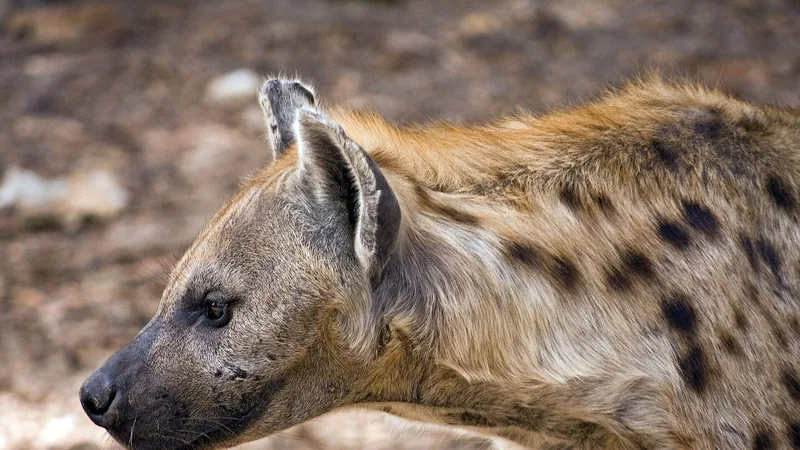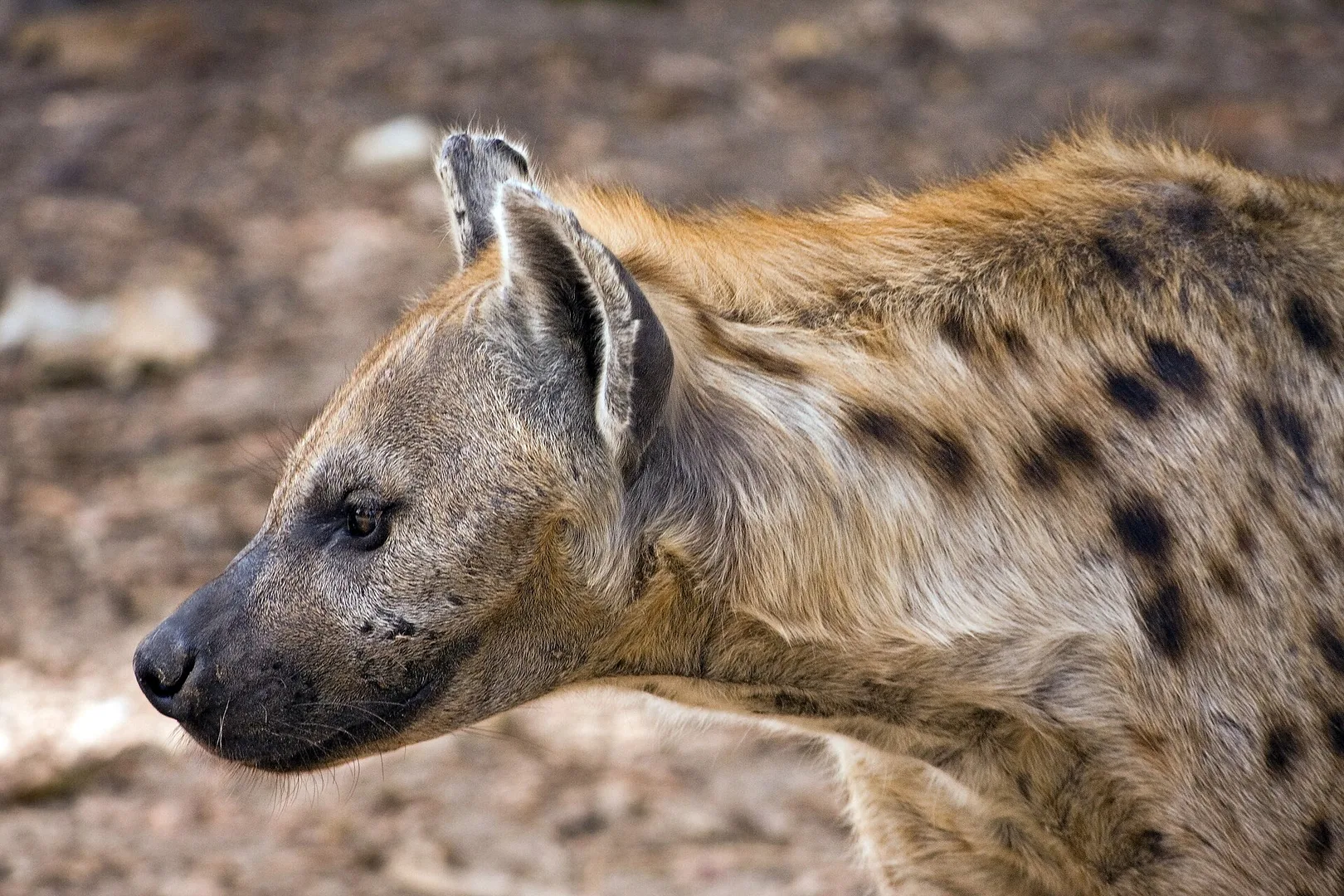
Spotted hyena in Etosha National Park.
Field
notes
Jaws That Crush Bone
The spotted hyena (Crocuta crocuta) has powerful jaws that crush bone with ease. It eats practically every part of its prey, including skin, hooves, bone and teeth, which most other predators could not eat. A computer model of a spotted hyena skull mid-bite found the stress running in an arc from the bite point up through the domed forehead and along the bony crest on top of the skull. The results suggest the skull’s air-filled sinuses, together with that domed forehead, help it resist bending and spread the stress evenly away from the face. Spotted hyenas can also digest things that most other animals cannot, like skin and bone, thanks to special acids in their stomach, and a hyena can eat a third of its own body weight at one meal.
Spotted hyenas measure 1.2 to 1.8 meters (4 to 5.9 feet) long and stand 77 to 81 centimeters (2.5 to 2.6 feet) at the shoulder. Weight runs from 40 to 86 kilograms (88 to 190 pounds), and females are 10 percent heavier than males. Half of all spotted hyena young die before they reach maturity, at about three years old. The oldest on record lived to 41.1 years in captivity.
A Strong, Capable Hunter
The bigger the clan, the larger its prey, which can include adult wildebeest, zebras and Cape buffalo, while smaller packs chase down gazelles. A seven-year study of one large wild clan in Kenya’s Masai Mara found that over 75 percent of 272 hunting attempts were made by lone hyenas, even when they hunted antelope three times their own body mass, and about one in three attempts ended in a catch. Spotted hyenas also scavenge, competing with jackals and vultures for leftovers.
Clan Rule Is Female
A spotted hyena clan can hold up to 100 members, and its society is matriarchal. Females are larger and, on average, much more assertive and aggressive than males, and even a low-ranking female’s cubs outrank the highest-ranking adult male who has moved in from another clan. Lower-ranking males are forced to stay on the outskirts of the clan, allowed to join only for a hunt or a fight against another clan or lions.
How Cubs Get Their Rank Young hyenas take a place in the dominance hierarchy next to their mothers’. In a large wild clan in Kenya, high-ranking mothers intervened on behalf of their cubs more often, and more effectively, than low-ranking mothers did. Young monkeys such as baboons and macaques appear to “inherit” their mothers’ ranks by strikingly similar mechanisms.
The Most Vocal Mammal in Africa
More than 11 different sounds have been recorded from spotted hyenas. Their famous giggle sounds like a human laughing, and they use it in moments of nervous excitement or submission to a dominant hyena. The whoop, heard for miles, is used to find cubs, advertise territory or bring the clan together, and hyenas can tell which individual is whooping.
Problem Solvers
In a problem-solving test in the wild, the hyenas that tried a greater variety of approaches at first were more successful. Juveniles solved the problem as often as adults, while exploring in more varied ways, persisting longer and showing less fear of new things.
Published Updated
Traits
Intel
& FAQ
Guess
first
How big is a Spotted Hyena, really? Slide, lock in, and see what the sources say. Every answer is a figure from this page, quoted from where it came from.
Sources
- 01Spotted Hyena. San Diego Zoo Wildlife Alliance.
- 02Crocuta crocuta (spotted hyena). AnAge: The Animal Ageing and Longevity Database.
- 03Tanner et al. (2008). Of arcs and vaults: the biomechanics of bone-cracking in spotted hyenas (Crocuta crocuta). Biological Journal of the Linnean Society.
- 04Holekamp et al. (1997). Hunting rates and hunting success in the spotted hyena (Crocuta crocuta). Journal of Zoology.
- 05Engh et al. (2000). Mechanisms of maternal rank 'inheritance' in the spotted hyaena, Crocuta crocuta. Animal Behaviour.
- 06Holekamp et al. (2011). Society, demography and genetic structure in the spotted hyena. Molecular Ecology.
- 07Benson-Amram & Holekamp (2012). Innovative problem solving by wild spotted hyenas. Proceedings of the Royal Society B: Biological Sciences.
- 08Bohm & Höner (2015). Crocuta crocuta. The IUCN Red List of Threatened Species 2015: e.T5674A45194782.
What the sources say: 51 claims checked word for word against these sources →