A salmon swims upriver to spawn.
Field
notes
Silver at sea, red in the river
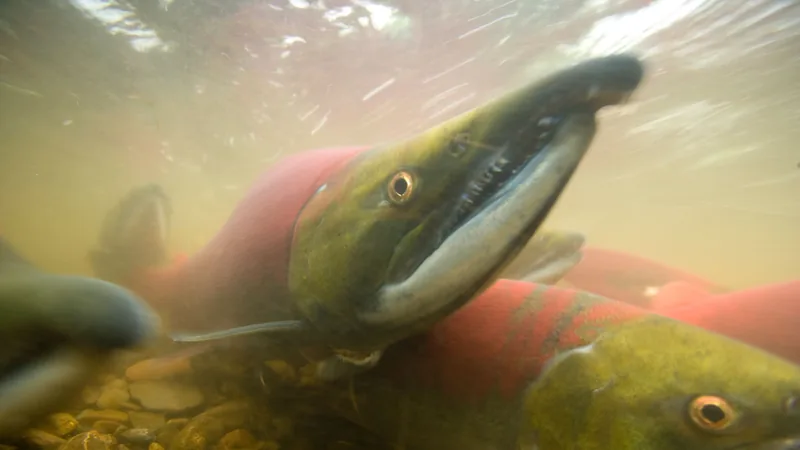
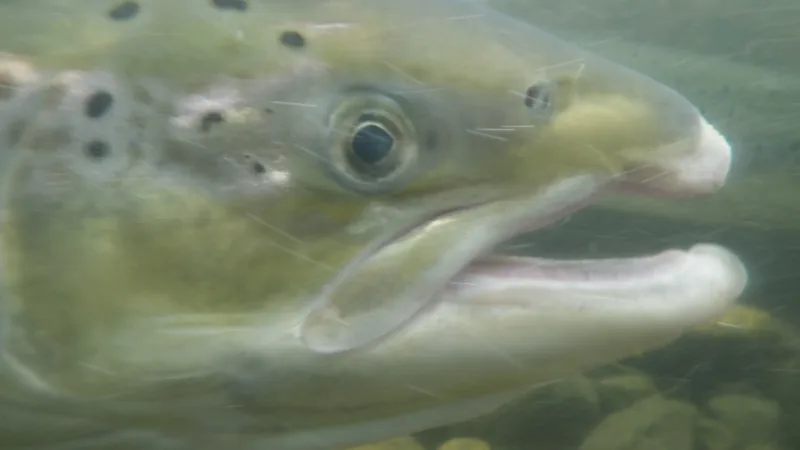
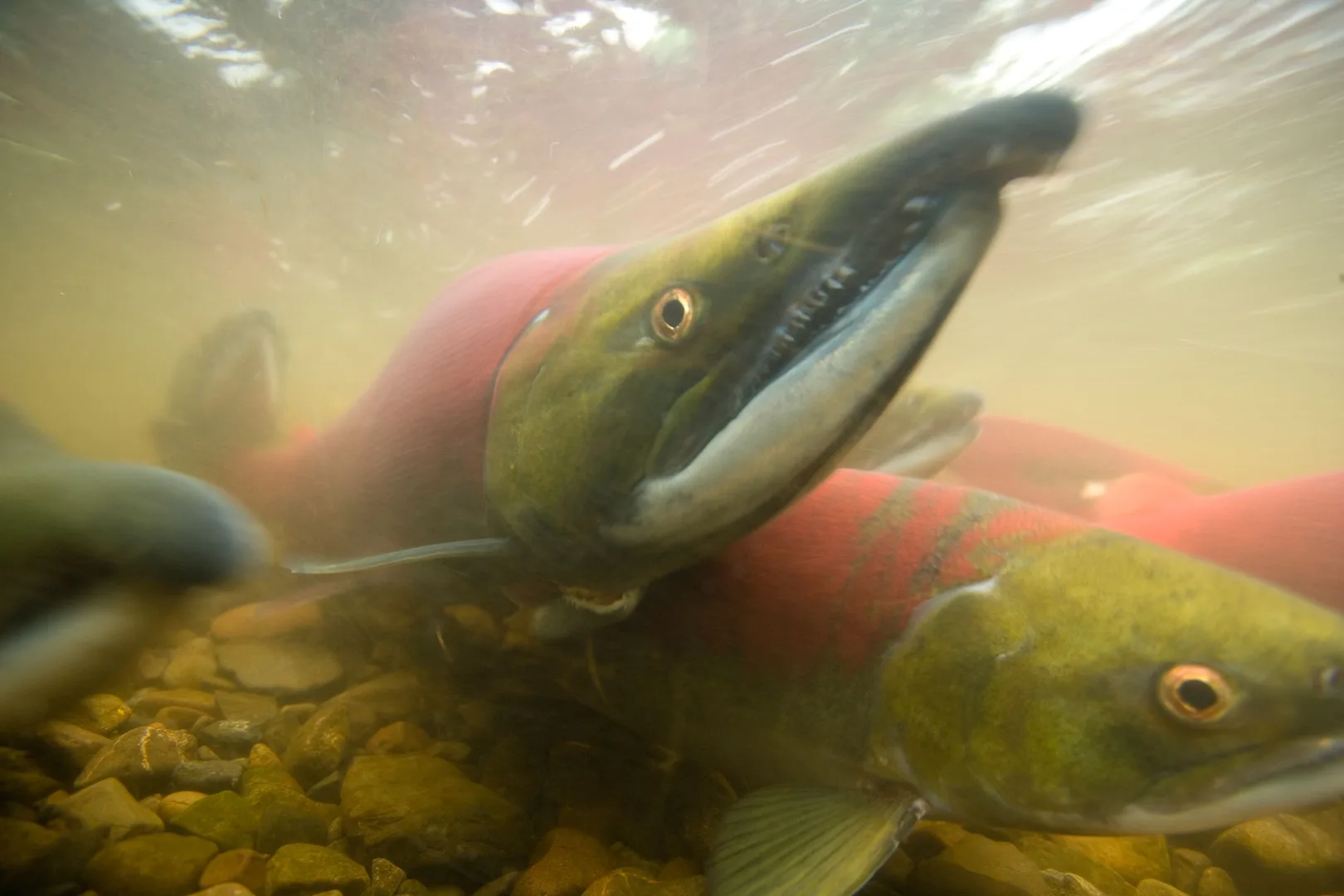
A sea-going sockeye has iridescent silver flanks, a white belly and a metallic green-blue back, which earns it the nickname “blueback”. Then it heads home, and its body changes. As sockeye return to their freshwater spawning grounds, their heads turn green and their bodies turn bright red. Spawning males also grow a humped back and hooked jaws filled with tiny, visible teeth.
Thousands of miles, then home Alaska sockeye travel thousands of miles at sea, drifting in the counter-clockwise current of the Alaska Gyre in the Gulf of Alaska. Eventually they return to spawn in the same freshwater system where they were hatched.
A five-year loop
Sockeye is one of the smaller species of Pacific salmon, measuring 1.5 to 2.5 feet (about 46 to 76 cm) and weighing 4 to 15 pounds (about 1.8 to 6.8 kg). Kokanee, sockeye that spend their whole lives in fresh water, rarely exceed 1.2 feet (about 37 cm). A sockeye’s lifespan is about 5 years, although some live longer.
Most sockeye hatch in freshwater streams or lakes and generally rear in lakes for 1 to 3 years, feeding mainly on zooplankton (tiny floating animals). Then they migrate to the ocean to feed and grow. They typically return to fresh water after 2 to 3 years at sea. The female digs nests, called redds, with her tail and deposits 2,000 to 4,500 eggs in them. All sockeye die within a few weeks after spawning, but the carcasses are a valuable source of energy and nutrients to the river ecosystem.
From Oregon to Siberia
In North America, sockeye range from northwest Alaska to the Deschutes River in Oregon. In Asia, they range from Hokkaido, Japan, to the Anadyr River in Siberia. The largest populations are in the rivers that flow into Alaska’s Bristol Bay, plus the Fraser River system in Canada. In good years, these runs can number in the tens of millions of fish.
Sockeye filter zooplankton and other small animals from the water with their gill rakers. In the ocean they also eat small crustaceans, insects, and occasionally squid and small fish. Sharks, lampreys and marine mammals prey on adults at sea, and bears, eagles and occasionally wolves feed on them in fresh water.
Trouble in warm water
Researchers predicted that unusually high river temperatures in 2004 caused a complete collapse of aerobic scope (the gap between the oxygen a fish uses at rest and the most it can use when working hard) for part of one Fraser River sockeye population during its migration. They tracked individual sockeye up the Fraser River with biotelemetry, and the data backed the prediction: for that same population, the success of the river migration depended on temperature. The researchers suggest that the collapse was an important mechanism behind the high salmon mortality seen during the migration.
Published
Traits
Intel
& FAQ
Guess
first
How big is a Sockeye Salmon, really? Slide, lock in, and see what the sources say. Every answer is a figure from this page, quoted from where it came from.
Sources
- 01Sockeye Salmon. NOAA Fisheries.
- 02Sockeye Salmon. Alaska Department of Fish and Game.
- 03Rand (2011). Oncorhynchus nerka. The IUCN Red List of Threatened Species 2011: e.T135301A4071001.
- 04Farrell et al. (2008). Pacific Salmon in Hot Water: Applying Aerobic Scope Models and Biotelemetry to Predict the Success of Spawning Migrations. Physiological and Biochemical Zoology.
What the sources say: 52 claims checked word for word against these sources →