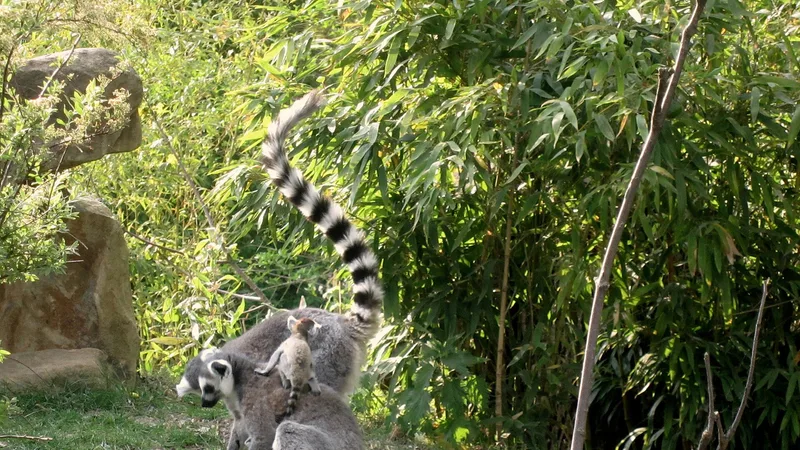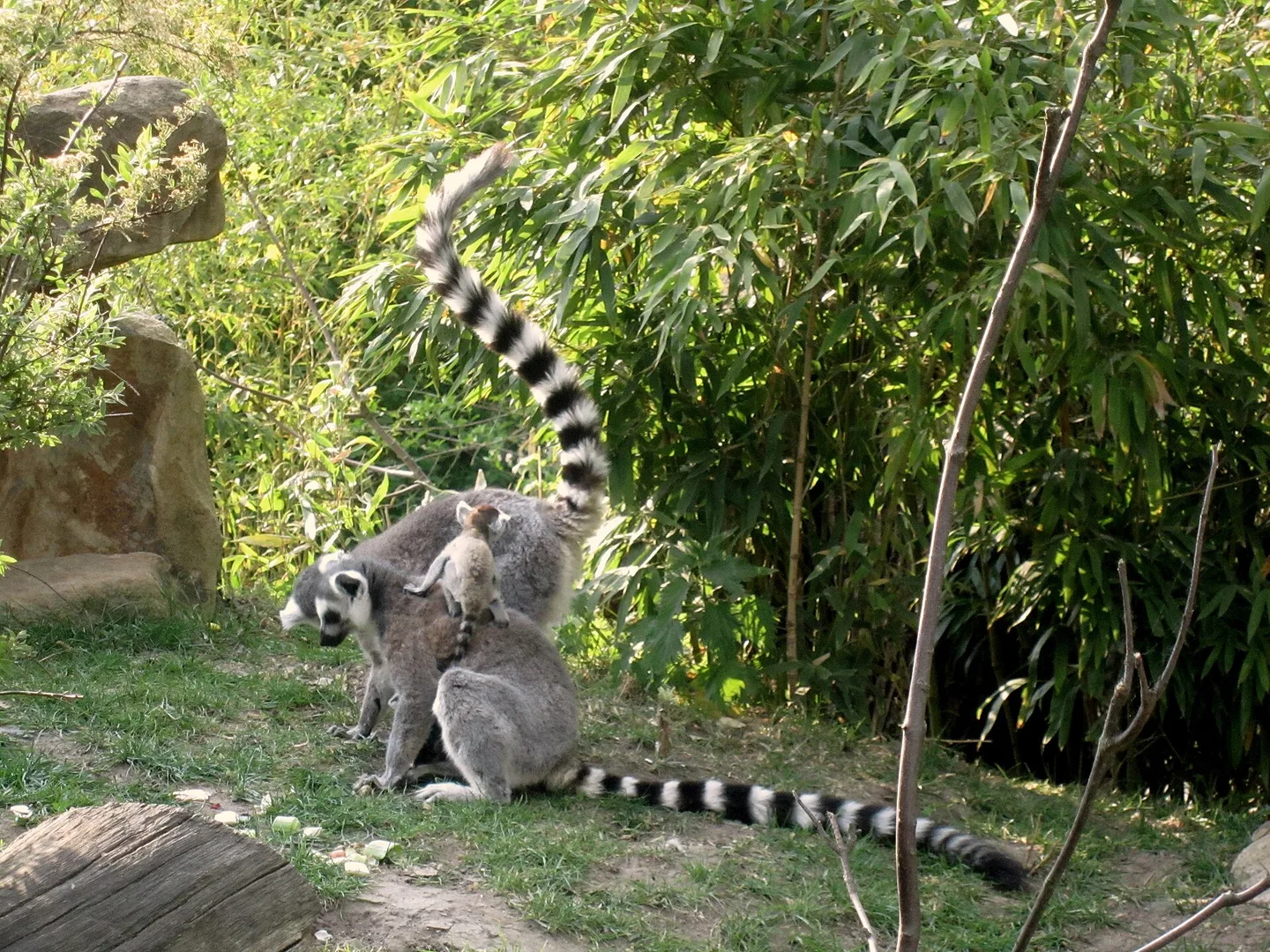
A wild ring-tailed lemur in a fruiting tree in Anja Reserve, Madagascar
Field
notes
Wrist Glands and Stink Fights
Each male ring-tailed lemur (Lemur catta) carries scent glands on the inside of his wrists (antebrachial glands) and on his chest (brachial glands), plus a horny spur on each wrist gland that he uses to pierce tree branches before marking them. When a rival shows up, he mixes his wrist and chest secretions and anoints his tail with them. The two males face each other a few feet apart, repeatedly drawing their tails through their wrist glands and waving them over their heads while staring each other down. Eventually, one of them loses his nerve and runs. Females carry only one scent gland, near the genitals, and a female’s scent may advertise her fertility and even how far along a pregnancy is.
Where Females Run the Show
Ring-tailed lemur troops answer to the females. Every female outranks every male: even the lowest-ranking female ranks higher than the highest-ranking male. Females also get first access to food and their choice of mates, which is unusual for a primate. The ranking among females isn’t a simple ladder, and daughters don’t always inherit their mother’s rank. One explanation is that mothers don’t back their daughters in social interactions, so daughters fight for rank of their own. In Madagascar, troops can hold up to 30 animals. Females spend their whole lives in their birth troop, while males generally change troops when they reach sexual maturity at age three.
Tough Fruit, Thin Enamel
Adults weigh 2.2 to 2.7 kilograms (4.9 to 6 pounds), and females are usually smaller than males. The body is 39 to 46 centimeters long, and the black-and-white ringed tail can reach 61 centimeters (2 feet). Ring-tailed lemurs eat fruit, leaves, flowers, bark, sap, and the occasional invertebrate. In riverside gallery forests, hard, tough tamarind fruit is a key fallback food (one they turn to when preferred foods run short), yet their dental enamel is thin. A study that re-examined the same 50 wild lemurs a year apart found an individual’s tooth loss could rise by as much as 20% in that time. Even so, lemurs losing teeth this fast are able to survive, sometimes helped by tamarind fruit that other lemurs have already partly processed.
How long a ring-tail lives Ring-tailed lemurs in human care have a median life expectancy of 16.7 years. One long-running study suggests wild ring-tails may reach a maximum life-span of 18 to 20 years.
Sunbathing, Predators and People
Troops gather in open patches of forest to sunbathe, sitting with their bellies turned to the sun and their arms and legs stretched wide, in a pose some call “yoga.” It exposes the sparser fur of their undersides to the sun’s heat before they forage. Fossas, snakes, and birds of prey hunt ring-tailed lemurs, and traveling as a troop helps deter predators that pick off lone animals. Population fragmentation, the splitting of a species into small, cut-off groups, is a major threat, mostly due to human-induced habitat loss and degradation. In some regions ring-tailed lemurs are hunted with dogs for food, and they also turn up in the pet trade. The IUCN lists the species as Endangered.
Published Updated
Traits
Intel
& FAQ
Guess
first
How big is a Ring-Tailed Lemur, really? Slide, lock in, and see what the sources say. Every answer is a figure from this page, quoted from where it came from.
Sources
- 01Baumhofer (2017). Lemur catta (ring-tailed lemur). Animal Diversity Web, University of Michigan.
- 02Ring-tailed lemur. Smithsonian's National Zoo and Conservation Biology Institute.
- 03Lemur. San Diego Zoo Wildlife Alliance.
- 04Ring-tailed Lemur. Duke Lemur Center.
- 05Cuozzo & Sauther (2006). Severe wear and tooth loss in wild ring-tailed lemurs (Lemur catta): A function of feeding ecology, dental structure, and individual life history. Journal of Human Evolution.
- 06Gould, Sussman & Sauther (2003). Demographic and life‐history patterns in a population of ring‐tailed lemurs (Lemur catta) at Beza Mahafaly Reserve, Madagascar: A 15‐year perspective. American Journal of Physical Anthropology.
- 07LaFleur & Gould (2020). Lemur catta. The IUCN Red List of Threatened Species 2020: e.T11496A115565760.
What the sources say: 36 claims checked word for word against these sources →