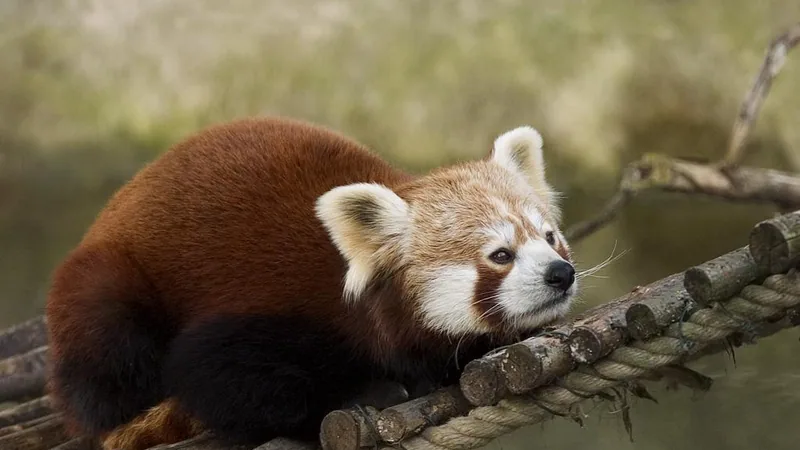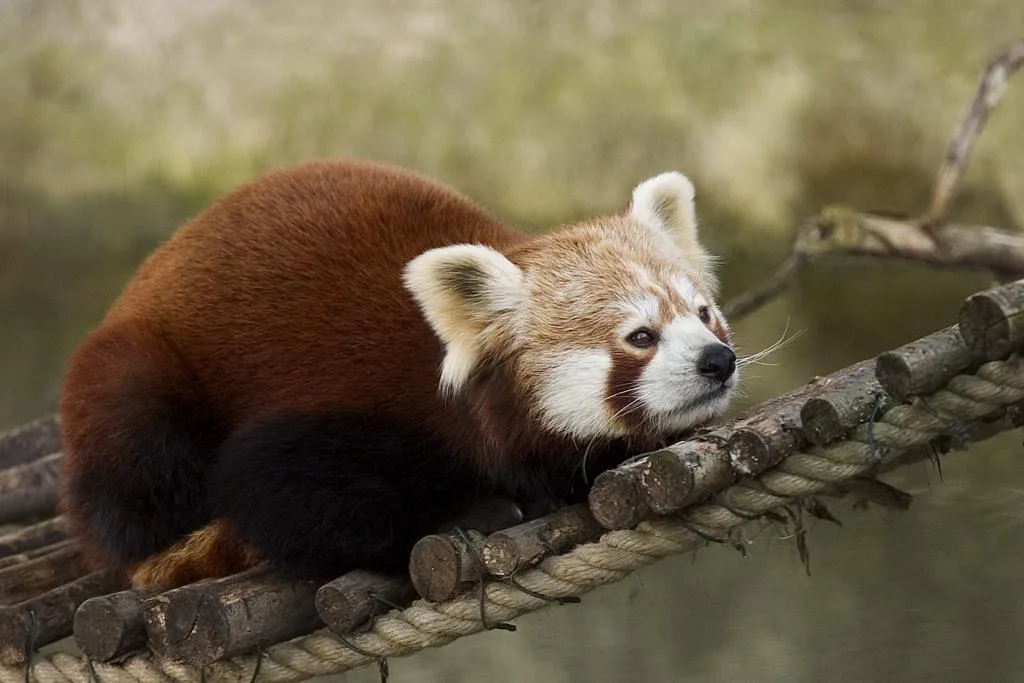
Red panda (Ailurus fulgens) in Munich Zoo
Field
notes
The Other Panda
The red panda (Ailurus fulgens) shares a name, a taste for bamboo and, in China, the same bamboo forests as the giant panda. Kinship is another matter. Naturalists first filed it with raccoons, then with bears, before genetic research gave it a family of its own: Ailuridae, of which the red panda is the only living member. Its closest living relatives are probably in the group that includes skunks, raccoons and weasels.
Both pandas share a “false thumb,” an enlarged wrist bone called the radial sesamoid that works like an opposable digit for gripping bamboo. Fossils of a Miocene red panda relative found in Spain show it already had one of its own, so the two thumbs evolved independently.
A Full-Time Bamboo Job
Bamboo makes up about 95 percent of a red panda’s diet, and unlike a giant panda, which eats nearly every above-ground part of the plant, a red panda feeds selectively: choosing the most nutritious leaf tips and, when available, tender shoots. Its gut can extract only about 24 percent of the bamboo it eats, so it needs to eat 20 to 30 percent of its own body weight every day, roughly 2 to 4 pounds (1 to 2 kilograms). A red panda rounds out the diet with berries, blossoms, eggs, insects, and occasionally a small rodent.
Built for the Cold and the Climb
San Diego Zoo Wildlife Alliance puts adults at 20 to 25 inches (51 to 64 centimeters) long, not counting a tail of 11 to 19 inches (28 to 49 centimeters) that makes up almost half the animal’s total length. It gives females 6 to 10 pounds (3 to 4.5 kilograms) and males 10 to 14 pounds (4.5 to 6.2 kilograms), while Smithsonian’s National Zoo says adults typically weigh 8 to 17 pounds (3.6 to 7.7 kilograms). They differ on lifespan too: San Diego says a red panda typically lives eight to ten years, and up to 15 in zoos; the Smithsonian says they may live as long as 23.
Dense fur covers even the soles of its feet, helping it climb wet, slippery branches and walk on icy rocks. Extremely flexible ankles, with a fibula that can rotate on its own axis, let it climb straight down a tree trunk headfirst. In the cold it curls into a tight ball to conserve body heat, and its long, bushy tail helps shield it from harsh cold and wind.
A Nose Built Into the Tongue A red panda tests odors using the underside of its tongue, which has a cone-like structure for collecting liquid and carrying it close to a gland inside its mouth. It is the only carnivore with this adaptation.
One Name, Two Species?
A study of 65 whole genomes argues that “the red panda” is really two species: a Himalayan red panda and a Chinese red panda. The two split apart about 220,000 years ago, around the time a glaciation bottlenecked both populations. The IUCN Red List, which assessed the red panda as a single species in 2015, lists it as Endangered. San Diego Zoo Wildlife Alliance says red panda numbers may have fallen by as much as 40 percent over the last 50 years; Smithsonian’s National Zoo says researchers believe the population fell 40 percent in the past two decades. Estimates of the surviving population range from about 2,500 to 10,000 adults.
Published Updated
Traits
Intel
& FAQ
Guess
first
How big is a Red Panda, really? Slide, lock in, and see what the sources say. Every answer is a figure from this page, quoted from where it came from.
Sources
- 01Ailurus fulgens (red panda). Animal Diversity Web, University of Michigan.
- 02Red Panda. San Diego Zoo Wildlife Alliance.
- 03Red Panda. Smithsonian's National Zoo and Conservation Biology Institute.
- 04Glatston, Wei & Sherpa (2015). Ailurus fulgens. The IUCN Red List of Threatened Species 2015: e.T714A110023718.
- 05Salesa et al. (2005). Evidence of a false thumb in a fossil carnivore clarifies the evolution of pandas. Proceedings of the National Academy of Sciences.
- 06Hu et al. (2017). Comparative genomics reveals convergent evolution between the bamboo-eating giant and red pandas. Proceedings of the National Academy of Sciences.
- 07Hu et al. (2020). Genomic evidence for two phylogenetic species and long-term population bottlenecks in red pandas. Science Advances.
- 08Zhu et al. (2018). Potential Mechanism of Detoxification of Cyanide Compounds by Gut Microbiomes of Bamboo-Eating Pandas. mSphere.
What the sources say: 66 claims checked word for word against these sources →