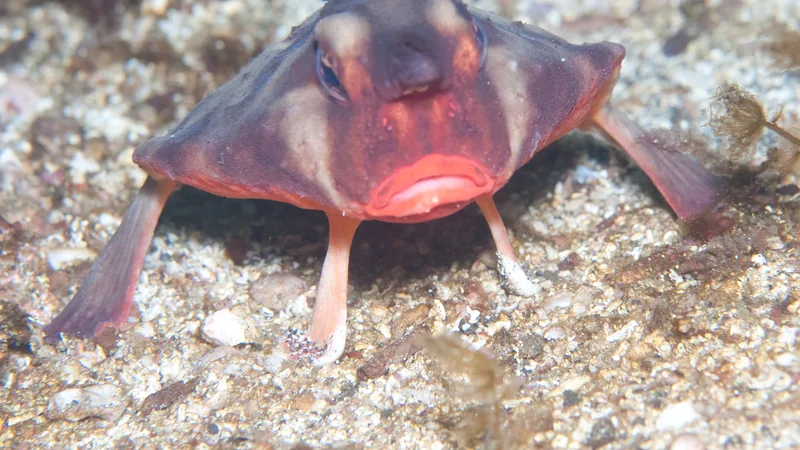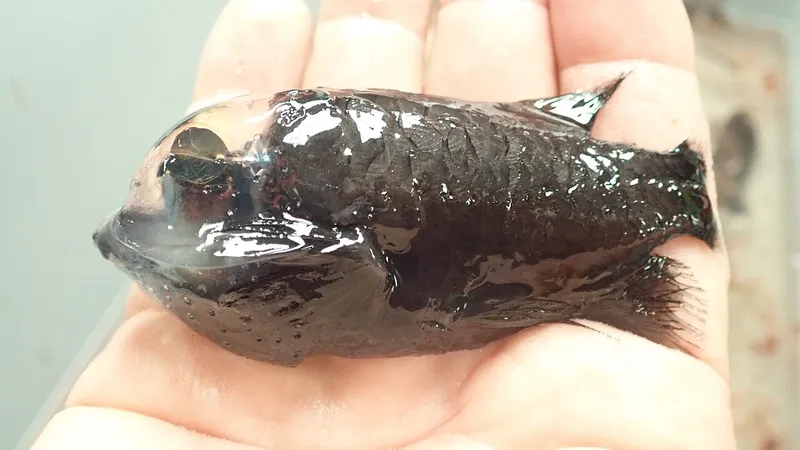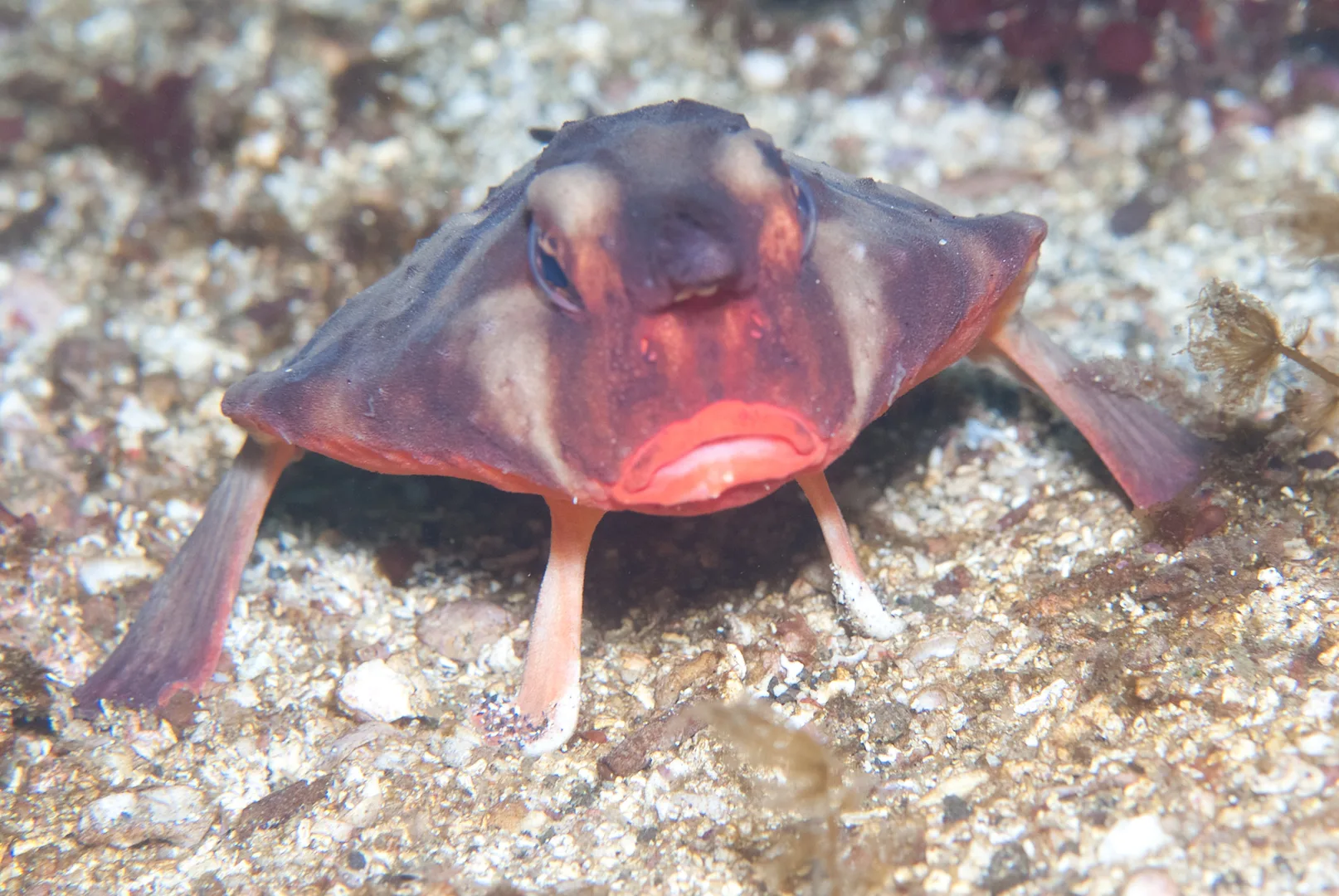
Red-lipped batfish in the Galápagos.
Field
notes
A fish that walks
Batfishes are anglerfishes that are dorsoventrally flattened, which means squashed from top to bottom like a pancake. The red-lipped batfish (Ogcocephalus darwini) belongs to this family, and its genus has pectoral and pelvic fins (the paired fins behind the head and on the belly) modified so the fish can slowly “walk” along the bottom. Swimming is something they do only over short distances.
A relative in the same genus, the Brazilian batfish, was filmed in the wild. It alternately used its pectoral and pelvic fins to slide slowly across the seabed. Its second move resembled a jump, ending in a quick lunge.
A fishing rod in a snout cavity
Batfishes carry an illicium, a modified front dorsal-fin spine that works like a fishing pole and usually bears a lure called an esca. When the illicium is retracted, the lure is sheltered in a cavity between the mouth and the tip of the snout.
For the Brazilian batfish, whether the lure really attracts prey is still questioned. One filmed in the wild extended and retracted its illicium three times, and a small crustacean in front of it seemed attracted. Researchers working on the polka-dot batfish, another relative, reported that its esca apparently secretes a chemical that draws in gastropods (sea snails and slugs). Those observations come from relatives, not from the Galápagos species.
Small and shallow
A male or unsexed red-lipped batfish tops out at 20.3 cm in standard length, and a female at 21.5 cm. It is found on sandy bottoms, between 3 and 120 m deep but usually at 3 to 76 m. It is believed to be predatory, feeding on small invertebrates.
FishBase says it is common below 10 m and seems incautious, unlike other batfishes that are limited in their range due to many predators. It lists the fish as harmless to humans.
Range update A 2022 report described a specimen caught by an artisanal fishing fleet using bottom longlines in Ecuador. Until that find the species was considered endemic to the Galápagos, though it had already been reported off northern Peru, and the Ecuador fish added the continental shelf.
FishBase gives its range as the Galápagos Islands south to Peru. The IUCN Red List rates the species Least Concern.
Published
Traits
Intel
& FAQ
Guess
first
How big is a Red-Lipped Batfish, really? Slide, lock in, and see what the sources say. Every answer is a figure from this page, quoted from where it came from.
Sources
- 01Rivera et al. (2023). Ogcocephalus darwini. The IUCN Red List of Threatened Species 2023: e.T183821A217631260.
- 02Ogcocephalus darwini Hubbs, 1958. FishBase.
- 03Alves, Campos-da-Paz & Vianna (2021). Illicium use in Brazilian batfish Ogcocephalus vespertilio (Linnaeus, 1758) feeding behavior in nature and in captivity. Ocean and Coastal Research.
- 04Briones-Mendoza et al. (2022). New finding and description of the Galapagos batfish, Ogcocephalus darwini (Actinopterygii: Lophiiformes: Ogcocephalidae), in marine waters of Manabi, Ecuador. Acta Ichthyologica et Piscatoria.
- 05Derouen et al. (2015). Examining evolutionary relationships and shifts in depth preferences in batfishes (Lophiiformes: Ogcocephalidae). Molecular Phylogenetics and Evolution.
What the sources say: 37 claims checked word for word against these sources →