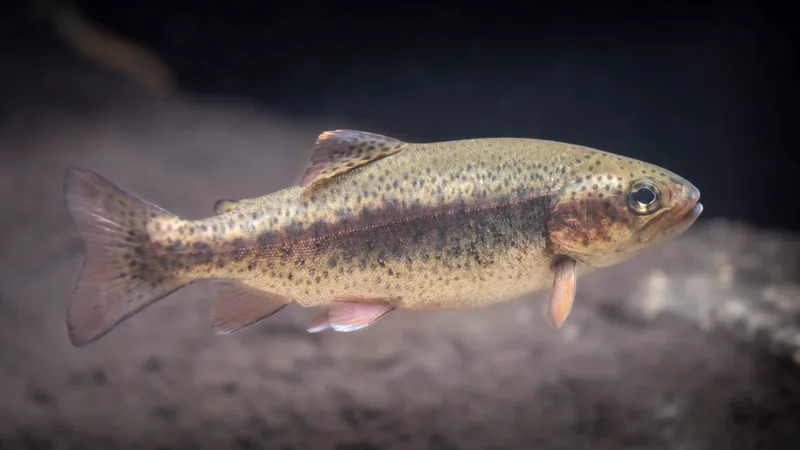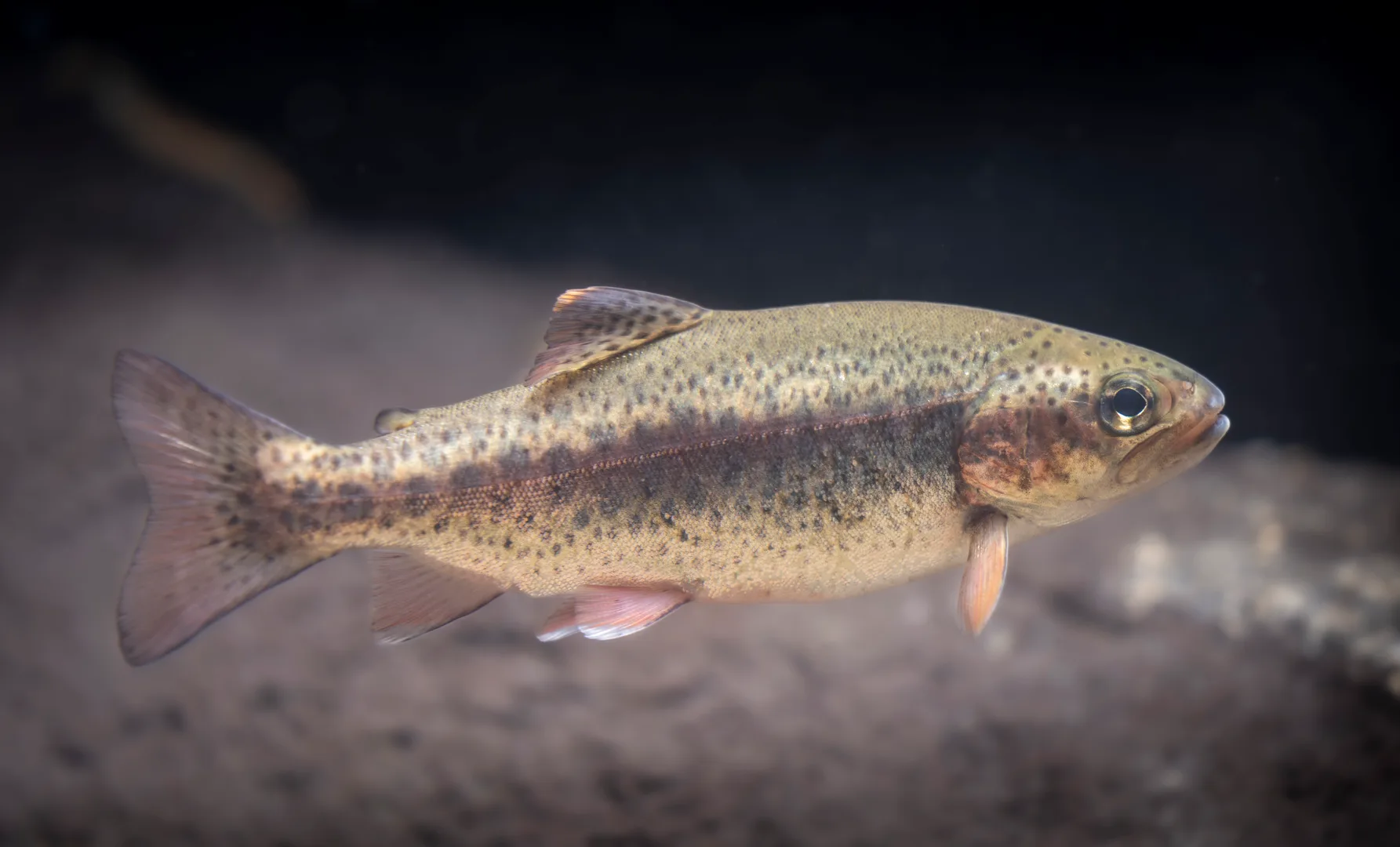
Rainbow trout.
Field
notes
One Gene Decides the Sex
A rainbow trout’s sex depends on a gene called sdY, short for “sexually dimorphic on the Y chromosome”, and it is expressed only in the testis. Researchers who switched it off in males, using a tool called zinc-finger nuclease, got fish that grew ovaries. Researchers who added sdY to females got fish that grew testes.
Master switch The sdY gene is a vertebrate master sex-determining gene not related to any known sex-differentiating gene.
Cold, Clear Water
Rainbow trout live in clear, cold headwaters, creeks, rivers, lakes and intertidal areas. Their native range runs down the Pacific Slope, from the Kuskokwim River drainage in Alaska to the Otay River drainage in California, with another native population on Russia’s Kamchatka Peninsula.
FishBase gives a common length of about 60 centimeters. FishBase lists a maximum length of 123 centimeters, a maximum published weight of 25.9 kilograms and a maximum reported age of 11 years.
They feed on aquatic and terrestrial invertebrates and small fishes. In 2020 a trout of about 30 centimeters was caught in a small French stream. Inside it was a live hatchling grass snake about 20 centimeters long. The authors say the evidence suggests fish eating these snakes is rare.
Stream Fish or Sea Fish
Some rainbow trout stay in fresh water all their lives. Others migrate to the ocean and come back to spawn, and those are called steelhead. NOAA calls steelhead a unique life-history type of rainbow trout, and says the ones that go to sea typically grow larger than the ones that stay.
Steelhead can reach about 30 pounds (roughly 14 kilograms) and 40 inches (about a meter), and NOAA says they live up to 11 years, usually 5 to 8. Unlike most other Pacific salmonids, the group that includes salmon and steelhead, they do not necessarily die after spawning.
At spawning time the female digs a pit in the gravel while a male courts her or drives other males away. A female makes 700 to 4,000 eggs per spawning event.
A Fish That Went Global
Rainbow trout are often hatched and stocked into rivers and lakes, especially to attract recreational anglers. FishBase lists them as widely introduced and established in Canada and the USA, and elsewhere in the world. It says several countries report adverse ecological impact after introduction. Animal Diversity Web adds that where they are introduced they can outcompete native trout species.
The Red List rates the species Least Concern. NOAA adds that along the West Coast, 11 steelhead populations are protected under the Endangered Species Act.
Published Updated
Traits
Intel
& FAQ
Guess
first
How big is a Rainbow Trout, really? Slide, lock in, and see what the sources say. Every answer is a figure from this page, quoted from where it came from.
Sources
- 01Hammerson & Bogutskaya (2024). Oncorhynchus mykiss. The IUCN Red List of Threatened Species 2024: e.T166481A18229476.
- 02Yano et al. (2012). An Immune-Related Gene Evolved into the Master Sex-Determining Gene in Rainbow Trout, Oncorhynchus mykiss. Current Biology.
- 03Thomas, Allain & Owen (2021). Predation and ingestion of a barred grass snake Natrix helvetica by a rainbow trout Oncorhynchus mykiss in Lot, France. Herpetological Bulletin.
- 04Oncorhynchus mykiss (Walbaum, 1792), Rainbow trout. FishBase.
- 05Steelhead Trout. NOAA Fisheries.
- 06Oncorhynchus mykiss, Coast rainbow trout. Animal Diversity Web, University of Michigan Museum of Zoology.
What the sources say: 44 claims checked word for word against these sources →