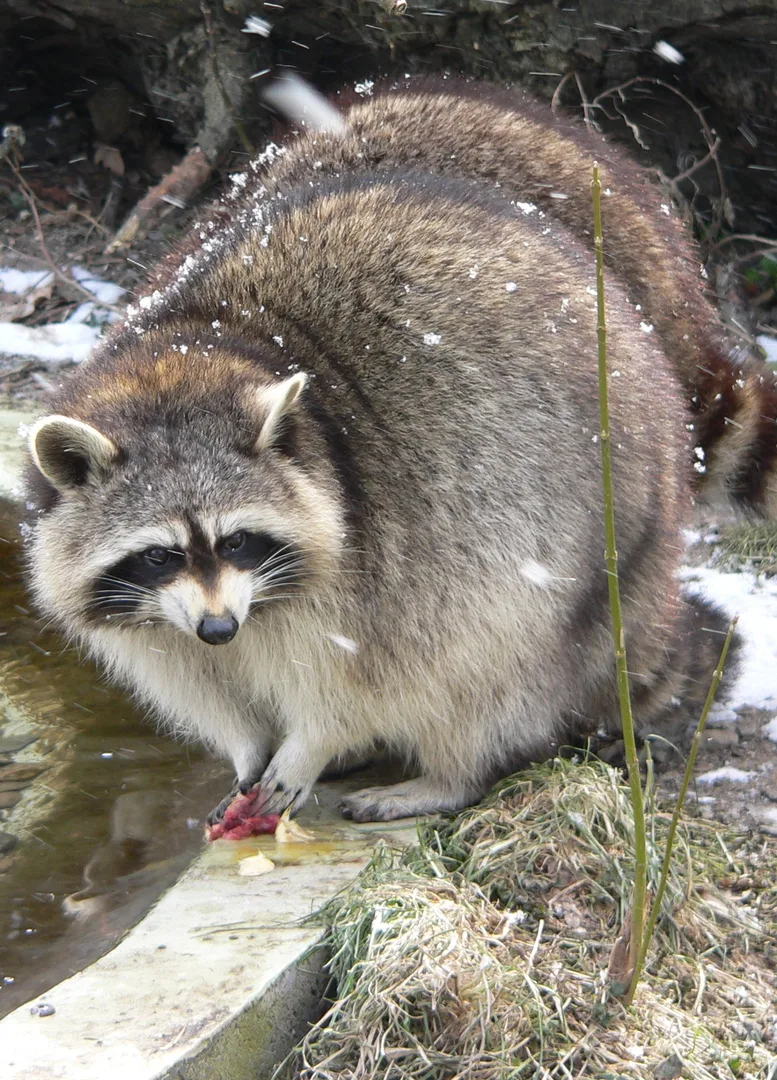
A young raccoon sitting up in tall grass
Field
notes
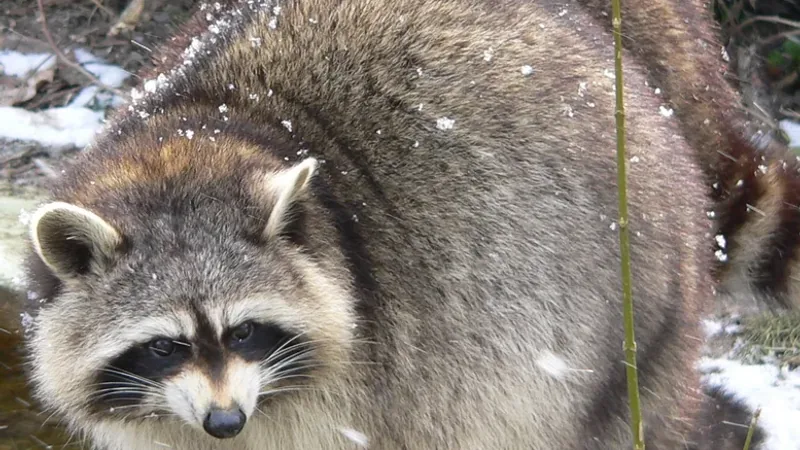
North America’s mask-wearing outlaw, the Common Raccoon (Procyon lotor) weighs 12 to 35 pounds (5 to 16 kilograms) and measures 24 to 37 inches long, and its ringed tail makes up about 42 to 52 percent of that length. In the wild a raccoon’s life span is two to three years; in managed care it can reach 20. Native to southern Canada, most of the United States and northern South America, it has also been introduced to parts of Europe and Asia. It is an opportunistic omnivore whose diet can include crayfish, frogs, acorns, bird eggs, corn, roadkill and trash.
Sensitive Hands
Animal Diversity Web describes the forepaws as “especially sensitive,” letting a raccoon handle and pry open prey and climb with ease. Its scientific name, lotor, means “the washer,” but the dunking habit is not about cleanliness: the State University of New York’s College of Environmental Science and Forestry says the raccoon’s tendency to handle food in water “is not related to a need to wet or wash them,” and many foods are eaten unmoistened. Much of the activity probably serves to locate, capture, identify and orient food, placing it in the mouth.
Fingertip Forager The toes of a raccoon’s front feet are long and slender, with a highly developed sense of touch that plays a large role in how it gathers plant and animal foods.
A Cat-Sized Cortex, Crowded With Neurons
A 2017 study that counted the neurons in the brains of eight carnivoran species found that the raccoon stands out. Its cerebral cortex and a house cat’s weigh a similar 24 grams, but the study’s raccoons averaged 438 million cortical neurons against its one cat’s 250 million. One raccoon carried 512 million, more than one of the study’s two dogs. The raccoon’s cortical neurons are packed about three times as densely as expected for a non-primate mammal with that many, approaching the densities found in primate cortices. “They have a fairly small brain but they have as many neurons as you would expect to find in a primate,” Suzana Herculano-Houzel, the study’s senior author, told Vanderbilt University’s research office, “and that’s a lot of neurons.”
Built to Break In
San Diego Zoo Wildlife Alliance says the raccoon’s dexterity “has proved no match for combination locks on dumpsters or fastened windows.” It also calls raccoons one of the few native North American animals that have not been restricted by urbanization and human development: they have adapted to living with and near humans. A raccoon climbs down a tree head-first by rotating its hind feet, and runs at 10 to 15 miles an hour, a pace it does not usually keep up for long, according to SUNY-ESF. It’s a strong swimmer, though it may be reluctant to swim: without waterproof fur, swimming forces it to take on extra weight, per Animal Diversity Web.
Published Updated
Traits
Intel
& FAQ
Guess
first
How big is a Common Raccoon, really? Slide, lock in, and see what the sources say. Every answer is a figure from this page, quoted from where it came from.
Sources
- 01Procyon lotor. Animal Diversity Web, University of Michigan.
- 02Raccoon. San Diego Zoo Wildlife Alliance.
- 03Raccoon. SUNY College of Environmental Science and Forestry, Adirondack Ecosystem.
- 04Timm et al. (2016). Procyon lotor. The IUCN Red List of Threatened Species 2016: e.T41686A45216638.
- 05Jardim-Messeder et al. (2017). Dogs Have the Most Neurons, Though Not the Largest Brain: Trade-Off between Body Mass and Number of Neurons in the Cerebral Cortex of Large Carnivoran Species. Frontiers in Neuroanatomy.
- 06Sorry, Grumpy Cat: Study finds dogs are brainier than cats. Vanderbilt University Research News.
What the sources say: 34 claims checked word for word against these sources →