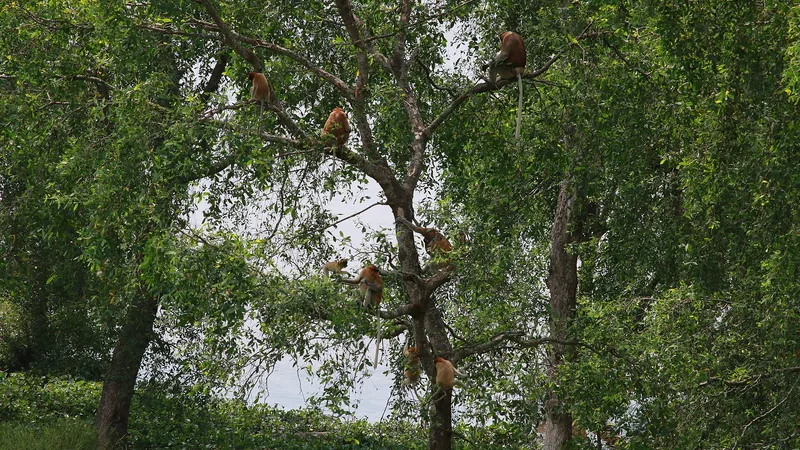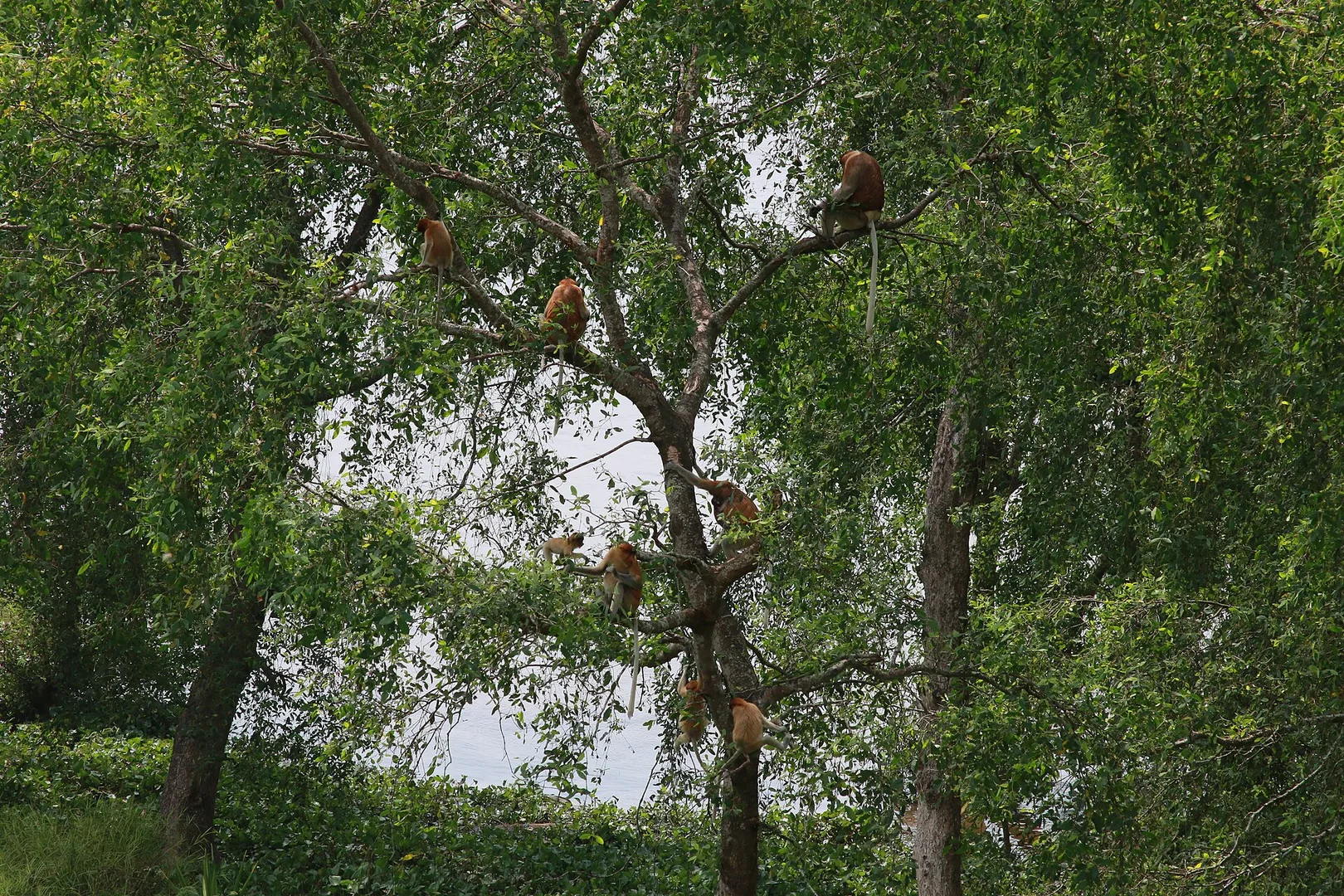
A proboscis monkey group in a rambai tree, which they use for feeding, resting and play
Field
notes
A Nose Built to Be Heard
Male proboscis monkeys (Nasalis larvatus) grow a large, bulbous nose unlike any other primate’s. It droops over the mouth and sometimes tops 4 inches (10.1 cm). Many groups have one adult male, several females and their young, while other males live in bachelor groups. Earlier studies found males in breeding groups have bigger noses than bachelors, and bigger-nosed males tend to have more adult females in their group. The nose may let males make louder or deeper honks and roars.
A 2024 study of skulls strongly backed both roles, display and sound. A male’s bony nose opening keeps growing after his adult teeth are in, which fits a display. His nasal cavity is shaped to make loud, deep-sounding calls.
Males can weigh up to 50 pounds (22 kg) and measure 29 to 30 inches (73 to 76 cm) from head to belly, with a tail nearly as long as the body. Females are much smaller, averaging 22 pounds (10 kg) and 24 to 25 inches (61 to 64 cm). In captivity, the record lifespan is 25.1 years. The species lives only on Borneo, in Malaysia, Indonesia and Brunei. It is found mostly in coastal mangrove forests or in lowland rainforest along rivers.
A Monkey That Chews Like a Cow
One group studied along a river in Sabah, Malaysia, spent about three-quarters of its time resting and a fifth feeding. Young leaves took nearly two-thirds of that feeding time and fruit about a quarter, and over 90% of the fruit feeding was on unripe fruit. When proboscis monkeys do eat ripe fruit, they usually pick out the seeds and leave the rest, because its sugars can cause severe indigestion. Their big bellies hold a stomach with several chambers that helps them digest fiber-rich plants.
A first for primates In 2011, scientists reported 23 wild proboscis monkeys bringing food back up from the stomach to chew it again, the first time this had been seen in a primate. Ruminants such as cattle do it far more consistently.
Scientists watched one wild male for 169 days and saw him do it on 11 of them, mostly in the morning. Researchers call it a “facultative” strategy, meaning the monkeys use it only some of the time. A 2015 study of four captive monkeys found their digestion lacks the typical features of a ruminant’s, which may explain why. Their droppings hold smaller food particles than other primates’, one clue that they rechew.
Built to Cross Rivers
Proboscis monkeys rarely come down from the trees. When they do, it’s usually to escape a predator or cross a river. Webbed fingers and toes, rare among primates, help them swim. Often they leap far out from high in the canopy to keep the swim short, splaying their arms and legs, then tucking them in just before they hit the water.
Clouded leopards and crocodiles may be important predators. A 2008 study in Sabah recorded clouded leopards killing two young females from one group, an infant and a juvenile. It suggested adult males in one-male groups act as protectors.
Under Threat
The IUCN Red List classifies the proboscis monkey as Endangered, and its numbers are falling. Habitat loss is a major cause. Across Borneo, forests are being cleared for timber and farms, palm oil and rubber plantations have replaced large areas, and mangroves are being cut down for shrimp farms.
Published Updated
Traits
Intel
& FAQ
Guess
first
How big is a Proboscis Monkey, really? Slide, lock in, and see what the sources say. Every answer is a figure from this page, quoted from where it came from.
Sources
- 01Proboscis Monkey, Nasalis larvatus. New England Primate Conservancy.
- 02Nasalis larvatus. AnAge: The Animal Ageing and Longevity Database, Human Ageing Genomic Resources.
- 03Boonratana et al. (2021). Nasalis larvatus. The IUCN Red List of Threatened Species 2021: e.T14352A195372486.
- 04Balolia & Fitzgerald (2024). Male proboscis monkey cranionasal size and shape is associated with visual and acoustic signalling. Scientific Reports.
- 05Matsuda et al. (2011). Regurgitation and remastication in the foregut-fermenting proboscis monkey (Nasalis larvatus). Biology Letters.
- 06Matsuda et al. (2015). Excretion patterns of solute and different-sized particle passage markers in foregut-fermenting proboscis monkey (Nasalis larvatus) do not indicate an adaptation for rumination. Physiology & Behavior.
- 07Matsuda, Tuuga & Higashi (2009). The feeding ecology and activity budget of proboscis monkeys. American Journal of Primatology.
- 08Matsuda, Tuuga & Higashi (2008). Clouded leopard (Neofelis diardi) predation on proboscis monkeys (Nasalis larvatus) in Sabah, Malaysia. Primates.
What the sources say: 44 claims checked word for word against these sources →