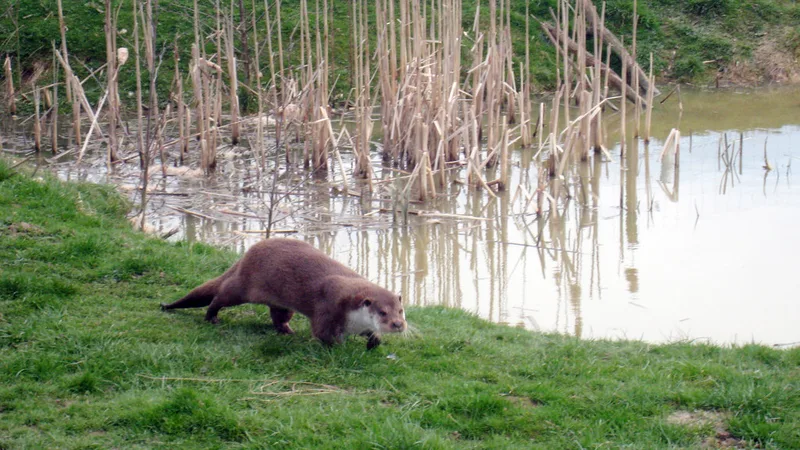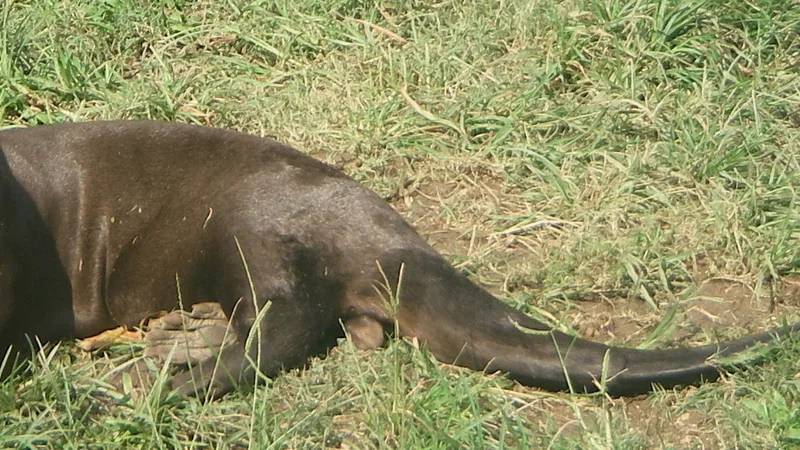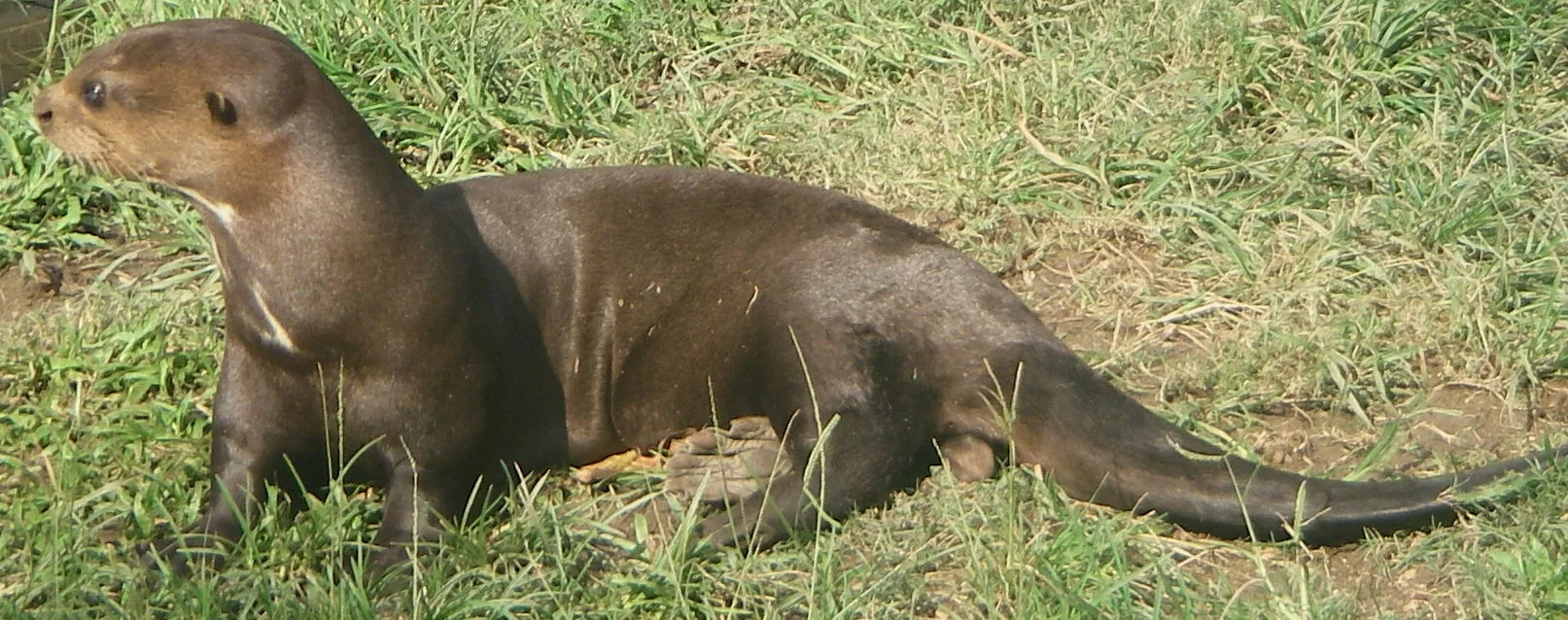
Anjo, one of a group of fourteen wild giant otters.
Field
notes
The Amazon’s River Wolf
In the waters of the Amazon, Pteronura brasiliensis is known as the “river wolf” for its large, razor-sharp teeth and muscular body. It is the biggest of all the otters, averaging 1.5 to 1.8 meters long and reaching up to 6 feet, and National Geographic gives its weight as 75 pounds (34 kilograms). Its life span is 10 to 13 years, though in human care giant otters can live for up to 21 years. It lives only in the rivers and creeks of the Amazon, Orinoco, and La Plata river systems. Swamps, flooded forests, and rivers keep it close to the fish it eats, and productive oxbow lakes are preferred core territories.
Long Jaws and a Fish Diet
A study of 150 skulls from four otter species found the giant otter had the greatest total skull length, palate length, and mandibular length of the four. A jaw can maximize force or velocity, but not both at once. The giant otter had the lowest mechanical advantage for its temporalis and masseter jaw muscles, which should maximize jaw velocity, an advantage for catching fast, elusive prey with its canines. It primarily eats fish such as perch, piranha, and catfish, and can eat up to nine pounds of food a day. It will also eat crabs, snakes, and even small caimans and anacondas. It has few predators, though jaguars and pumas occasionally kill one.
A Family Chorus
Giant otters live in family groups of up to 20, made up of a mated pair and their offspring of several generations. The group cooperates in breeding and territorial defense, though it is still unclear whether giant otters truly hunt cooperatively. Scientists who recorded five wild and three captive groups found 22 distinct call types made by adults and 11 in the babbling of newborns, and a comparison with other otters suggested the giant otter is the most socially and vocally complex species. When several group members give long-range screams at once, the result is a “group chorus” that can be heard over several hundred meters. Predators like caimans and jaguars might be mobbed with the help of these screams and choruses, which can also help giant otters avoid direct encounters with unfamiliar, potentially hostile otters.
One family that fed its matriarch In Manu National Park, Peru, one family had been observed every year for several years when, in 2007, its matriarch Cacao appeared to be in physical decline. She still caught medium and small fish but failed to catch even one large fish that year. She begged from other family members 43 times over 41 hours of observation and received food 11 times. Compared with 2004 to 2006, most help and food transfers that year went from young to old rather than from old to young.
Life on the Red List
The IUCN lists the giant otter as Endangered. Giant otters are hunted for their water-resistant fur and their meat, and between 1950 and 1970, 20,000 otter pelts were exported from Peru alone. The trade in giant otter fur was banned in 1973, but the species is still under threat. Territory expansion, mining, and hunting are some of the factors causing their numbers to decrease, logging and farming destroy their breeding sites, and mining poisons the rivers where they live with mercury.
Published Updated
Traits
Intel
& FAQ
Guess
first
How big is a Giant River Otter, really? Slide, lock in, and see what the sources say. Every answer is a figure from this page, quoted from where it came from.
Sources
- 01Giant otter. Chester Zoo.
- 02Giant Otter. National Geographic, Animal Facts.
- 03Otter. San Diego Zoo Wildlife Alliance.
- 04Pteronura brasiliensis (giant otter). Animal Diversity Web, University of Michigan.
- 05Groenendijk et al. (2023). Pteronura brasiliensis. The IUCN Red List of Threatened Species 2023: e.T18711A244867206.
- 06Mumm & Knörnschild (2014). The Vocal Repertoire of Adult and Neonate Giant Otters (Pteronura brasiliensis). PLoS ONE.
- 07Mumm & Knörnschild (2017). Territorial choruses of giant otter groups (Pteronura brasiliensis) encode information on group identity. PLOS ONE.
- 08Timm-Davis, DeWitt & Marshall (2015). Divergent Skull Morphology Supports Two Trophic Specializations in Otters (Lutrinae). PLOS ONE.
- 09Davenport (2010). Aid to a Declining Matriarch in the Giant Otter (Pteronura brasiliensis). PLoS ONE.
What the sources say: 71 claims checked word for word against these sources →