The planarian Schmidtea mediterranea
Field
notes
Cut it up, get new worms
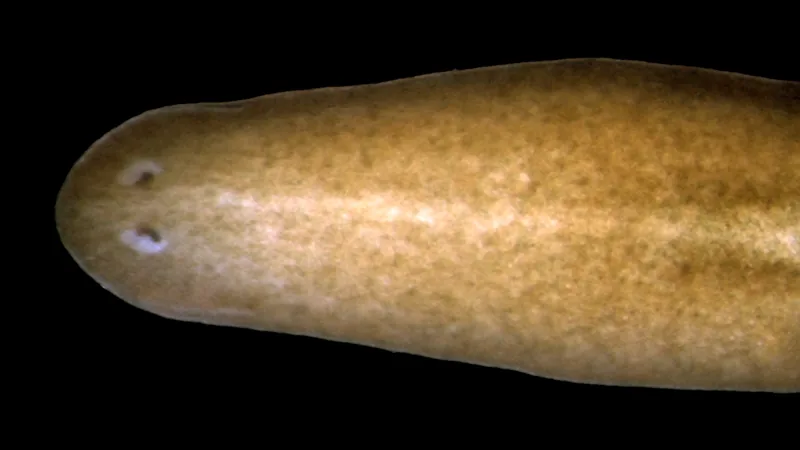
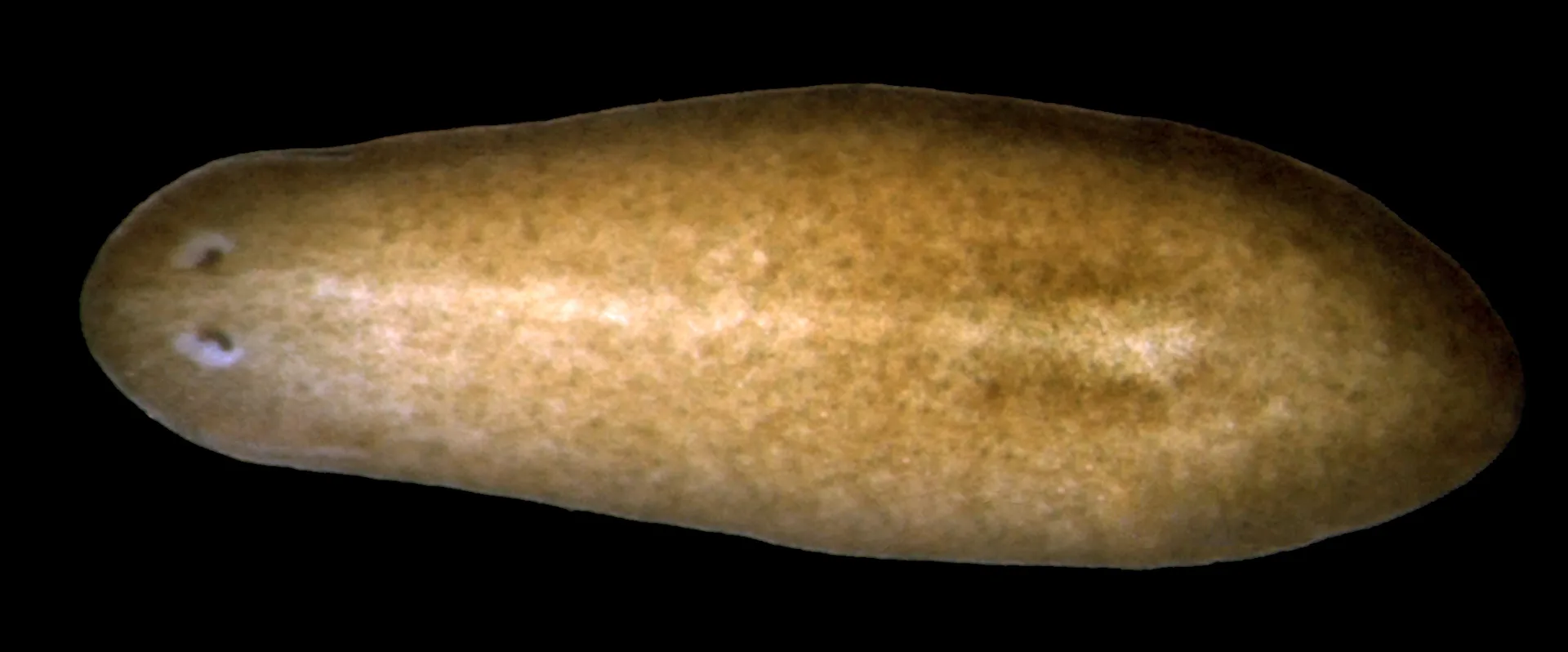
Schmidtea mediterranea is a freshwater planarian, a type of flatworm. In one lab study, the sexually mature worms used were about 1 cm long. Planarians can regenerate from essentially any type of injury, and they regrow rapidly from tiny tissue pieces. Stem cells called neoblasts do the work, and transplanting a single neoblast can rescue a worm given a lethal dose of radiation. By a 2007 estimate, these stem cells can produce the approximately 40 different cell types found in this animal.
A gene that decides head or tail
Tail into head When researchers silenced the gene beta-catenin, worms cut at the rear grew a head instead of a tail. In uncut adult animals, the tail turned into a head.
The authors suggest beta-catenin works as a molecular switch that specifies and maintains head-to-tail identity, during regeneration and in the uncut animal.
Immortal, with a catch
Scientists have called this species immortal. Adults hold a large pool of pluripotent stem cells, and those cells keep making every adult cell type. There is a catch. A study found that the worms lose fertility as they age. The problem sits in the female reproductive system, and regeneration can restore it. With age, a signaling gradient that sets head-to-tail position shifts toward the tail, and tuning it with gene silencing slowed down or sped up the worms’ reproductive aging.
One worm, two ways to breed
Hundreds of planarian species live worldwide, but this one has a restricted distribution in the western Mediterranean. Asexual populations live on the Catalan coast and the Balearic Islands. Sexual populations live in Corsica, Sardinia, Sicily and the Tunisian coast. No co-occurrence between the two strains has been reported. Planarians have a low dispersal ability because they dry out easily.
Asexual worms reproduce exclusively by fission, which means splitting, followed by whole-body regeneration, and they never develop sexual organs. Sexual worms are hermaphrodites, with both male and female organs, and lay egg capsules. Researchers mainly study a clonal lab strain that started from a single animal collected from a fountain in Montjuïc Park, Barcelona, in 1998.
Planarians in general are carnivores known to feed on living or recently dead invertebrates, including annelids, mollusks, crustaceans, and insect larvae. They extend a cylindrical eating tube, the pharynx, through an opening on the belly. Its muscles then pull tissue and fluid from the food.
Published
Traits
Intel
& FAQ
Guess
first
How big is a Planarian, really? Slide, lock in, and see what the sources say. Every answer is a figure from this page, quoted from where it came from.
Sources
- 01Brand et al. (2026). Stepwise emergence of recombination suppression precedes fissiparous asexuality in the planarian Schmidtea mediterranea. Nature Communications.
- 02Gurley, Rink & Alvarado (2008). β-Catenin Defines Head Versus Tail Identity During Planarian Regeneration and Homeostasis. Science.
- 03Plass et al. (2018). Cell type atlas and lineage tree of a whole complex animal by single-cell transcriptomics. Science.
- 04Verdesca et al. (2026). Drift of positional identity drives reproductive aging in a long-lived regenerative animal. Current Biology.
- 05Pacis et al. (2025). Red Midge Larvae Are an Invertebrate Alternative Diet to Beef Liver for Planarian Husbandry. Biomolecules.
- 06Sánchez Alvarado (2007). Stem cells and the Planarian Schmidtea mediterranea. Comptes Rendus. Biologies.
- 07Collins et al. (2010). Genome-Wide Analyses Reveal a Role for Peptide Hormones in Planarian Germline Development. PLoS Biology.
- 08Wenemoser & Reddien (2010). Planarian regeneration involves distinct stem cell responses to wounds and tissue absence. Developmental Biology.
- 09Grohme et al. (2018). The genome of Schmidtea mediterranea and the evolution of core cellular mechanisms. Nature.
What the sources say: 51 claims checked word for word against these sources →