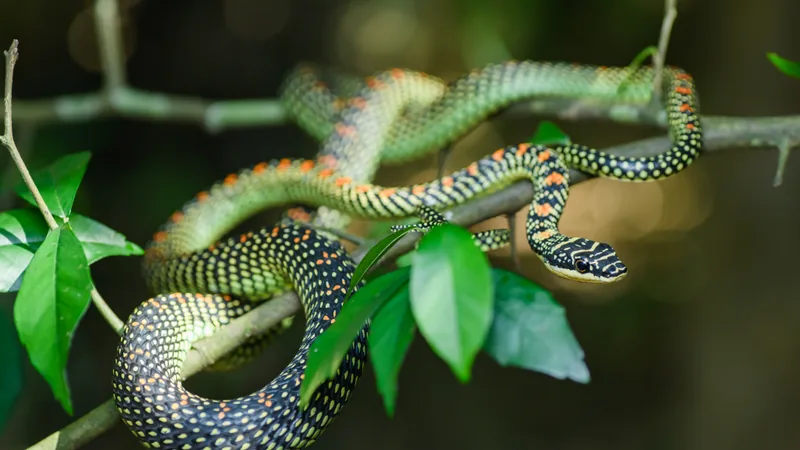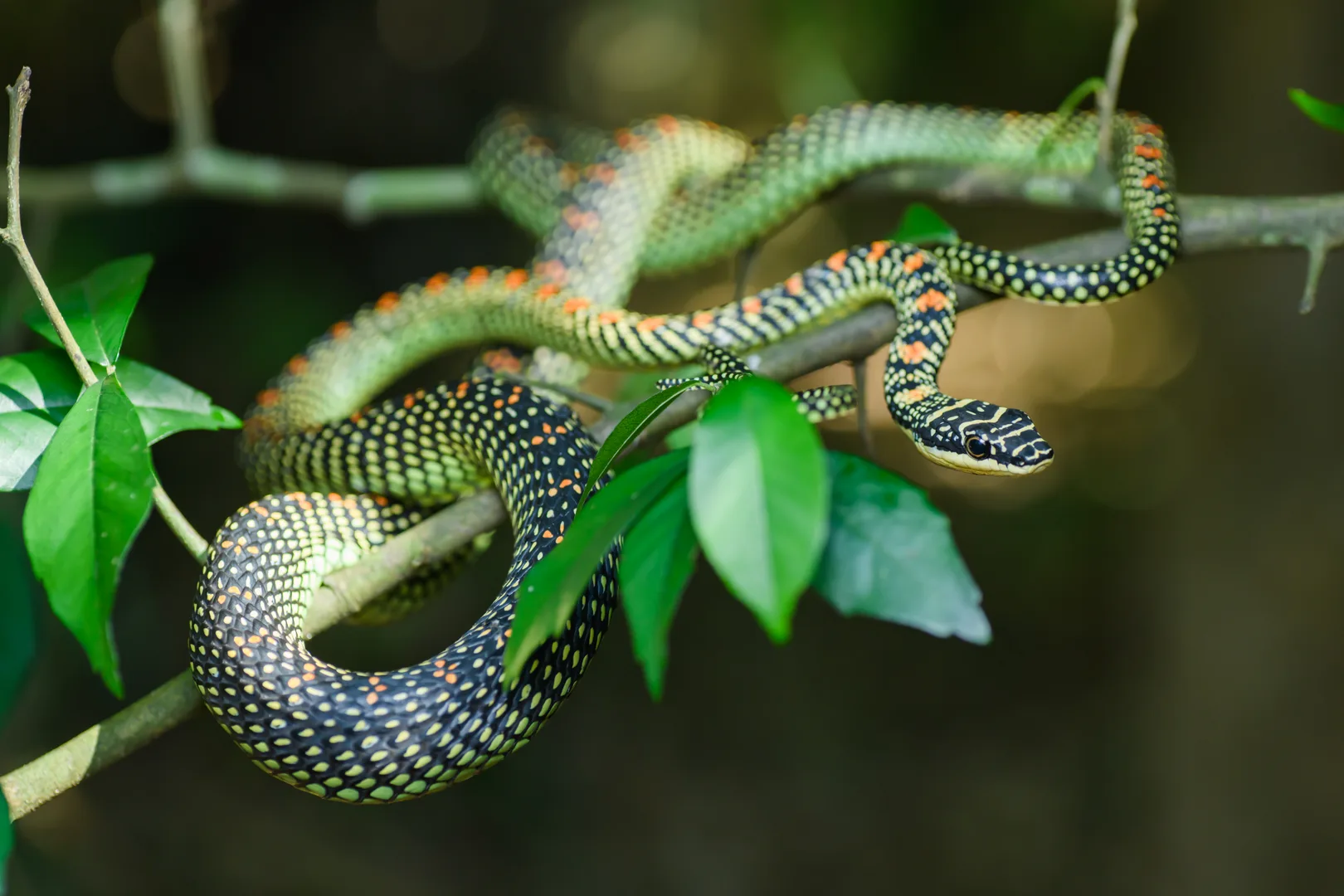
A paradise flying snake (Chrysopelea paradisi) in Kaeng Krachan National Park, Thailand
Field
notes
A Wing Cut From a Snake’s Own Ribs
The paradise flying snake (Chrysopelea paradisi) grows up to 91 centimetres (36 inches) long. It belongs to Chrysopelea, a genus of five slender tree snakes found in South Asia and the Indonesian archipelago. It has no wings or any other obvious body part built for flight. Instead, when it glides it splays its ribs outward and flattens its round body from top to bottom, turning its cross-section from round to triangular. Water-tunnel tests of a model of that shape found a higher maximum lift than many other shapes, airfoils among them, and relatively high lift even at a 60-degree angle of attack (the tilt between the body and the oncoming flow), the highest angle the researchers tested.
A Jump Before It Falls Filmed taking off from a branch, the snakes mostly used vertically looped “J-loop” takeoffs, which researchers call the only true jumping in snakes. In the commonest, the anchored J-loop, the snake hangs the front of its body in a loop, then holds its rear body still on the branch and accelerates up and away.
The Numbers Behind the Glide
In one study, snakes launched from a branch 9.62 metres up travelled a mean horizontal distance of 10.14 metres and reached an average airspeed of 10 metres per second, and the shallowest glide angle recorded was 13 degrees, figures the researchers say rival or beat familiar gliders such as flying squirrels. Despite an apparent lack of control surfaces, it can exert remarkable control over the direction it takes, and it can maneuver and land either on the ground or on vegetation. Flying snakes make visual assessments before take-off, and head models suggest this species likely has a field of view of about 308.5 degrees, with a considerable zone of binocular vision that extends overhead.
One Bite, Mild Effects
Despite carrying fangs at the back of its jaw, the genus Chrysopelea is classed as nonvenomous. A case report of a human bite recorded a 16-year-old with bite marks and moderate pain on one finger: the patient showed no evidence of significant local or systemic envenomation, and had a transient change in the blood-clotting tests. Its authors say the full effects of this snake’s bite remain uncharacterized. Flying snakes hunt by day, taking rodents, bats, birds, and lizards, and this species lays eggs.
Where It Lives
The paradise flying snake is fully arboreal. Its range takes in Thailand, Indonesia, Brunei, India’s Andaman Islands, Malaysia, Myanmar, the Philippines, and Singapore, and three subspecies are recognised. The IUCN Red List, in an assessment published in 2011, rates it Least Concern.
Published Updated
Traits
Intel
& FAQ
Guess
first
How big is a Paradise Flying Snake, really? Slide, lock in, and see what the sources say. Every answer is a figure from this page, quoted from where it came from.
Sources
- 01Flying snake. Encyclopedia Britannica.
- 02Chrysopelea paradisi. The Reptile Database.
- 03Noor Faradiana Binti Md Fauzi & Mohammad Shahfiz Azman (2023). Chrysopelea paradisi (Boie, 1827). Malaysia Biodiversity Information System (MyBIS).
- 04Vogel, Wogan, Diesmos, Gonzalez & Inger (2011). Chrysopelea paradisi. The IUCN Red List of Threatened Species.
- 05Socha (2002). Gliding flight in the paradise tree snake. Nature.
- 06Socha, O'Dempsey & LaBarbera (2005). A 3-D kinematic analysis of gliding in a flying snake,Chrysopelea paradisi. Journal of Experimental Biology.
- 07Socha (2011). Gliding Flight in Chrysopelea: Turning a Snake into a Wing. Integrative and Comparative Biology.
- 08Socha (2006). Becoming airborne without legs: the kinematics of take-off in a flying snake,Chrysopelea paradisi. Journal of Experimental Biology.
- 09Holden et al. (2014). Aerodynamics of the flying snake Chrysopelea paradisi: how a bluff body cross-sectional shape contributes to gliding performance. Journal of Experimental Biology.
- 10Zamore, Araujo & Socha (2020). Visual Acuity in the Flying Snake, Chrysopelea paradisi. Integrative And Comparative Biology.
- 11Tan et al. (2012). Bitten by the “Flying” Tree Snake, Chrysopelea Paradisi. The Journal of Emergency Medicine.
What the sources say: 46 claims checked word for word against these sources →