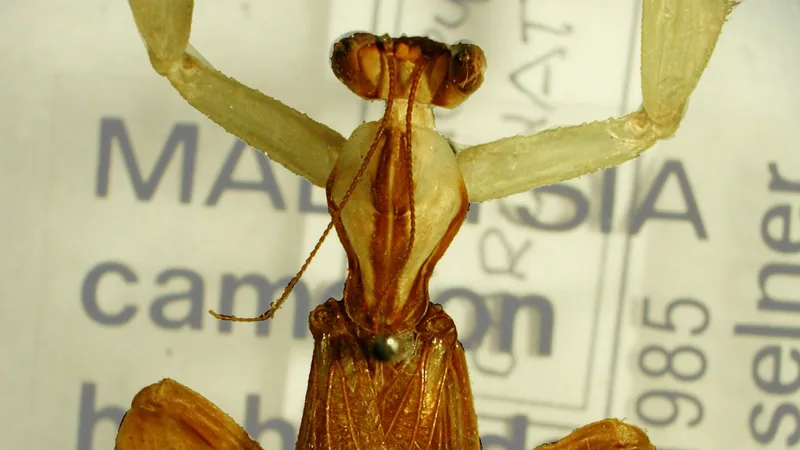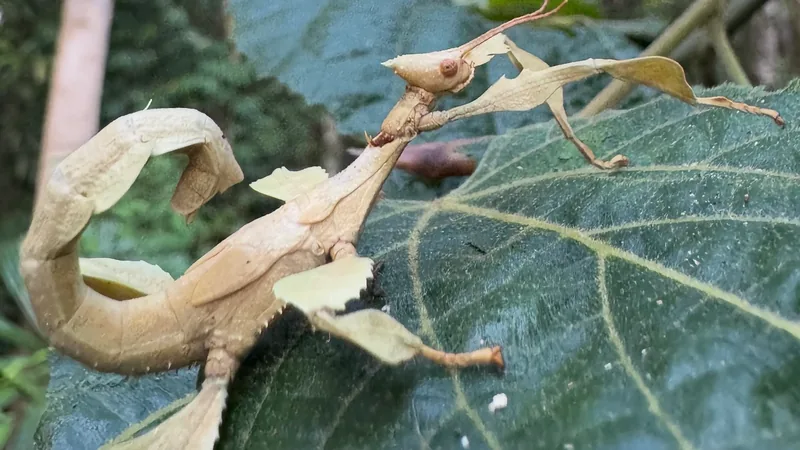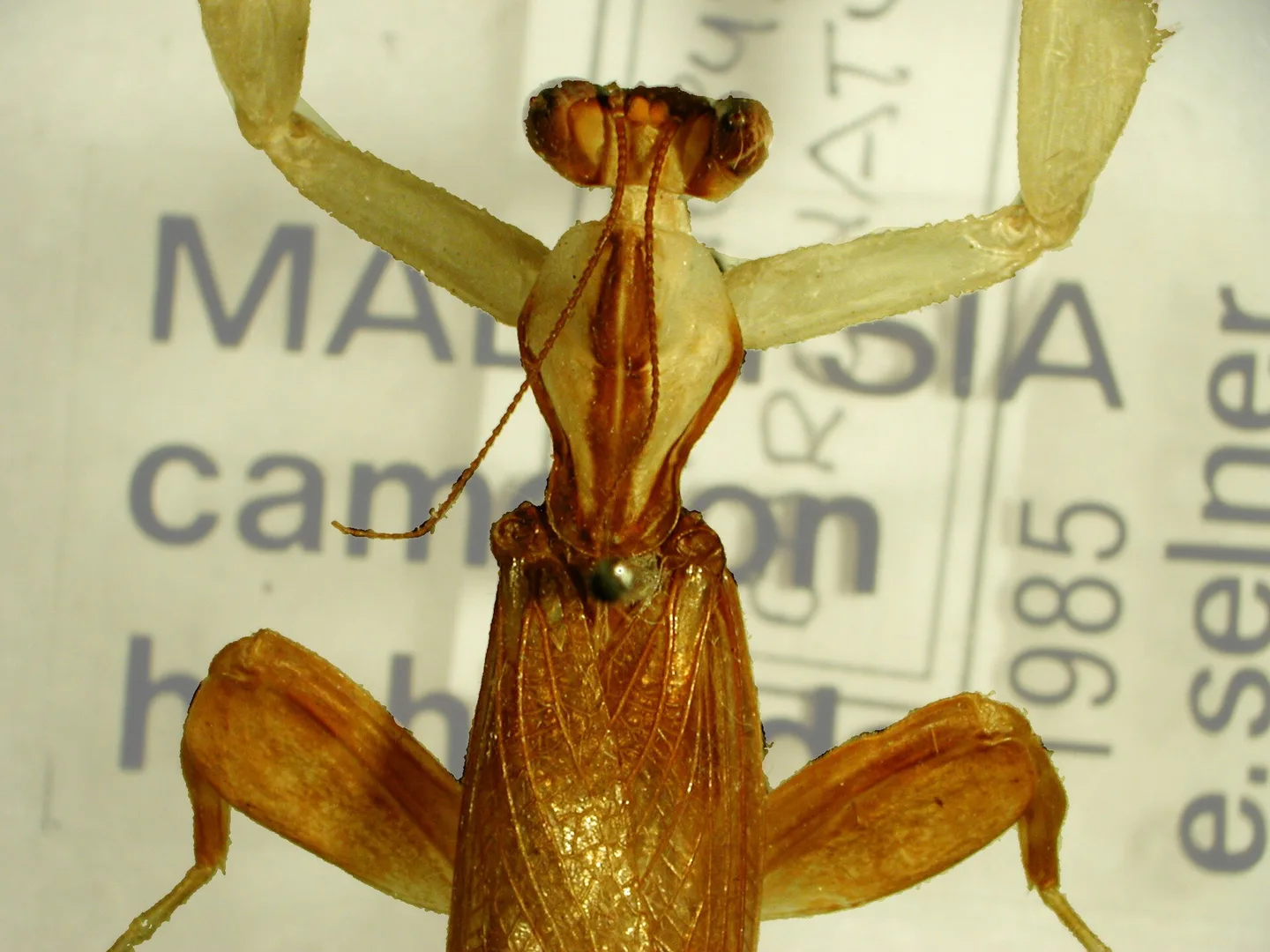
A wild orchid mantis nymph (Hymenopus coronatus) near Montha Than Waterfall, Thailand.
Field
notes
A Flower That Hunts
The orchid mantis (Hymenopus coronatus) hunts by deceiving pollinators. Its middle and hind legs carry broad lobes that resemble flower petals, and to a bee’s eyes its color is indistinguishable from the flowers growing around it. In field tests, isolated mantises attracted wild pollinators, including local bees, flies and butterflies, at an even higher rate than real flowers did, then caught them as prey. A 2014 study called it a hunting strategy not documented in any other animal species.
After searching Malaysian rainforests, researcher James O’Hanlon said, “As far as we can tell, they’re fantastically rare.” In an 11-year survey in and around a tropical botanical garden in Yunnan, China, researchers logged 54 records, and only two of those mantises were on flowers. The survey suggested it mainly stays on backgrounds such as green leaves, where its body color stands out.
The same team reared orchid mantises in a lab at the garden, inside the species’ natural range, and 91 reached adulthood with complete records. After their final molt into adults, females weighed about 1.4 grams on average and males about 0.24 grams, less than a fifth as much. In the lab, females lived an average of 192 days and males 138 days.
Built for Different Jobs
According to a 2016 study, adult males and females hunt in fundamentally different ways. Males rely on ambush, the hunting strategy of their ancestors, while females use aggressive mimicry, in which a predator copies something its prey is drawn to. Large pollinating insects are protected by their size from most predators that hunt on flowers, and the study concluded that females in this family line grew much bigger to catch them, not to have more offspring. Males stayed small and mobile, which helps them find mates. The authors knew of no other praying mantis species whose females are more than twice the size of males.
Chemical Bait Young orchid mantises, called nymphs, already look like flowers, but researchers doubted that looks alone could make them better hunters. The juveniles’ mandibles (jaws) carry two chemicals that are also part of the oriental honeybee’s pheromones, the chemical signals bees use to communicate. The researchers detected one of them in the air only while a juvenile was trying to catch prey, and in a field test honeybees mostly chose to visit dummies dosed with the right mix of both.
Legs That Glide
The petal-shaped lobes on its legs made the orchid mantis a textbook example of flower mimicry for about 200 years, but evidence suggests they do not help it lure pollinators. A 2024 study found another job for them: orchid mantises escape by jumping, and their nymphs are excellent gliders, with the shallowest glides observed in any land-dwelling invertebrate (an animal without a backbone). The lobes are cambered airfoils, curved surfaces that work like wings: they add about 36 percent to the area of the mantis’s outline and play a vital role in its gliding. Despite a 165-fold increase in body mass as they grow, older female nymphs could still glide. The researchers called it the first documented case of gliding “leg wings” in a wingless arthropod, the group that includes insects and spiders.
Published Updated
Traits
Intel
& FAQ
Guess
first
How big is a Orchid Mantis, really? Slide, lock in, and see what the sources say. Every answer is a figure from this page, quoted from where it came from.
Sources
- 01O’Hanlon, Holwell & Herberstein (2014). Pollinator Deception in the Orchid Mantis. The American Naturalist.
- 02Svenson et al. (2016). Selection for predation, not female fecundity, explains sexual size dimorphism in the orchid mantises. Scientific Reports.
- 03Mizuno et al. (2014). “Double-Trick” Visual and Chemical Mimicry by the Juvenile Orchid MantisHymenopus coronatusused in Predation of the Oriental HoneybeeApis cerana. Zoological Science.
- 04Zhao et al. (2024). Petal-shaped femoral lobes facilitate gliding in orchid mantises. Current Biology.
- 05Zhao, Liu & Chen (2022). The orchid mantis exhibits high ontogenetic colouration variety and intersexual life history differences. Research Square.
- 06A corsage that bites. Science News, 2013.
- 07Praying Mantis Looks Like a Flower: And Now We Know Why. National Geographic, 2016.
What the sources say: 55 claims checked word for word against these sources →