AnimalTracks.wiki

Ocellaris Clownfish

Amphiprion ocellaris

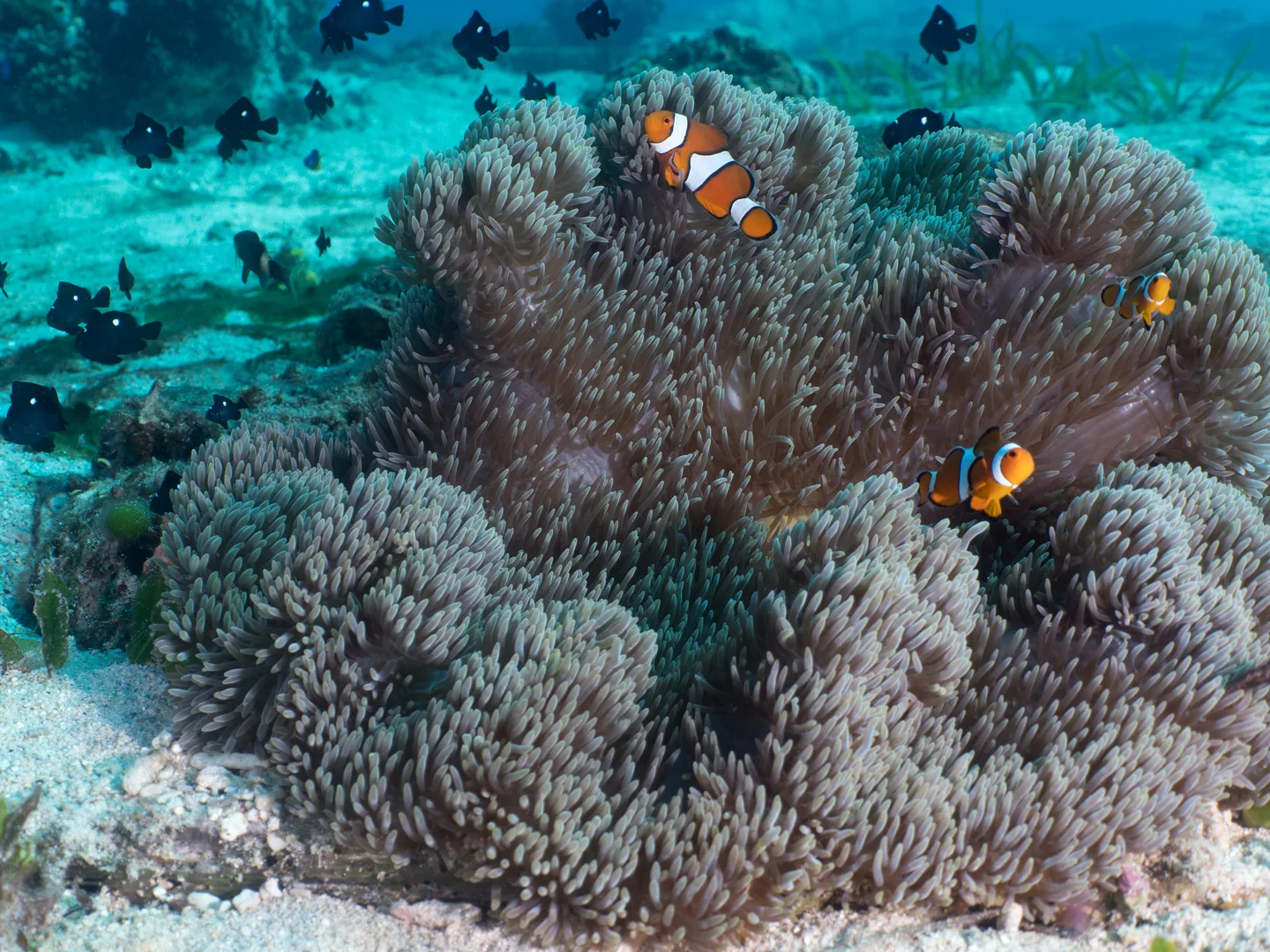
A reef fish about 8 cm long that shelters among stinging anemone tentacles, where the breeding male turns female if the female is lost.

Danger tierLowEffectively harmless to people.
IUCN status [LC]Least ConcernPopulation stable and widespread in natural habitats.Source: IUCN Red List
Vibe checkMogwaiPost-Rock & Cinematic OrchestralListen ↓

Field
notes

Checked against 3 sources ↓

Male first, female later

Every ocellaris clownfish matures as a male, and any of them can later turn female. Biologists call that being a protandrous hermaphrodite. One host anemone typically holds a breeding pair plus up to four juveniles that do not breed. The bigger fish of the pair is the female. She stops her mate from turning female, and he stops the juveniles from maturing into males.

Lose the female and the group reshuffles. Her mate changes sex and rapidly grows, and the next largest male usually becomes the new breeding male.

Dad does the nest work Once the eggs are laid, the male tends the nest for six to seven days, rarely helped by the female. He fans the eggs with his pectoral fins to aerate them and sweep off settled debris, eats any that are infertile or damaged, and aggressively chases off predators.

How big, how old

The average length is 8 cm (3.15 in), and the species can reach 11 cm (4.3 in). A clownfish lives about 8 years in the wild, and 12 years or more in a protected environment.

Over-collecting for the aquarium trade has hit populations in some areas, but the IUCN Red List rates the species Least Concern.

A home that stings

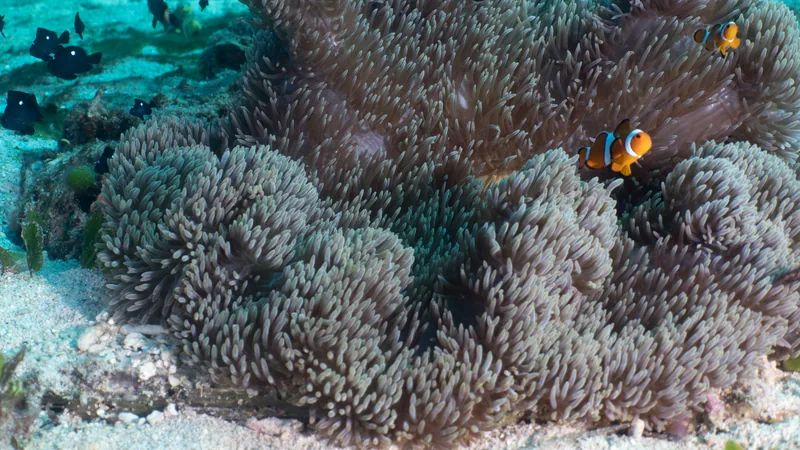
It is native from the Andaman Sea to northwest Australia, central Indonesia, the Philippines and southwest Japan. It lives on coastal seaward reefs and in shallow, sheltered lagoons at depths of 1 to 12 m (3.3 to 39.3 ft), and it depends on three host anemones: the magnificent anemone, the leathery anemone and the giant carpet anemone. It rarely strays more than 30 cm (12 in) from its host.

An anemone’s stinging cells are called nematocysts, so why do they spare the clownfish? Some researchers believe the fish’s mucus coat has a special biochemical makeup, so the anemone fails to recognize it as food and does not fire. Others theorize the mucus carries the same chemical signature as the host itself.

What is known is that a clownfish away from its host for a while has to re-adapt to the stings. On its return it performs a dance-like ritual, touching the tentacles first with only its ventral fins, then its whole belly. Acclimation takes several hours.

Its diet is mostly zooplankton (tiny drifting animals), with bottom-dwelling invertebrates and algae on the side.

Published

Traits

Intel
& FAQ

01Does a clownfish feed its anemone?

Not by catching food for it, whatever popular belief says. Instead, the anemone uses the fish's nitrogenous waste as food. The fish also aerates the water around the tentacles and clears waste from the anemone's oral disc.

Source: Aquarium of the Pacific

02How does a baby clownfish find an anemone?

Probably by smell. Juveniles find the same host anemones their parents preferred, and researchers believe an odor imprinted while they were eggs, in a nest close to the host, is what guides them. If one finds a host before a predator eats it or the current residents chase it off, it becomes the youngest and lowest-ranking member of the group.

Source: Aquarium of the Pacific

03How many eggs does a clownfish lay?

Anywhere from 100 to 1000, spread over several spawning passes, and older females lay more. The eggs start pink to orange, fade to a dull gray or brown, and turn silver shortly before they hatch.

Source: Aquarium of the Pacific

Guess
first

How big is a Ocellaris Clownfish, really? Slide, lock in, and see what the sources say. Every answer is a figure from this page, quoted from where it came from.

  1. ?
  2. ?

Sources

More Ray-Finned Fishes

Actinopterygii & Sarcopterygii

Hydrodynamic aquatic rulers with lateral line pressure sensors, swim bladders, and electrical weaponry.

A captive African lungfish resting on aquarium gravel, its long thread-like fins trailing from a mottled olive body

African Lungfish

Protopterus annectens

A fish that breathes air through two lungs and can live for over a year inside a cocoon of its own dried slime.

Obligate air breathing through two lungs, and over a year inside a cocoon of dried slimeView →
▸ ElderHeavy Psych & Desert Rock
Close view of an alligator gar's diamond-scaled back and blunt snout breaking a marsh surface

Alligator Gar

Atractosteus spatula

Described as a 100-million-year-old living fossil, armored in interlocking ganoid scales, with two rows of fang-like teeth in its upper jaw and a swim bladder that can work as a lung.

Interlocking ganoid scale armor with a hard outer layer over a tough bony base, two rows of fang-like teeth in the upper jaw, and a vascularized swim bladder that can work as a lungView →
▸ Creedence Clearwater RevivalClassic Hard Rock & Southern Blues
American paddlefish from below in murky green water, the pale bars of its gill rakers showing inside the open gill slit

American Paddlefish

Polyodon spathula

An ancient river giant that carries 50,000 to 70,000 electroreceptor organs, the largest number of any living vertebrate species.

Paddle and head covered in ampullary organs: 50,000 to 70,000 electroreceptors per adult, the largest number of any living vertebrate speciesView →
▸ Blackberry SmokeDelta Blues & Swamp Rock
Live blackfin icefish, a close relative, seen from above in a pale holding tank at Palmer Station

Antarctic Icefish

Champsocephalus gunnari

A Southern Ocean fish with no working red blood cells, whose nearly clear blood carries oxygen dissolved in plasma, along with its own antifreeze.

Belongs to the only vertebrate family that lacks working hemoglobin genes and working red blood cells: its blood carries oxygen dissolved in the plasma instead.View →
▸ BiosphereGlacial Ambient & Drone Soundscapes

Clade factLateral line sensory systems detect water displacement and pressure waves from surrounding swimming creatures.

Explore all 53 →

Head-to-head showdowns

Simulated face-offs, biological power gauges, and 3-round combat

Down the Rabbit Hole

Associative matches based on weird shared evolutionary traits