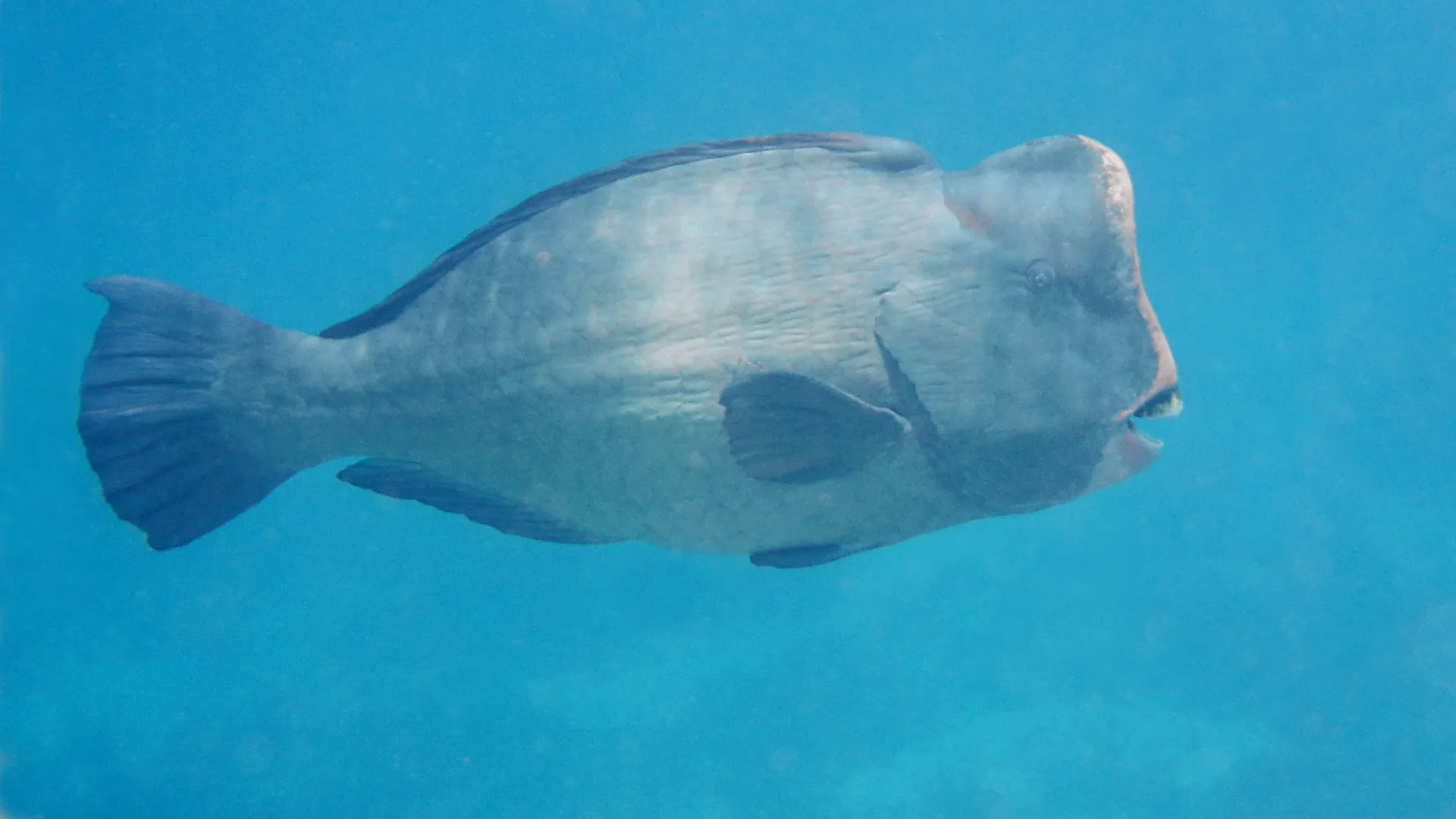
Agincourt Reef, Great Barrier Reef, Australia
Field
notes
A fish with a battering ram
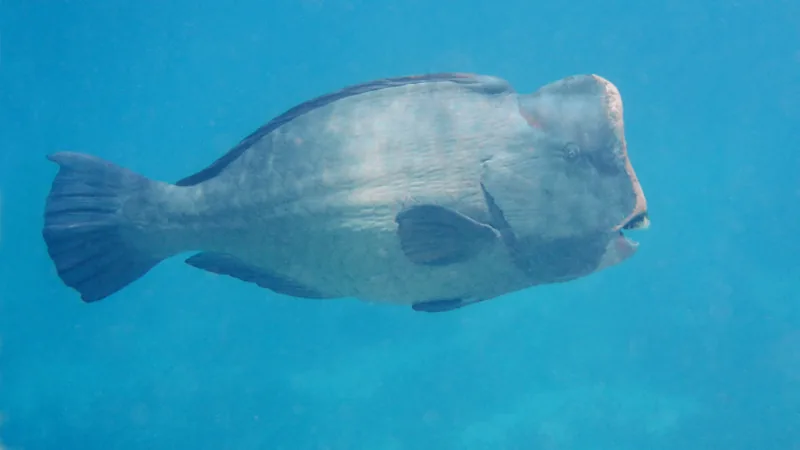
In the early morning on the outer reef of Wake Atoll, in the western Pacific, divers heard loud, jarring sounds and traced them to male green humphead parrotfish. The males charged each other, using their tail fins to slam their forehead humps together. Then they swam fast in a half circle, each trying to bite the other’s back and flank, swam apart and turned face to face for another collision. In one bout caught on video, four charges ended when the subordinate male fled. The researchers knew of no earlier scientific record of ritualized headbutting in any marine fish.
Reef grinder On Australia’s Great Barrier Reef, one of these fish can wear away over 5 tons of reef rock in a year.
Giant of the reef
This is the largest herbivorous fish on coral reefs. It is also the largest of the parrotfishes. FishBase lists a maximum length of 130 cm and a maximum published weight of 46 kg, with a common length of 70 cm measured without the tail fin. Young fish are brownish to green with rows of whitish spots, then dull grey with white spots, gradually turning uniformly dark green. Females can live to 40 years, and it is the longest-lived parrotfish.
It lives across the Indo-Pacific, from the Red Sea and East Africa to Samoa and the Line Islands, north to Wake and south to the Great Barrier Reef, at depths from the surface to about 40 m. It feeds on algae growing on the reef, live coral and shellfish, and sometimes rams its head against coral to help it feed.
Sleepovers and spawning grounds
Green humphead parrotfish often sleep and feed in big groups in shallow water, and FishBase notes they rest at night in caves and often in shipwrecks. On the Great Barrier Reef, schools of 30 to 50 are seen regularly. At Wake Atoll the mating system was a lek: males arrived early and defended small territories, apparently to attract females, who came later in big schools. There, the fish spawned on mornings near the full moon and the last quarter moon.
Wary, slow and Vulnerable
The Red List rates the species Vulnerable. It grows slowly, starts breeding late and replaces its numbers slowly, and as a result even moderate fishing has led to severe declines in the size and numbers of fish across much of its range. Night spearfishing grew with underwater flashlights in the 1970s, and in the western Solomon Islands it led to the disappearance of sleeping groups that had lasted for generations. Overfishing has made it shy of people: it has a name as the wariest parrotfish, and divers struggle to get close to one in most places.
Published
Traits
Intel
& FAQ
Guess
first
How big is a Green Humphead Parrotfish, really? Slide, lock in, and see what the sources say. Every answer is a figure from this page, quoted from where it came from.
Sources
- 01Bolbometopon muricatum, Green humphead parrotfish. FishBase.
- 02Sadovy et al. (2025). Bolbometopon muricatum. The IUCN Red List of Threatened Species 2025: e.T63571A264483873.
- 03Muñoz et al. (2012). Extraordinary Aggressive Behavior from the Giant Coral Reef Fish, Bolbometopon muricatum, in a Remote Marine Reserve. PLoS ONE.
- 04Muñoz et al. (2014). Spawning aggregation behavior and reproductive ecology of the giant bumphead parrotfish, Bolbometopon muricatum, in a remote marine reserve. PeerJ.
What the sources say: 36 claims checked word for word against these sources →