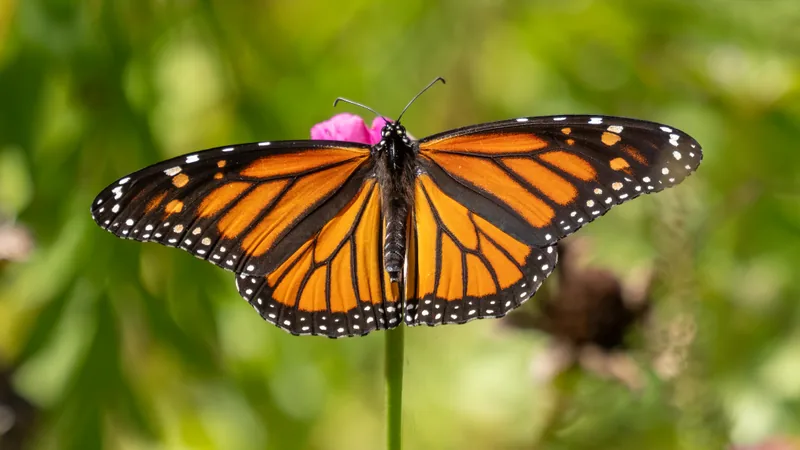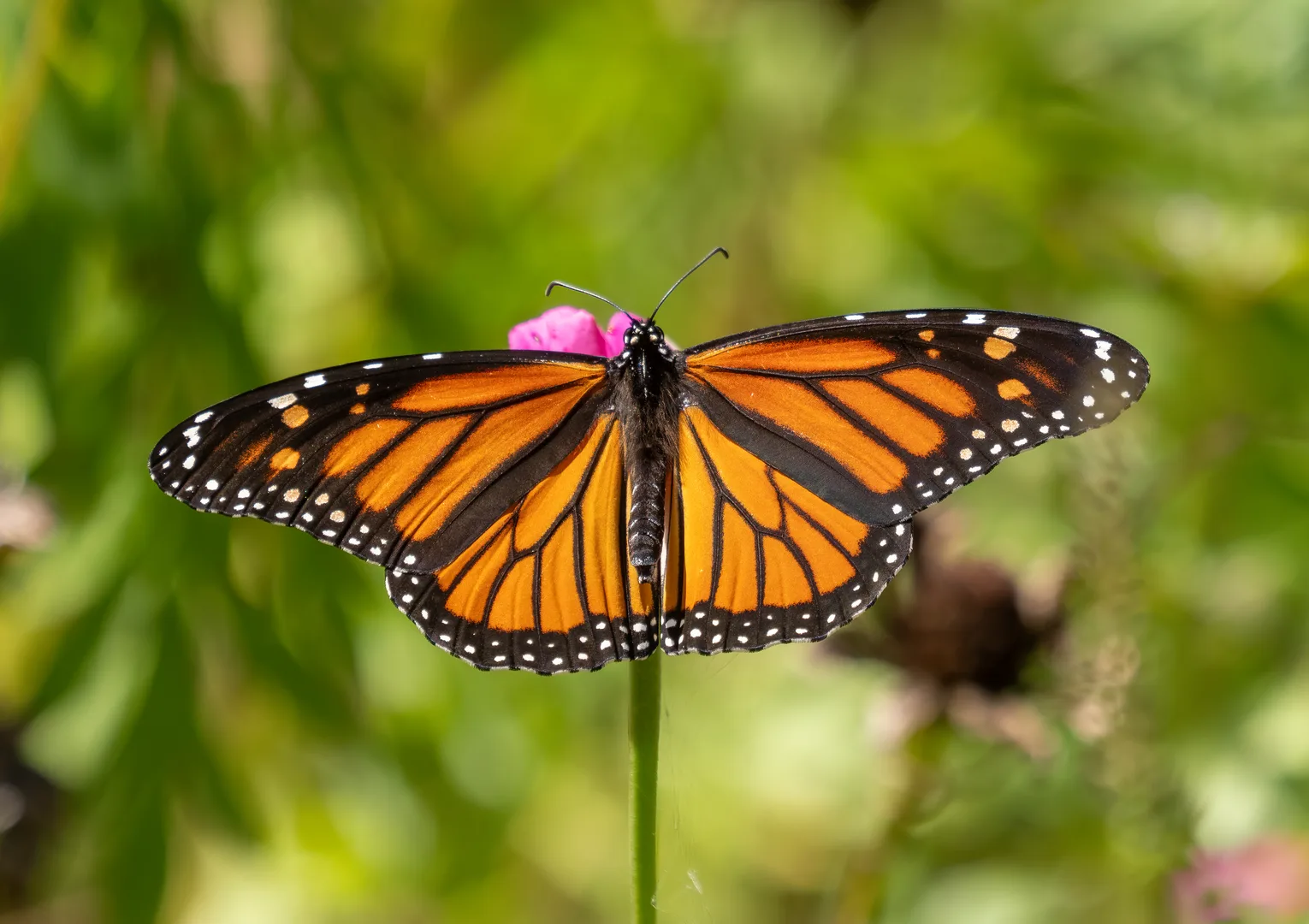
Monarch butterfly female in Walland, TN
Field
notes
Steering by the sun
The monarch butterfly, Danaus plexippus, makes one of the longest known insect migrations in the world. Eastern North American monarchs fly up to 3,000 miles each fall, from Canada through the United States to Mexico. The trip may last more than two months, and the longest single-day flight recorded for a tagged eastern monarch is 265 miles.
Sun compass Migrating eastern monarchs use a time-compensated sun compass to find their overwintering grounds in central Mexico. A 2009 study found that the antennae are necessary for proper sun compass orientation, that antennal clocks exist in monarchs, and that they likely provide the primary timing mechanism.
The time compensation comes from a circadian clock, an internal body clock. Scientists had assumed it sat in the brain, although nobody had tested that directly, and the authors called their antennae findings unexpected.
Armor from a weed
A monarch caterpillar eats milkweed. By consuming it, monarchs obtain toxins called cardenolides that defend them against predators. The adult’s bright orange wings with a black border act as a warning that eating one can be toxic.
Many insects that colonized cardiac glycoside plants, monarchs among them, evolved changes in the sodium pump, the cell protein those toxins attack. In 2019 scientists used CRISPR gene editing to rebuild the monarch’s changes in fruit flies. Their triple-mutant “monarch flies” were as insensitive to the toxins as monarch butterflies.
Small wings, short lives
An adult monarch has a wingspan of 3 to 4 inches (7 to 10 cm). On average it weighs about half a gram, less than a paperclip. Caterpillars have black, yellow and white stripes and reach 2 inches (5 cm) before they pupate, or turn into a chrysalis.
Most breeding adults live about two to five weeks. Overwintering adults that enter reproductive diapause, a state of suspended reproduction, can live six to nine months. A year brings four to five generations, and the late-summer and fall ones are the ones that migrate.
Where to find one
Monarchs are native to North and South America and have spread to many other places, including Australia, New Zealand and parts of the Iberian Peninsula. North America’s migratory monarchs form two populations. Most eastern monarchs winter in oyamel fir forests in the mountains of central Mexico, while western monarchs, west of the Rocky Mountains, winter mainly in California. Where milkweed grows all year and temperatures suit them, monarchs in many areas live and breed year round without migrating. The IUCN Red List rates the species Least Concern.
Published
Traits
Intel
& FAQ
Guess
first
How big is a Monarch Butterfly, really? Slide, lock in, and see what the sources say. Every answer is a figure from this page, quoted from where it came from.
Sources
- 01Walker et al. (2022). Danaus plexippus. The IUCN Red List of Threatened Species 2022: e.T159971A219149911.
- 02Monarch (Danaus plexippus). U.S. Fish & Wildlife Service.
- 03Monarch Butterfly. San Diego Zoo Wildlife Alliance.
- 04Taylor (2017). Biology of the Monarch Butterfly. Kansas School Naturalist 62(2), Monarch Watch.
- 05Merlin, Gegear & Reppert (2009). Antennal Circadian Clocks Coordinate Sun Compass Orientation in Migratory Monarch Butterflies. Science.
- 06Karageorgi et al. (2019). Genome editing retraces the evolution of toxin resistance in the monarch butterfly. Nature.
What the sources say: 44 claims checked word for word against these sources →