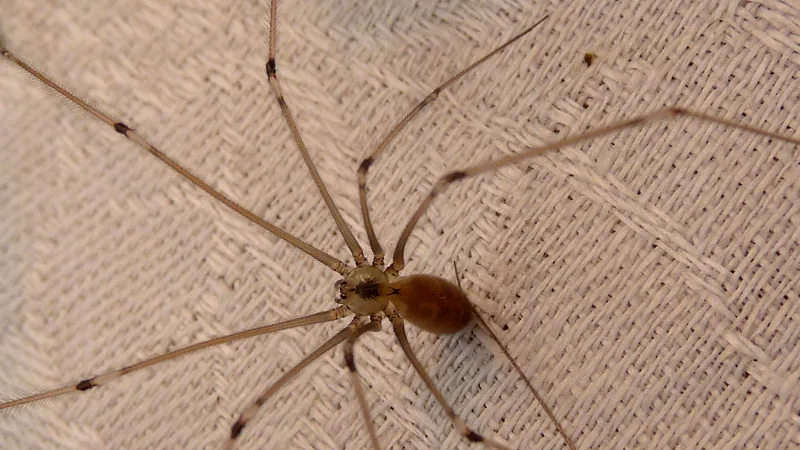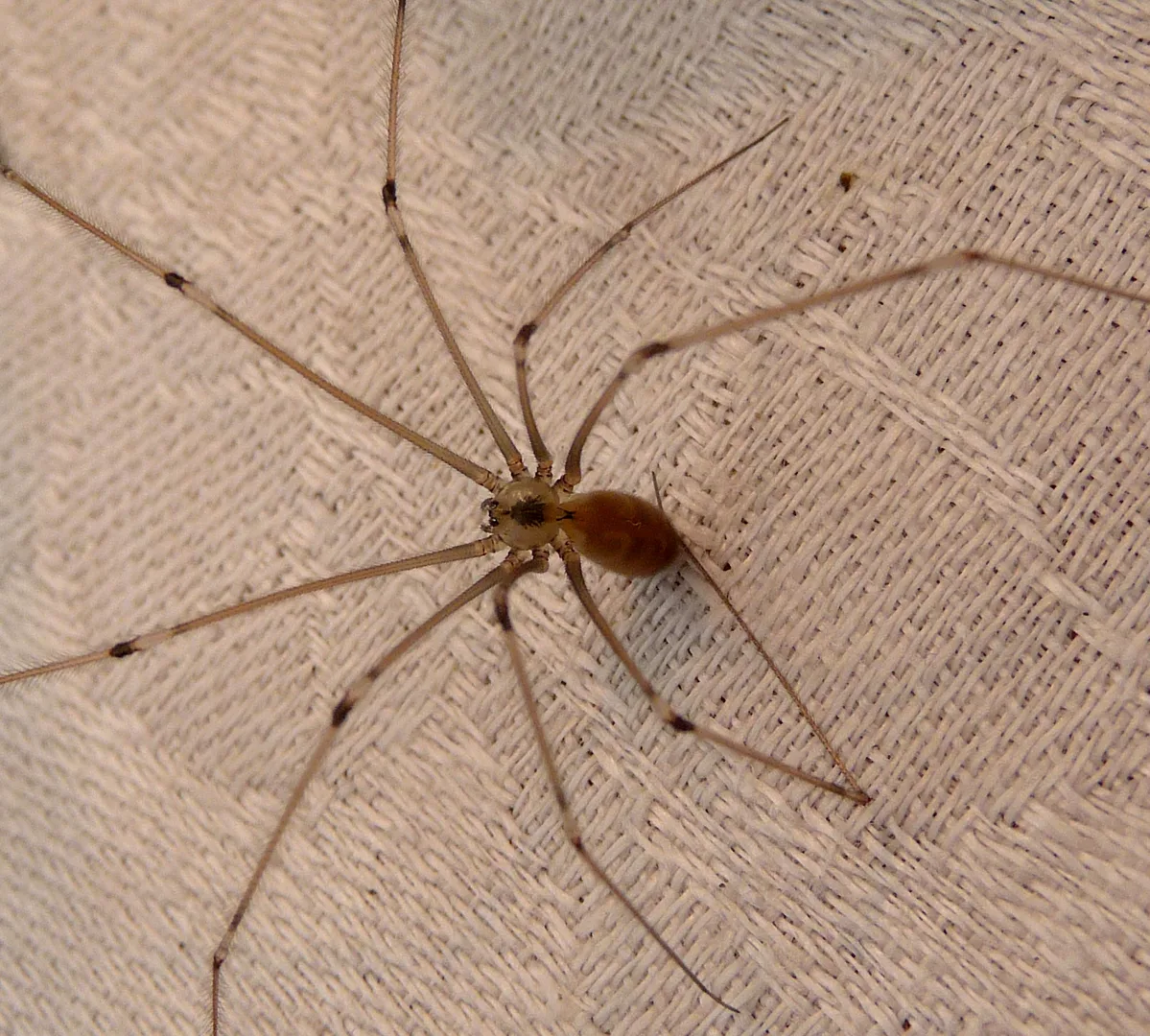
Long-bodied cellar spider in Cradley, Malvern, UK.
Field
notes
A Spider That Hunts Spiders
The long-bodied cellar spider, Pholcus phalangioides, builds a web to catch prey, but it also invades the webs of other spiders. Females have been seen invading a neighbour’s web, eating the owner, and then using that web to catch new prey. A study of its hunting found it acts as an aggressive mimic, making special vibrations that the web’s owner responds to as it normally would to its own prey.
On its own web, it is most efficient at catching spiders and, especially, insects. When prey trips a line at the edge of the web without entering it, it leans out and throws silk over the victim, keeping as few as two legs on the web. It attacks prey by wrapping it in silk.
Tiny Body, Giant Legs
Females are 7 to 8 millimetres long and males are 6 millimetres. The forelegs of an adult female are about 50 millimetres in length. The abdomen is about three times as long as it is wide, and the body is pale yellow-brown with a large gray patch in the center of the cephalothorax, the front body section. The body and legs are almost translucent, and under a microscope you can see blood cells moving in the legs and body of a living spider.
Penn State Extension says it takes about a year for the spiders to mature, and they can live for two or more years as adults. A female carries her eggs, wrapped in silk in clusters of 25 to 60, in her jaws as she hangs upside down in her web.
Now You See It, Now You Don’t
Whirling The spider swings its body around in a circle while keeping its long legs on the silk, and a lab experiment gave further evidence that this is an effective defence against jumping spiders.
When its web is disturbed, it swings fast enough to become very hard to see. Portia, a genus of jumping spiders, preys on it in nature, and birds are listed as known predators.
Found Almost Everywhere
This spider lives throughout the world, and it is common across the United States. ITIS lists it as introduced in both Canada and the continental US. It can be found in undisturbed, low light spots such as basements, caves, and under stones and ledges. Many people know it from the ceilings and corners of homes, where it builds large, loose, flat webs.
Penn State Extension calls it the most common of its family in the United States, adds that it is not known to bite people, and says it is not medically important.
Published
Traits
Intel
& FAQ
Guess
first
How big is a Long-Bodied Cellar Spider, really? Slide, lock in, and see what the sources say. Every answer is a figure from this page, quoted from where it came from.
Sources
- 01Pholcus phalangioides. Animal Diversity Web, University of Michigan.
- 02Longbodied Cellar Spider. Penn State Extension.
- 03Jackson & Brassington (1987). The biology of Pholcus phalangioides (Araneae, Pholcidae): predatory versatility, araneophagy and aggressive mimicry. Journal of Zoology.
- 04Jackson (1990). Predator-prey interactions between jumping spiders (Araneae, Salticidae) and Phokus phalangioides (Araneae, Pholcidae). Journal of Zoology.
- 05Heuts et al. (2001). Long-duration whirling of Pholcus phalangioides (Araneae, Pholcidae) is specifically elicited by Salticid spiders. Behavioural Processes.
- 06Zobel-Thropp et al. (2019). Not so Dangerous After All? Venom Composition and Potency of the Pholcid (Daddy Long-Leg) Spider Physocyclus mexicanus. Frontiers in Ecology and Evolution.
- 07Pholcus phalangioides (Fuesslin, 1775), Taxonomic Serial No. 865102. Integrated Taxonomic Information System.
What the sources say: 42 claims checked word for word against these sources →