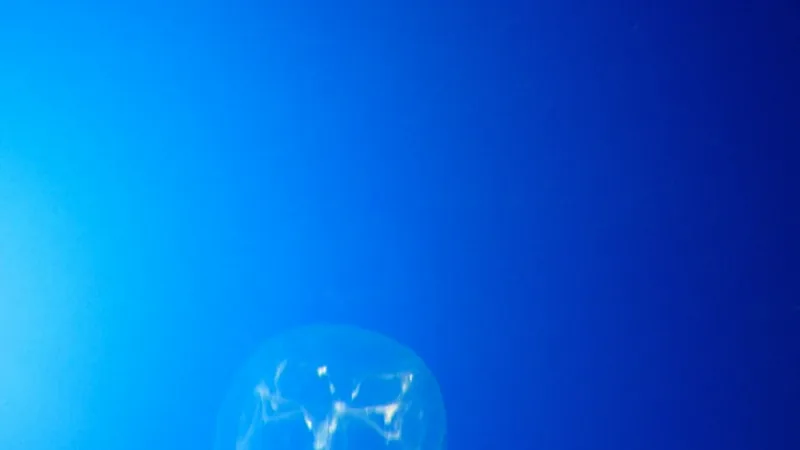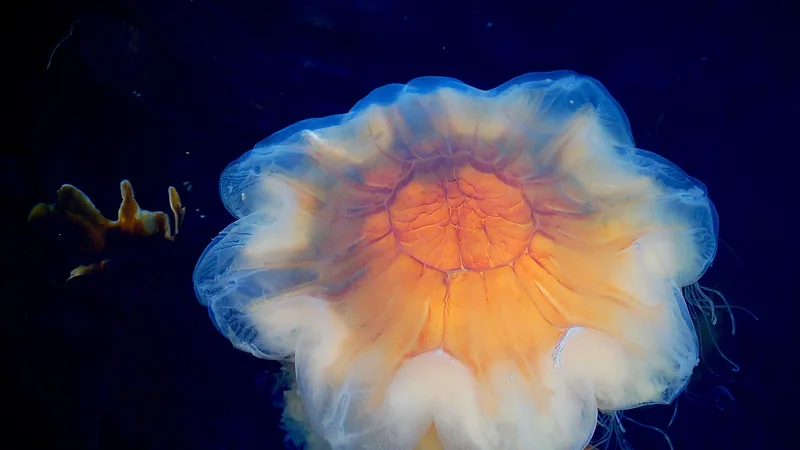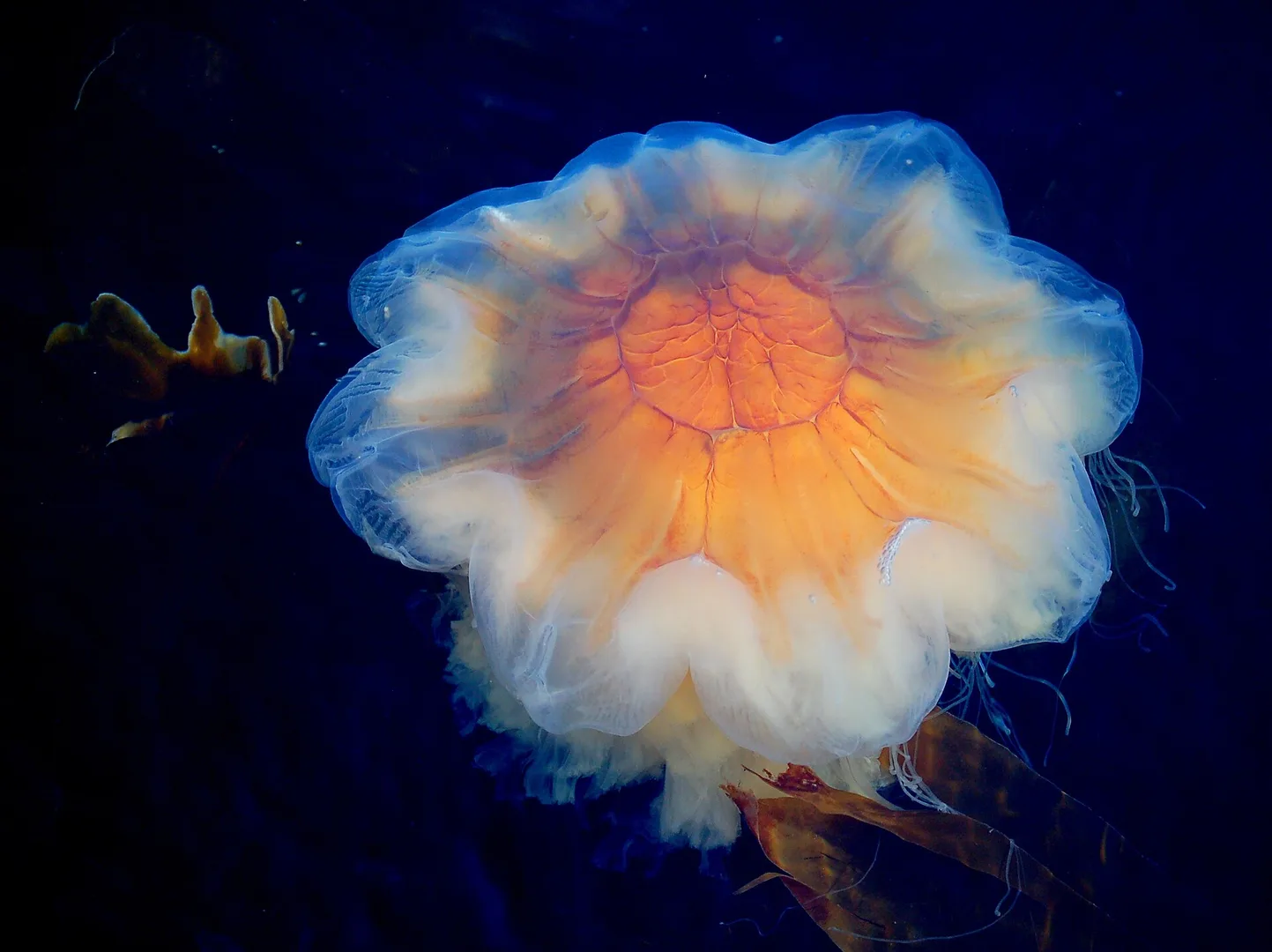
A lion's mane jellyfish in open water.
Field
notes
Often Called the Longest Jellyfish
The lion’s mane jellyfish (Cyanea capillata) drifts through cold and temperate water across the Arctic, Atlantic and Pacific, including the North Sea and Baltic Sea. Its bell usually spans 30 to 80 centimeters (12 to 31 inches) but can reach up to 1.8 meters (5.9 feet) across, divided into eight lobes with a mane of tentacles, arranged in eight clusters, hanging beneath it.
Those tentacles are speculated to trail up to 36.6 meters (120 feet), a figure that comes from one jellyfish a naturalist named Agassiz measured at Nahant, on the east coast of the United States, and reported in 1865. A 2015 study of giant marine animals is skeptical of that measurement, because Agassiz gave no details of how he took it. It also notes that genetic data suggests the jellyfish of the eastern United States are an undescribed Cyanea species, distinct from the European Cyanea capillata. The study found no other size measurements of Cyanea in the literature, yet the 120-foot figure is repeated in both the popular media and scientific literature.
A Net of a Thousand Tentacles
It hunts by sinking slowly with its tentacles spread in a circle around it, catching prey in the net and stunning it with nematocysts, the stinging cells its tentacles carry. Oceana says more than 1,000 tentacles hang from its bell. In jellyfish generally, a single tentacle can hold hundreds or thousands of nematocysts. Each one contains a hollow, coiled, barbed thread: on contact, pressure inside the cell fires it out like a small harpoon, injecting paralyzing toxins. One study identified 53 putative toxins in the venom of this species’ nematocysts, including neurotoxins and pore-forming toxins.
Still Armed After Death Even a dead lion’s mane jellyfish, or a tentacle torn loose from it, is capable of stinging.
On the Leatherback Menu
Unusually for jellyfish, lion’s manes come together in shoals, which can sometimes be a kilometer (0.6 miles) long. Such assemblies have been seen off Norway and in the North Sea. Off Cape Breton Island, Nova Scotia, researchers attached video cameras to 19 leatherback sea turtles and found lion’s mane jellyfish was their dominant prey. They estimated the turtles ate approximately 261 lion’s mane jellyfish per day on average, and up to 664, and capture success was 100 percent for all turtles. On 4 of the 19 videos, pilot fish were seen swimming near the turtle’s head or near the jellyfish it was about to eat.
Oceana says the species is not known to face any major threats, and its population has not been assessed.
Published Updated
Traits
Intel
& FAQ
Guess
first
How big is a Lion's Mane Jellyfish, really? Slide, lock in, and see what the sources say. Every answer is a figure from this page, quoted from where it came from.
Sources
- 01Cyanea capillata (Lions mane). Animal Diversity Web, University of Michigan.
- 02Lion's Mane Jellyfish. Oceana Marine Life Encyclopedia.
- 03McClain et al. (2015). Sizing ocean giants: patterns of intraspecific size variation in marine megafauna. PeerJ.
- 04Heaslip et al. (2012). Jellyfish Support High Energy Intake of Leatherback Sea Turtles (Dermochelys coriacea): Video Evidence from Animal-Borne Cameras. PLoS ONE.
- 05Wang et al. (2018). Unique Diversity of Sting-Related Toxins Based on Transcriptomic and Proteomic Analysis of the Jellyfish Cyanea capillata and Nemopilema nomurai (Cnidaria: Scyphozoa). Journal of Proteome Research.
- 06Jellyfish Information. South Carolina Department of Natural Resources, Marine Resources Division.
What the sources say: 42 claims checked word for word against these sources →