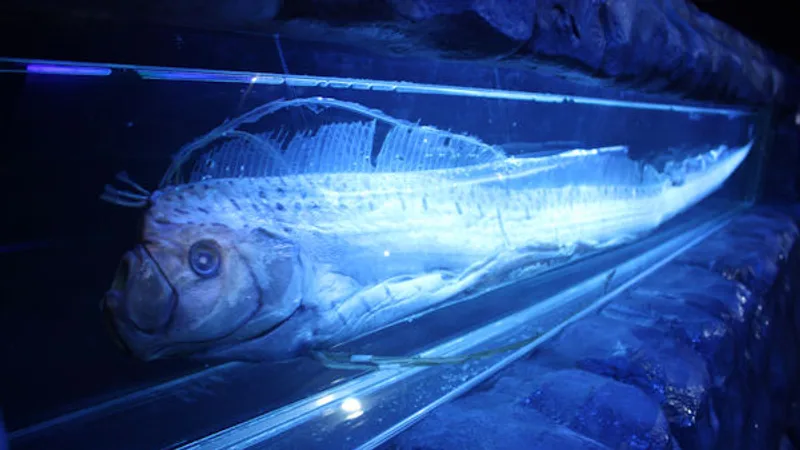
Giant oarfish (Regalecus glesne) stranded at Aramoana Spit, Otago, New Zealand
Field
notes
Standing at Attention
The giant oarfish (Regalecus glesne) keeps its long body straight and swims by rippling its red dorsal fin, an “amiiform” swimming style. It has also been seen swimming upright, which is believed to be how it searches for prey. Researchers suggest that for long, thin fish like oarfish, an upright stance may help them spot prey against light filtering down from above while making their own outline harder to see. That dorsal fin runs the entire length of its body in roughly 400 rays, with the first ten to twelve stretched into a trailing, spotted crest.
Stretching the Truth
The giant oarfish has been reliably documented to 8 meters (26 feet), and the Guinness Book of World Records considers it the longest bony fish alive in modern times, though it is more commonly seen at about 3 meters (10 feet). Fish up to 17 meters have been reported, but a detailed 2012 study found the largest museum specimens were just under 8 meters long, and no evidence that any oarfish grows longer. The maximum published weight for the species is 272 kilograms (600 pounds).
The Oarfish That Was a Shark A report of a 15 to 16 meter oarfish stranded on Stronsay Island in the Orkneys in 1808 was based on the rotting carcass of a large basking shark. Records of 10 to 11 meters added an estimated length for the missing tail end.
Life in the Open Ocean
The giant oarfish is found worldwide in tropical and temperate seas, more typically down to about 200 meters, though it has been reported as deep as 1,000 meters. Underwater robots in the Gulf of Mexico spotted it at 463 to 492 meters, the deepest verified record of the species as of 2013. It has no visible teeth and no swim bladder, and instead of scales its skin is coated in silvery guanine. Its confirmed diet is krill, strained from the water with specially evolved gill rakers; one fish caught off California contained 10,000 krill. Reports of it also eating other invertebrates and fish have not been confirmed. It is believed to live alone except when spawning.
The Sea Serpent’s Secrets
A close relative, the streamer fish, has been reported to give a mild electric shock when handled, though it is unclear whether the giant oarfish can too. In Japan, folklore says an unusual appearance of a deep-sea fish such as an oarfish warns of a coming earthquake; a statistical study built a database of newspaper and museum reports of these appearances, compared them against earthquake records, and found almost no link in place or time, calling the belief a superstition. Few parasites have been recorded in this fish, but scientists once pulled 63 tapeworm larvae from the intestine of an adult giant oarfish stranded in Mexico. Sharks and other large fish are its main potential predators, on account of its size.
Published Updated
Traits
Intel
& FAQ
Guess
first
How big is a Giant Oarfish, really? Slide, lock in, and see what the sources say. Every answer is a figure from this page, quoted from where it came from.
Sources
- 01Oarfish, Regalecus glesne. Australian Museum, 2021.
- 02Regalecus glesne (Oarfish). Florida Museum of Natural History, Ichthyology, 2025.
- 03McClain et al. (2015). Sizing ocean giants: patterns of intraspecific size variation in marine megafauna. PeerJ.
- 04Benfield et al. (2013). Five in situ observations of live oarfish Regalecus glesne (Regalecidae) by remotely operated vehicles in the oceanic waters of the northern Gulf of Mexico. Journal of Fish Biology.
- 05Albano et al. (2022). Distribution of the Order Lampriformes in the Mediterranean Sea with Notes on Their Biology, Morphology, and Taxonomy.
- 06Orihara et al. (2019). Is Japanese Folklore Concerning Deep‐Sea Fish Appearance a Real Precursor of Earthquakes? Bulletin of the Seismological Society of America.
- 07Smith-Vaniz (2015). Regalecus glesne. The IUCN Red List of Threatened Species 2015: e.T190378A115316206.
- 08Lozano-Cobo et al. (2021). Molecular Identification of Plerocercoids of Clistobothrium montaukensis (Cestoda: Phyllobothriidea) Parasitizing the King of Herrings Regalecus glesne. Acta Parasitologica.
What the sources say: 46 claims checked word for word against these sources →