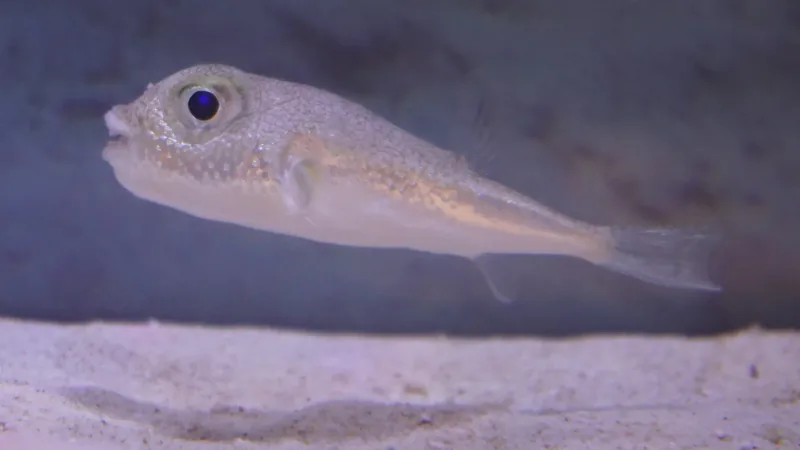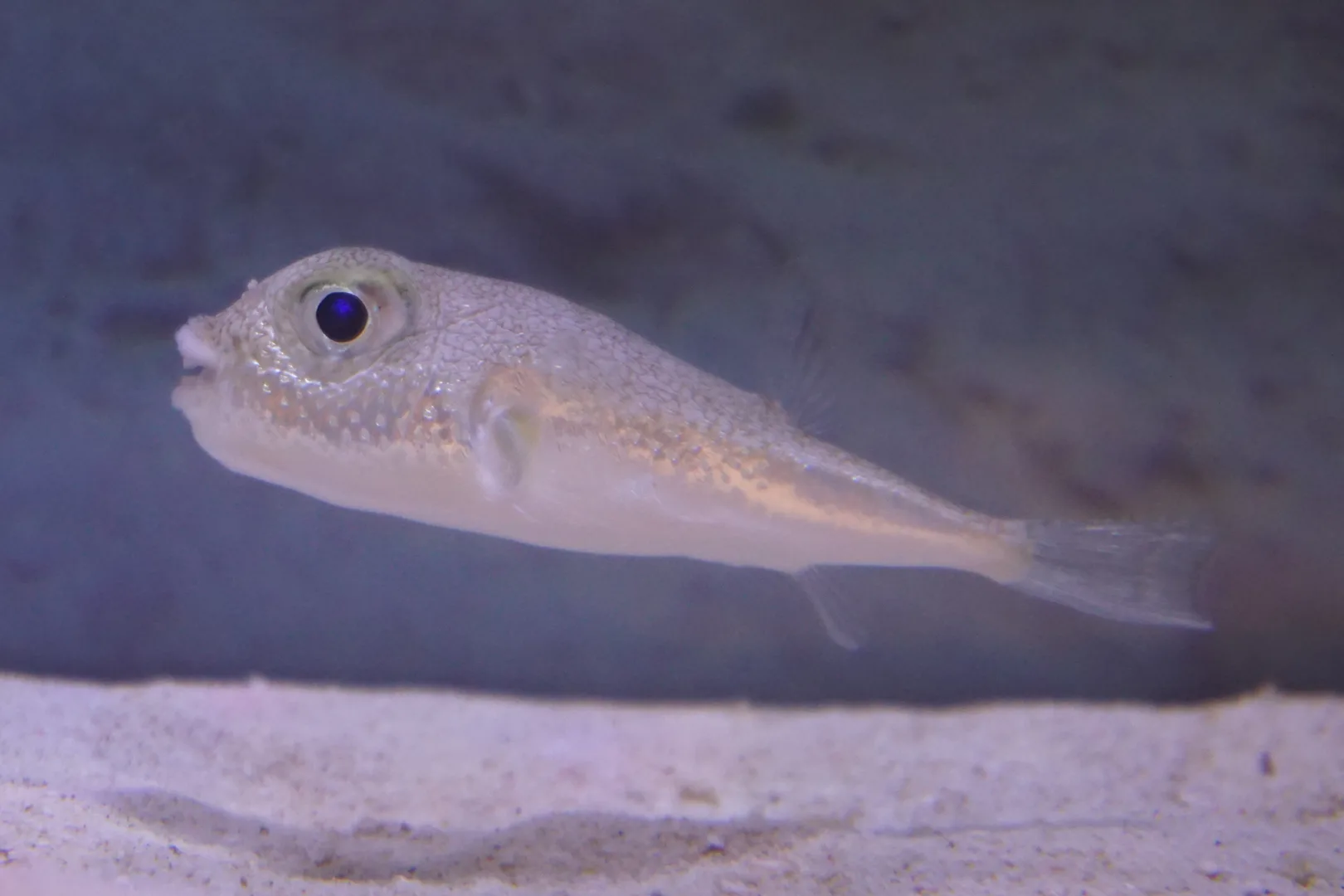
White-spotted pufferfish (Torquigener albomaculosus) in an aquarium in Japan.
Field
notes
A Crop Circle Under the Sea
In 1995, divers off Amami-Oshima, an island in southern Japan, found a geometric circle about 2 meters across on the sandy seabed. Nobody knew what made it, and the divers named it a “mystery circle.” In 2011, scientists first caught the builder at work. It was a male white-spotted pufferfish (Torquigener albomaculosus), about 120 millimeters long. FishBase gives a maximum of 12.0 cm total length for a male and 9.1 cm standard length (snout to tail base) for a female.
About 10,000 Digs
The male starts by pushing his belly into the sand to mark the center. Then he swims in straight lines from the outside toward the middle, digging with his pectoral, anal and tail fins. One study estimated about 10,000 digs for a whole nest. The job takes 7 to 9 days, and the finished circle has a radius of 79 to 105 centimeters. Each valley is as wide as the male’s body, and a flat central zone of 31 to 50 centimeters in radius is left in the middle.
A computer simulation built from a male’s recorded digs reproduced the radial ditches of the outer ring, suggesting that simple repeated moves can make the pattern.
Decorated for a Date
Near the end, the male places shell and coral fragments on the ridges. He also flaps his anal fin over the center to draw an irregular pattern in fine sand, which the ridges help funnel inward. Females were seen visiting only at this final stage. As one approaches he stirs up the sand, and when she enters he rushes at her several times. She stays about a minute, and often comes back. The eggs are released in the center. In 2013 the researchers wrote that three features of this nest had never been reported in any fish: ridges built around the nest site, shell decorations on them, and a pattern of fine sand in the middle.
Built to be wrecked After spawning, the male stays 6 days to care for the eggs and does no repairs. Currents smooth the circle almost flat. No male in the study went back to an old nest: each built a new one at a separate site.
A Very Small Neighborhood
When the first study came out in 2013, this fish had been found only off southern Amami-Oshima, in small numbers and in very restricted areas. FishBase now adds another population at around 30 meters off the island’s north. Divers have seen it at 10 to 27 meters on sandy bottom. In a flow experiment on a half-scale model of a circle, the current in the center was 24.2% lower than outside.
Published Updated
Traits
Intel
& FAQ
Guess
first
How big is a White-Spotted Pufferfish, really? Slide, lock in, and see what the sources say. Every answer is a figure from this page, quoted from where it came from.
Sources
- 01Kawase, Okata & Ito (2013). Role of Huge Geometric Circular Structures in the Reproduction of a Marine Pufferfish. Scientific Reports.
- 02Mizuuchi et al. (2018). Simple rules for construction of a geometric nest structure by pufferfish. Scientific Reports.
- 03Torquigener albomaculosus, White-spotted pufferfish. FishBase.
What the sources say: 55 claims checked word for word against these sources →