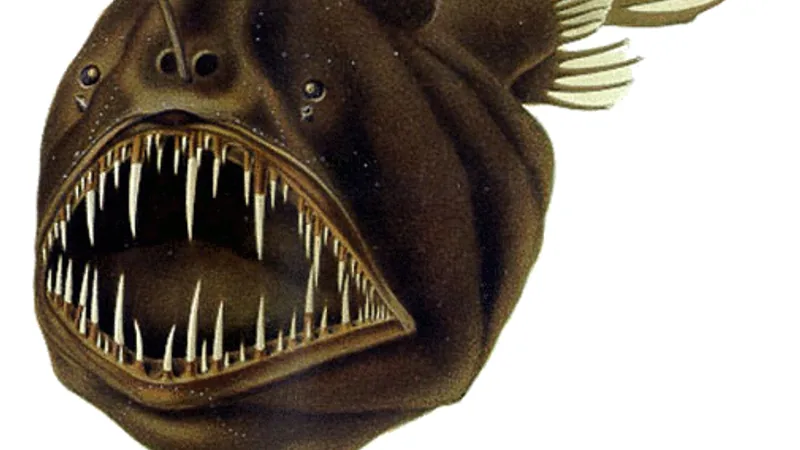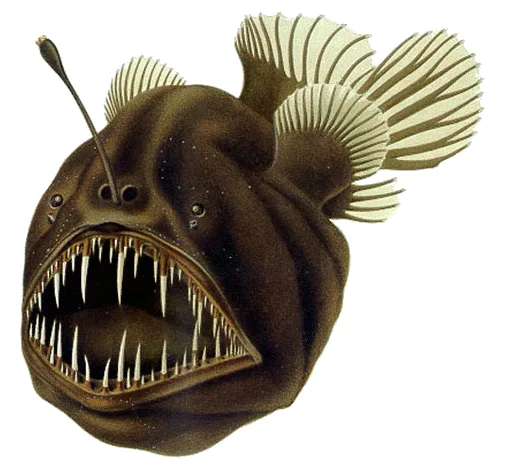
Melanocetus johnsonii, painted for August Brauer's Die Tiefsee-Fische (1906). No freely licensed photograph of a living humpback...
Field
notes
A lure in the dark
The female humpback anglerfish is a soft-bodied fish with no scales and no pelvic fins. Live fish are black, and the genus name Melanocetus comes from Greek words for “black” and “large sea creature”. She has a large head, a big mouth and long pointed teeth. On her snout sits a short rod called an illicium, tipped with a bulb called an esca.
She belongs to the ceratioids, a group of deep-sea anglerfishes. Ceratioids have a bacterial light organ that serves as bait to attract prey.
Small male, bigger female
Males and females look very different. Females grow to 18 cm. Males are slender, have no lure and only reach 2.9 cm. They are also dwarfed and non-parasitic, meaning they do not live off the female.
Her eggs are presumably held in floating gelatinous rafts. The larvae are planktonic, which means they drift with the plankton, and they are found mostly in the top 100 m of water.
Swallowing fish bigger than herself
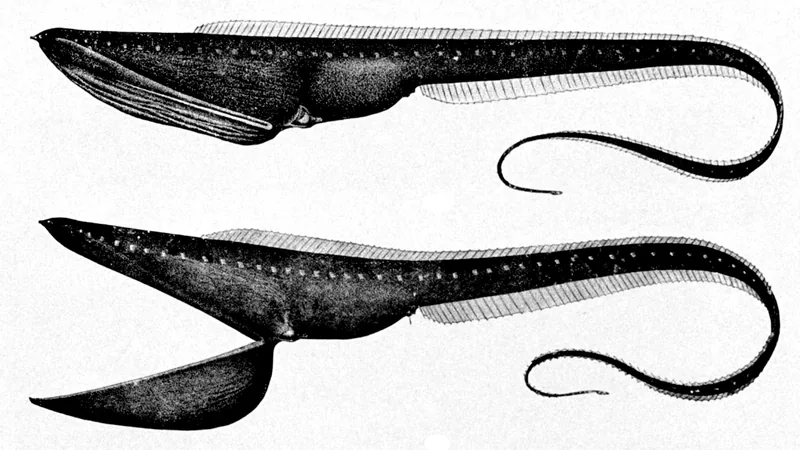
The species is capable of catching and swallowing prey larger than itself. FishBase gives one case: a 6.6 cm individual with a Chauliodus of about 24 cm in its stomach, more than three times its length.
The original fish Albert Günther described the species in 1864 from a 64 mm female that James Yates Johnson brought from Madeira. Its big belly held a fish, rolled into a ball, nearly twice the length of the anglerfish. Günther named it for Johnson.
From Madeira to the Ross Sea
The species lives in tropical to temperate parts of all oceans. It is usually found between 100 and 1,500 m, with a recorded range of 100 to 4,500 m. In Australia it is known off central to southern New South Wales and near Norfolk Island.
In 2014 one turned up in the stomach of a 138 cm Antarctic toothfish in the Ross Sea, the first record in Antarctic waters. The toothfish was caught on a bottom longline at 1,243 to 1,355 m. Scientists confirmed the anglerfish’s identity from the structure of its esca and from a gene called COI. The anglerfish measured 157 mm and weighed 290 g. The IUCN Red List rates the species Least Concern.
Published
Traits
Intel
& FAQ
Guess
first
How big is a Humpback Anglerfish, really? Slide, lock in, and see what the sources say. Every answer is a figure from this page, quoted from where it came from.
Sources
- 01Humpback Blackdevil, Melanocetus johnsonii Gunther, 1864. Australian Museum.
- 02Melanocetus johnsonii, Humpback anglerfish. FishBase.
- 03Orlov et al. (2015). First record of humpback anglerfish (Melanocetus johnsonii) (Melanocetidae) in Antarctic waters. Polar Research.
- 04Pietsch (2009). Oceanic Anglerfishes: Extraordinary Diversity in the Deep Sea, Introduction and Historical Perspective. University of California Press.
- 05Hendry et al. (2018). Ongoing Transposon-Mediated Genome Reduction in the Luminous Bacterial Symbionts of Deep-Sea Ceratioid Anglerfishes.
- 06Arnold (2015). Melanocetus johnsonii. The IUCN Red List of Threatened Species 2015: e.T18127840A21911455.
What the sources say: 51 claims checked word for word against these sources →