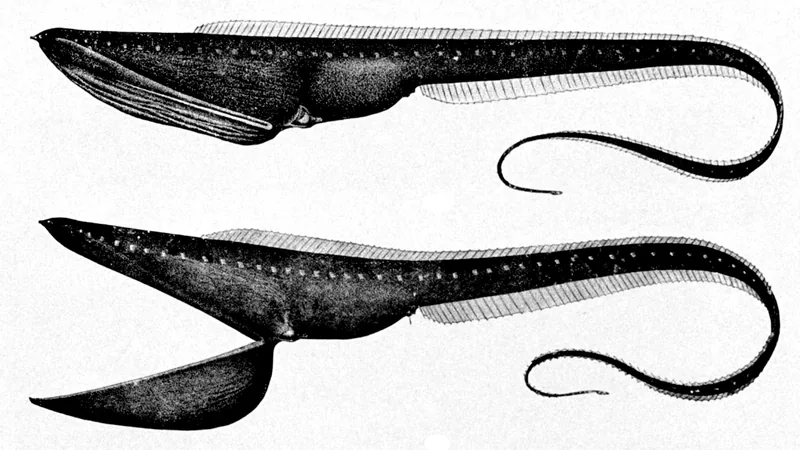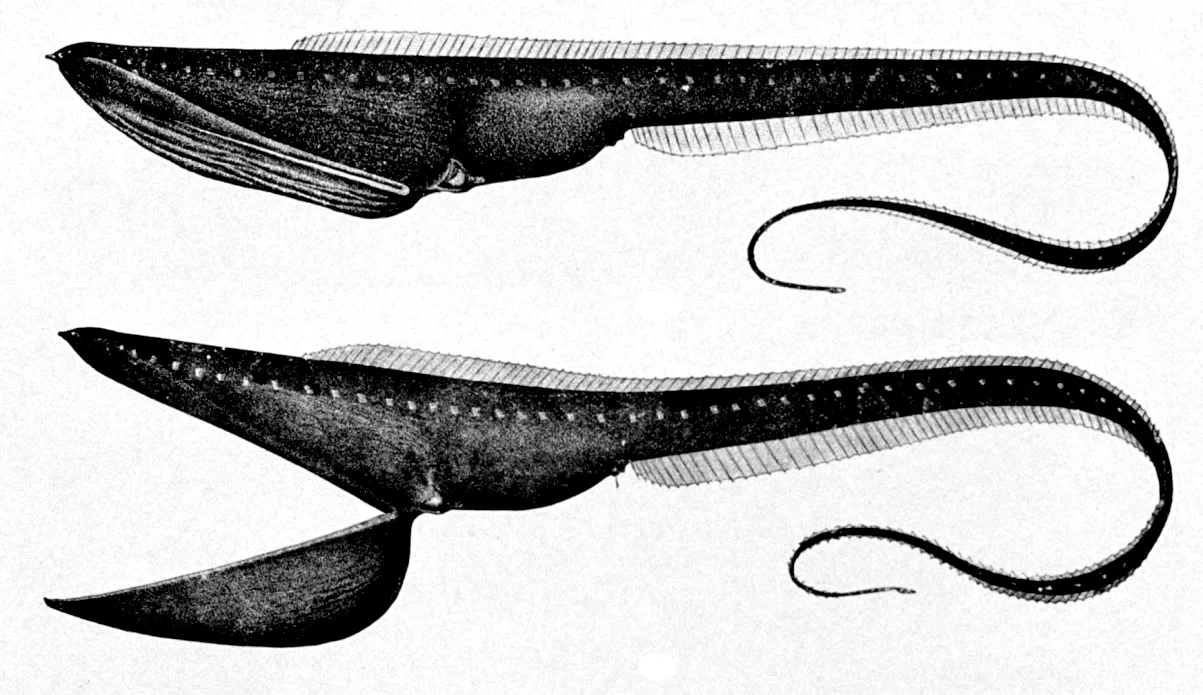
The head and gills of a pelican eel, photographed for a 2018 study of deep-sea eels.
Field
notes
A Mouth Built Like a Trap
The gulper eel, also called the pelican eel (Eurypharynx pelecanoides), has a mouth greatly enlarged by jaws that extend backward. It can grow to 1 meter long, though 55 centimeters is a more common length. Its gape is half or more of the length from its snout to its vent (its rear opening), and the inside of its mouth can stretch enormously. A 1989 study of 760 Atlantic specimens judged that huge gape unsuitable for sucking prey in. Instead, the researchers proposed, the eel thrusts its head forward, and the water pressure this creates expands its mouth to several times the volume of the eel itself.
An Origami Trick
Robot designers have copied that mouth. Their 2019 paper describes it changing shape in two steps: it first unfolds and then inflates, to give the eel the best chance of engulfing its prey. Their design uses stretchable origami units that imitate the pelican eel’s stretchable, foldable frames, and the team built an artificial pelican eel that reproduced the same two-step move.
Life in the Deep
Gulper eels live in tropical and temperate oceans worldwide, between about 500 and 7,625 meters down, though they usually stay around 1,200 to 1,400 meters. In the eastern Pacific they range from northern California to Peru. In the 1989 study, stomachs from 120 eels held a varied diet led by crustaceans, fish and squid, and often Sargasso weed too, which the researchers took as a sign that the eel does not pick and choose what it swallows. Its forward-facing eyes appear to give it depth vision for locating prey, possibly helped by its well developed lateral line, the sense organ along a fish’s sides that detects movement in the water. Instead of pores, the gulper eel’s lateral line has groups of raised tubes.
One Shot Only Gulper eels and the related deep-sea eels in their group all spawn just once in their lives. In the 1989 study, ripening fish, males especially, changed in some body features, a sign of that single breeding. Breeding only once seems to be the rule among eels in general.
Odd Genes, Drifting Larvae
Even its genes are unusual. Most vertebrates arrange the genes in their mitochondria, the energy-producing parts of cells, in the same order, but a 2018 study found that the gulper eel’s family and four related deep-sea eel families each have an order of their own. Its eggs hatch into drifting larvae called leptocephali. Researchers conclude that the species spawns in the Sargasso Sea, where its larvae are often caught, small ones included. The IUCN rates it Least Concern, and it is of no interest to fisheries.
Published Updated
Traits
Intel
& FAQ
Guess
first
How big is a Gulper Eel (Pelican Eel), really? Slide, lock in, and see what the sources say. Every answer is a figure from this page, quoted from where it came from.
Sources
- 01Eurypharynx pelecanoides. FishBase.
- 02Nielsen, Bertelsen & Jespersen (1989). The Biology of Eurypharynx pelecanoides (Pisces, Eurypharyngidae). Acta Zoologica.
- 03Kim et al. (2019). Bioinspired dual-morphing stretchable origami. Science Robotics.
- 04Poulsen et al. (2018). Resolving deep-sea pelagic saccopharyngiform eel mysteries: Identification of Neocyema and Monognathidae leptocephali and establishment of a new fish family "Neocyematidae" based on larvae, adults and mitogenomic gene orders. PLOS ONE.
- 05Iwamoto (2015). Eurypharynx pelecanoides. The IUCN Red List of Threatened Species 2015: e.T18227119A42691734.
What the sources say: 47 claims checked word for word against these sources →