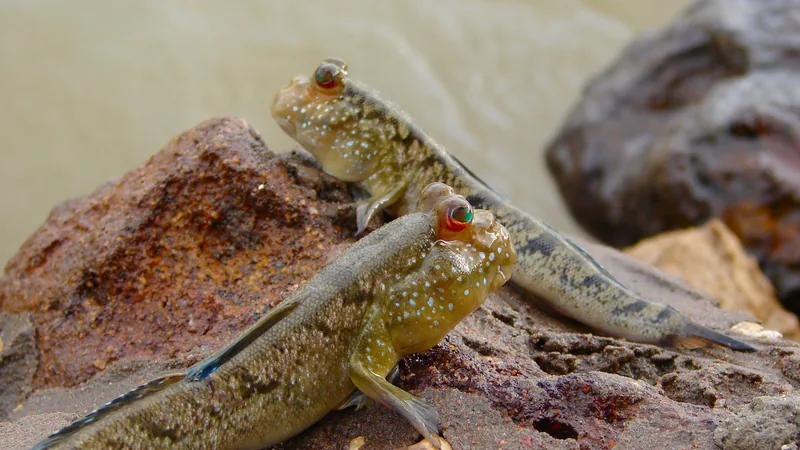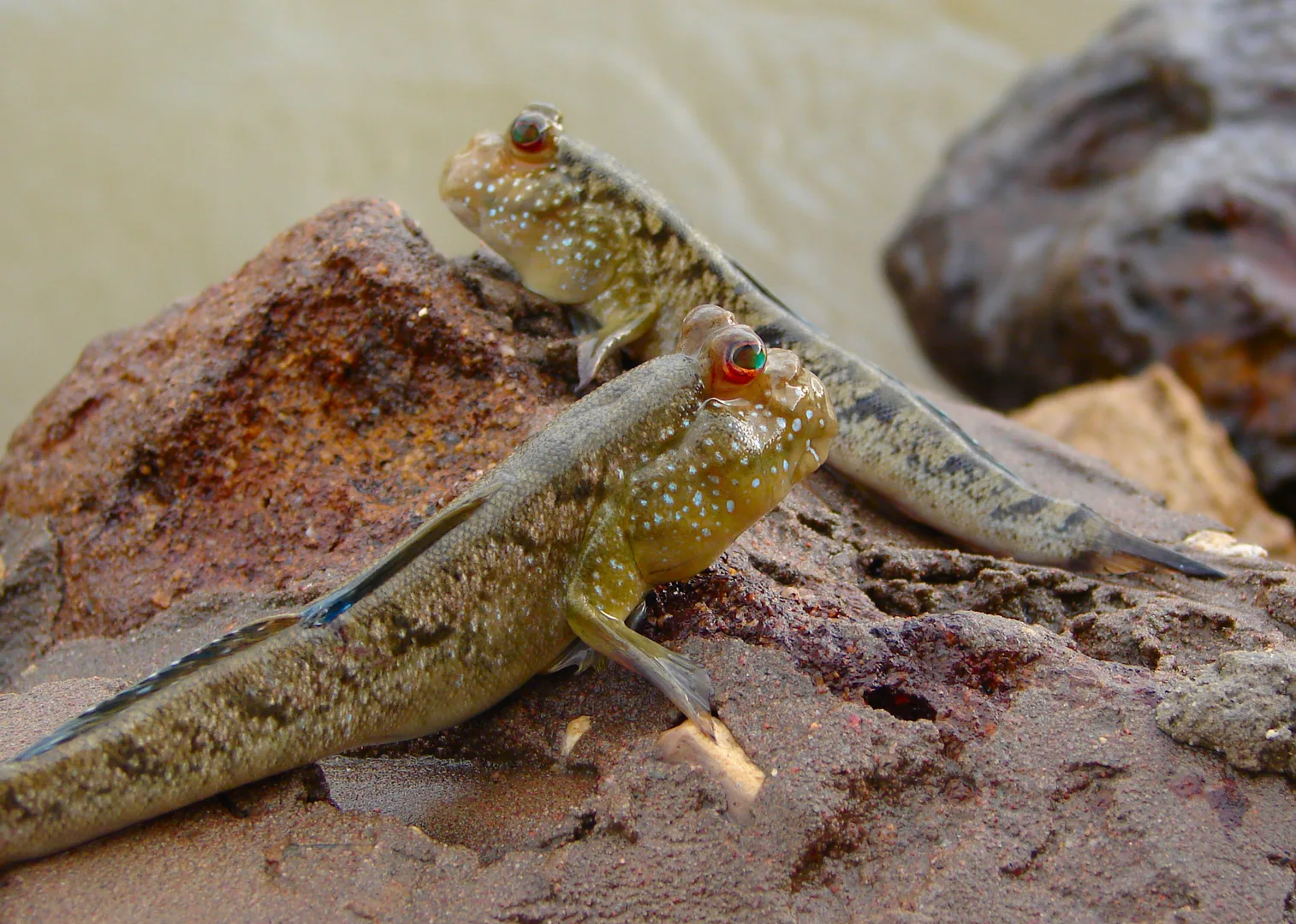
Atlantic mudskippers in the Gambia.
Field
notes
A fish that blinks
Most tetrapods, the four-limbed vertebrates, blink. Mudskippers are fish that evolved blinking separately, and the Atlantic mudskipper does it on land. To blink, it pulls its eye down into a space below the eye socket while a membrane called the dermal cup rises. When researchers raised the evaporation rate in its tank about 30 times, the fish blinked more often, which fits the idea that a blink keeps the eye wet. A single blink can also fully clean the cornea, the clear front of the eye, of particles. Mudskippers have not evolved new muscles or glands for blinking.
Blink timing Twelve spontaneous blinks from four mudskippers lasted 480 to 700 ms, averaging 560 ms, about the same as a human’s 572 ms.
Walking to dinner
The mudskipper is an amphibious air-breather that skips or walks across sand and mud in search of food. Its pectoral fins have a long muscular lobe, and its eyes bulge out close together. Adults feed chiefly on arthropods from the mud surface, such as crabs and insects, and the fish feeds mostly on land.
Aquatic vertebrates generally feed by sucking water into the mouth. On land the mudskipper uses what researchers call a hydrodynamic tongue: water in its mouth flows forward as the mouth opens and helps it feed. On land it raises and then drops the floor of its mouth, a movement kept from the way it uses water in its mouth underwater. Just before it feeds in water its gill slits open; on land they stay closed. It can also hold a little water and air in its mouth while out of the water, with the gill lid shut.
Size and range
FishBase gives a maximum length of 14.7 cm standard length, measured from the snout to the end of the backbone, and a length at first maturity of about 9.6 cm. Over a year of trapping in Nigeria’s New Calabar River, 1,572 fish of 4.1 to 14.2 cm total length weighed 0.70 to 39.62 g.
Its range is the West African coast from Senegal to Angola. It lives on muddy ground in brackish estuaries, lagoons and mangrove swamps, and it spawns in burrows. The IUCN Red List rates it Least Concern, assessed in 2019.
Published
Traits
Intel
& FAQ
Guess
first
How big is a Atlantic Mudskipper, really? Slide, lock in, and see what the sources say. Every answer is a figure from this page, quoted from where it came from.
Sources
- 01Diouf et al. (2020). Periophthalmus barbarus. The IUCN Red List of Threatened Species 2020: e.T182285A21913503.
- 02Aiello et al. (2023). The origin of blinking in both mudskippers and tetrapods is linked to life on land. Proceedings of the National Academy of Sciences.
- 03Michel, Aerts & Van Wassenbergh (2016). Environment-dependent prey capture in the Atlantic mudskipper (Periophthalmus barbarus). Biology Open.
- 04Kuciel (2012). The mechanism of olfactory organ ventilation in Periophthalmus barbarus (Gobiidae, Oxudercinae). Zoomorphology.
- 05Chukwu & Deekae (2011). Length-weight relationship, condition factor and size composition of Periophthalmus barbarus (Linneaus 1766 ) in New Calabar River, Nigeria. Agriculture and Biology Journal of North America.
- 06Periophthalmus barbarus (Linnaeus, 1766), Atlantic mudskipper. FishBase.
What the sources say: 57 claims checked word for word against these sources →