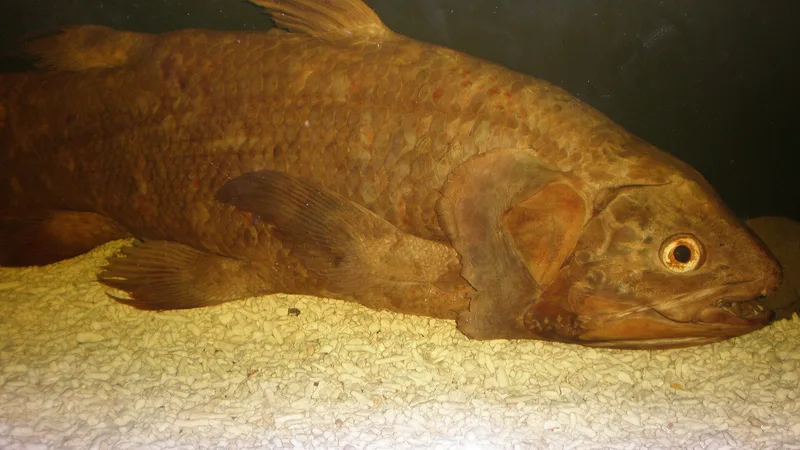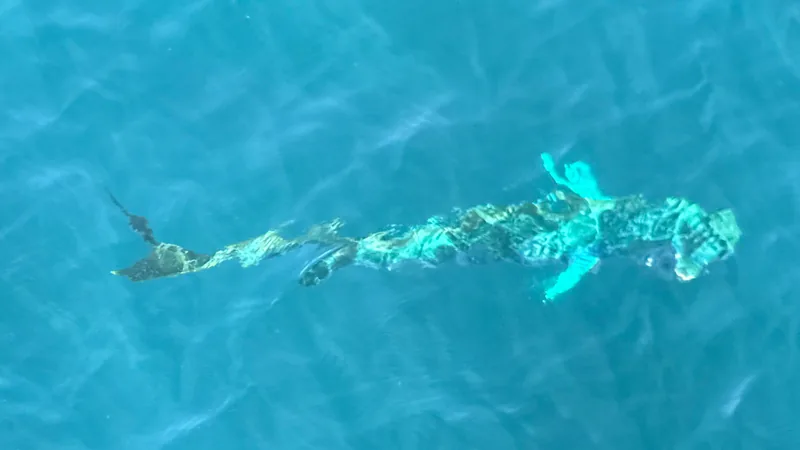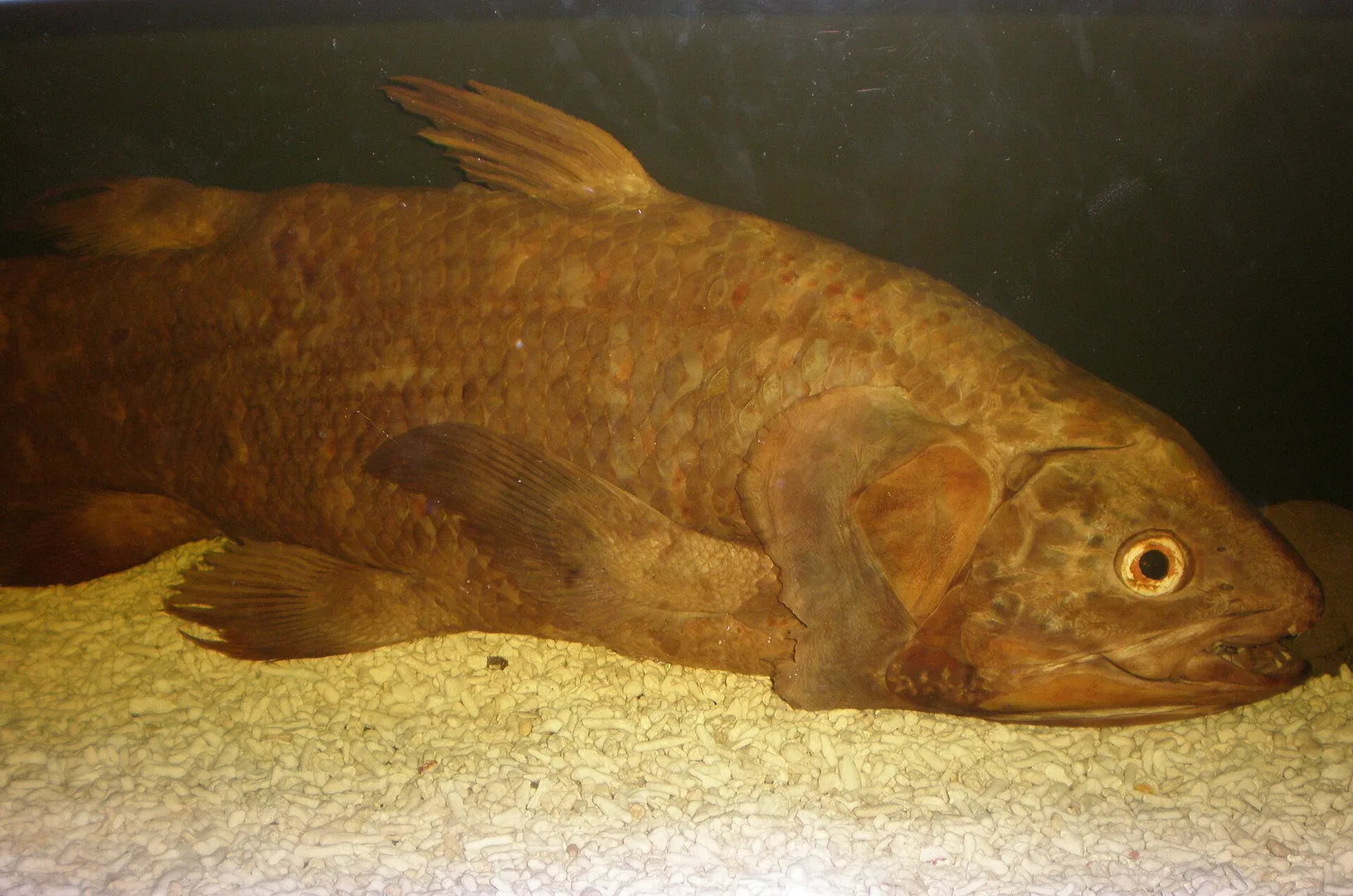
A live coelacanth 69 m deep off Pumula on the KwaZulu-Natal South Coast, South Africa, in November 2019
Field
notes
Back From the Dead
Biologists once believed the coelacanth had died out in a mass extinction around 65 million years ago, because it disappears from the fossil record after the Late Cretaceous period. Then, on 22 December 1938, a trawler working off East London, South Africa, hauled up a living one, a find later called one of the greatest zoological discoveries of the 20th century. It took almost 15 years for a second one to turn up, in the Comoros Islands, where more than 200 had been recorded by 2020.
Deep-Water Basics
A coelacanth (Latimeria chalumnae) can grow up to 2 meters (6.5 feet) long. Females are larger than males, which rarely grow past 150 centimeters, and one of the largest on record, a female caught off Mozambique in 1991, measured 179 centimeters and weighed 98 kilograms. A 2021 study of yearly growth rings on the scales of 27 coelacanths found it is among the longest-lived fish species, with a lifespan of probably around 100 years. The only two earlier studies had suggested a maximum lifespan of 20 years, an underestimate by a factor of five. Males reach maturity between 40 and 69 years old, and females between 58 and 66.
A Very Long Pregnancy Females give birth to live young after carrying them for around five years, possibly the longest gestation of any vertebrate. The 98-kilogram female caught off Mozambique was carrying 26 pups.
A Living Fossil’s Toolkit
Its body looks much like coelacanth fossils at least 300 million years old, which is why it earned the nickname “the living fossil.” Its fins are fleshy and lobed, and it moves the front and back pairs in a diagonal rhythm, like the legs of a four-legged land animal. Scientists long debated whether the coelacanth or the lungfish is the closest living fish relative of tetrapods, the four-limbed land animals. A 2013 study of its genome concluded that it is the lungfish, and found that the coelacanth’s protein-coding genes have changed at about half the rate of those in tetrapods since the two lineages split. In its snout sits a rostral organ believed to sense electric fields. A joint at the back of its skull lets it open its upper and lower jaws at the same time, and among living vertebrates only coelacanths have one.
Hanging by a Thread
At night the coelacanth is a slow drift-hunter, eating cephalopods, eels, cuttlefish and deepwater fish. From the few feeding observations so far, it seems not to chase prey but to snap up anything of a suitable size that passes within 20 centimeters of the front of its mouth. In the Comoros it spends the day in caves roughly 100 to 200 meters down, while off South Africa a diver saw one at about 54 meters. By 2020 the species had also been recorded off Tanzania (over 70 fish), Madagascar (over 13), and Kenya and Mozambique (one each), and a colony was discovered off South Africa in 2000. It is rated Critically Endangered on the IUCN Red List, in an assessment that dates from 2000. Getting caught by accident in fishing gear has historically been its biggest threat, and the 2021 scale study warned that its long, slow life means it may be more threatened than previously thought. In 2016 the United States listed the Tanzanian population as Threatened under the Endangered Species Act.
Published Updated
Traits
Intel
& FAQ
Guess
first
How big is a Coelacanth, really? Slide, lock in, and see what the sources say. Every answer is a figure from this page, quoted from where it came from.
Sources
- 01African Coelacanth. NOAA Fisheries.
- 02Latimeria chalumnae (coelacanth). Animal Diversity Web, University of Michigan.
- 03Fraser et al. (2020). Live coelacanth discovered off the KwaZulu-Natal South Coast, South Africa. South African Journal of Science.
- 04Amemiya et al. (2013). The African coelacanth genome provides insights into tetrapod evolution. Nature.
- 05Nikaido et al. (2013). Coelacanth genomes reveal signatures for evolutionary transition from water to land. Genome Research.
- 06Mahé, Ernande & Herbin (2021). New scale analyses reveal centenarian African coelacanths. Current Biology.
- 07Musick (2000). Latimeria chalumnae. The IUCN Red List of Threatened Species 2000: e.T11375A3274618.
What the sources say: 53 claims checked word for word against these sources →