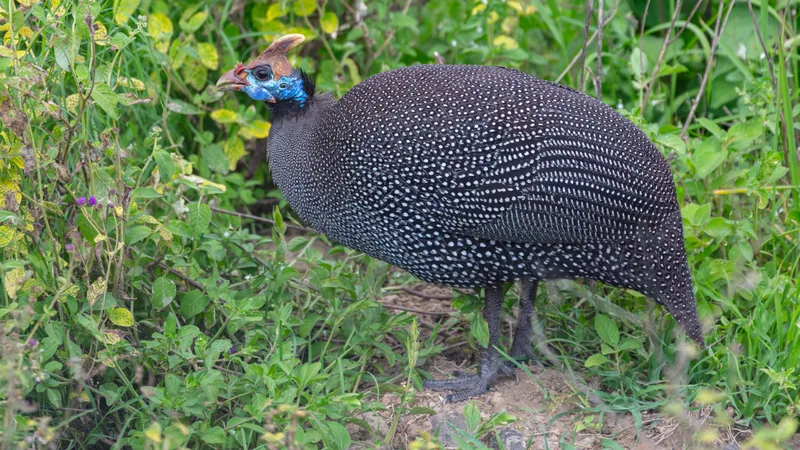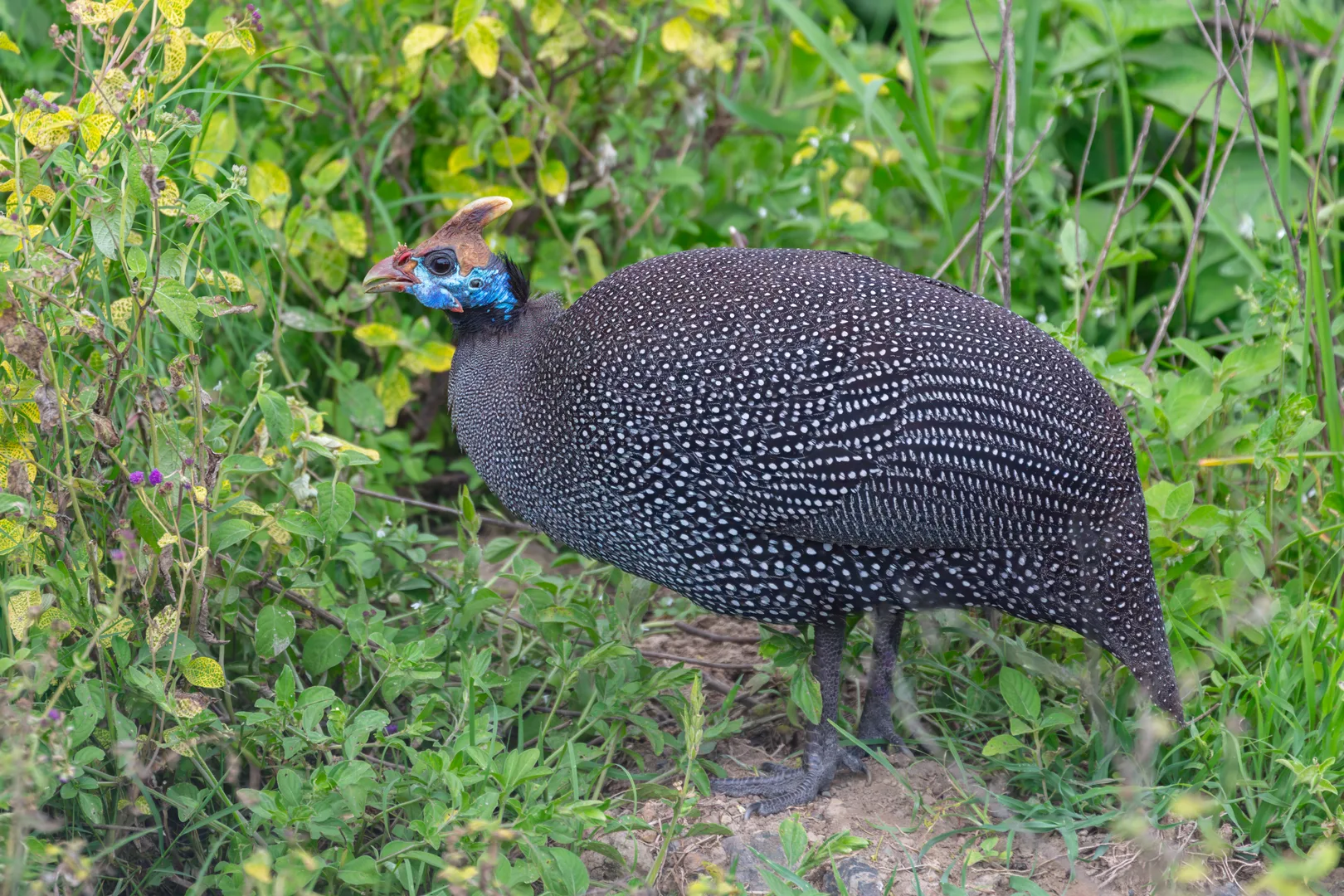
Helmeted guineafowl ( Numida meleagris ), Lake Nakuru National Park, Kenya
Field
notes
A hidden drop in the track
The helmeted guineafowl, Numida meleagris, is a ground bird with a body shaped like a chicken’s. It lives across most of sub-Saharan Africa, from Senegal in the west to Eritrea at the northern edge of its range, and south to South Africa. Scientists have put it through a tough running test.
Surprise drop test Researchers camouflaged a drop in the running surface so the birds had no visual cue about the drop. The guinea fowl stumbled only once in 19 unexpected drops, and did not fall. When the drop was in plain sight, they stumbled in 4 of 20 trials and fell twice.
A second study found that adjusting the limb’s angle as it touches down explains 80% of the variation in how hard the limb is loaded after the drop. X-ray video of guineafowl skeletons shows that below 2.0 metres per second there is no aerial phase, a moment with both feet off the ground.
Helmet, speckles and a big voice
Males and females both have a bony “helmet” on the crown of the head, called a casque. Male casques are usually larger. The sides of the head, down to the middle of the neck, are bare and sky blue to dark blue. The body feathers are black to dark grey with white speckles, and one feather can carry a dozen or more of them.
An adult weighs 1,134 to 1,842 grams, which is about 40 to 65 ounces.
The alarm call is a very loud, harsh, repeating rattle, written as “kek-kek-kek-kek-krrrrrrrrr”. Calls grow louder and faster when the birds are excited or sense danger, and the harsh, dry calls can carry vast distances.
Flocks, ticks and enemies
By day the birds forage on the ground in flocks, and some flocks hold up to 100 birds. At night they roost in trees. They eat grass seeds, roots and fruit, and also snails, beetles, ticks, frogs, small lizards and small mice. They swallow small pebbles for their gizzards, the muscular part of a bird’s stomach that grinds food.
They have been known to eat deer ticks that carry Lyme disease, and they are used as tick and insect control in farm fields. Their known predators include leopards, servals, crocodiles, snakes and martial eagles.
Eggs, keets and a record age
A female digs a scrape in thick plants and lays around six to fifteen eggs in it, then sits on them for up to thirty days. The chicks are called keets, and they are fledged in four weeks.
A note published in 2016 gave the species’ longevity record as a ringed bird caught again 9 years, 2 months and 5 days after it was ringed. The IUCN Red List rated the species Least Concern in 2018.
Published
Traits
Intel
& FAQ
Guess
first
How big is a Helmeted Guineafowl, really? Slide, lock in, and see what the sources say. Every answer is a figure from this page, quoted from where it came from.
Sources
- 01Numida meleagris. Animal Diversity Web, University of Michigan.
- 02AnAge entry for Numida meleagris. AnAge: The Animal Ageing and Longevity Database, Build 15, Human Ageing Genomic Resources.
- 03Oschadleus, Schultz & Schultz (2016). Longevity of the Helmeted Guineafowl Numida meleagris. Biodiversity Observations.
- 04Daley et al. (2006). Running over rough terrain: guinea fowl maintain dynamic stability despite a large unexpected change in substrate height. Journal of Experimental Biology.
- 05Daley & Biewener (2006). Running over rough terrain reveals limb control for intrinsic stability. Proceedings of the National Academy of Sciences.
- 06Gatesy (1999). Guineafowl hind limb function. I: Cineradiographic analysis and speed effects. Journal of Morphology.
- 07Numida meleagris. The IUCN Red List of Threatened Species 2018: e.T22679555A132052202.
What the sources say: 44 claims checked word for word against these sources →