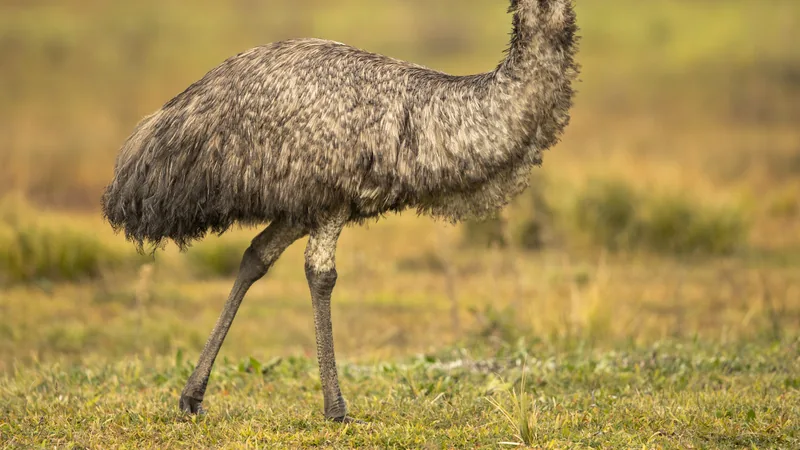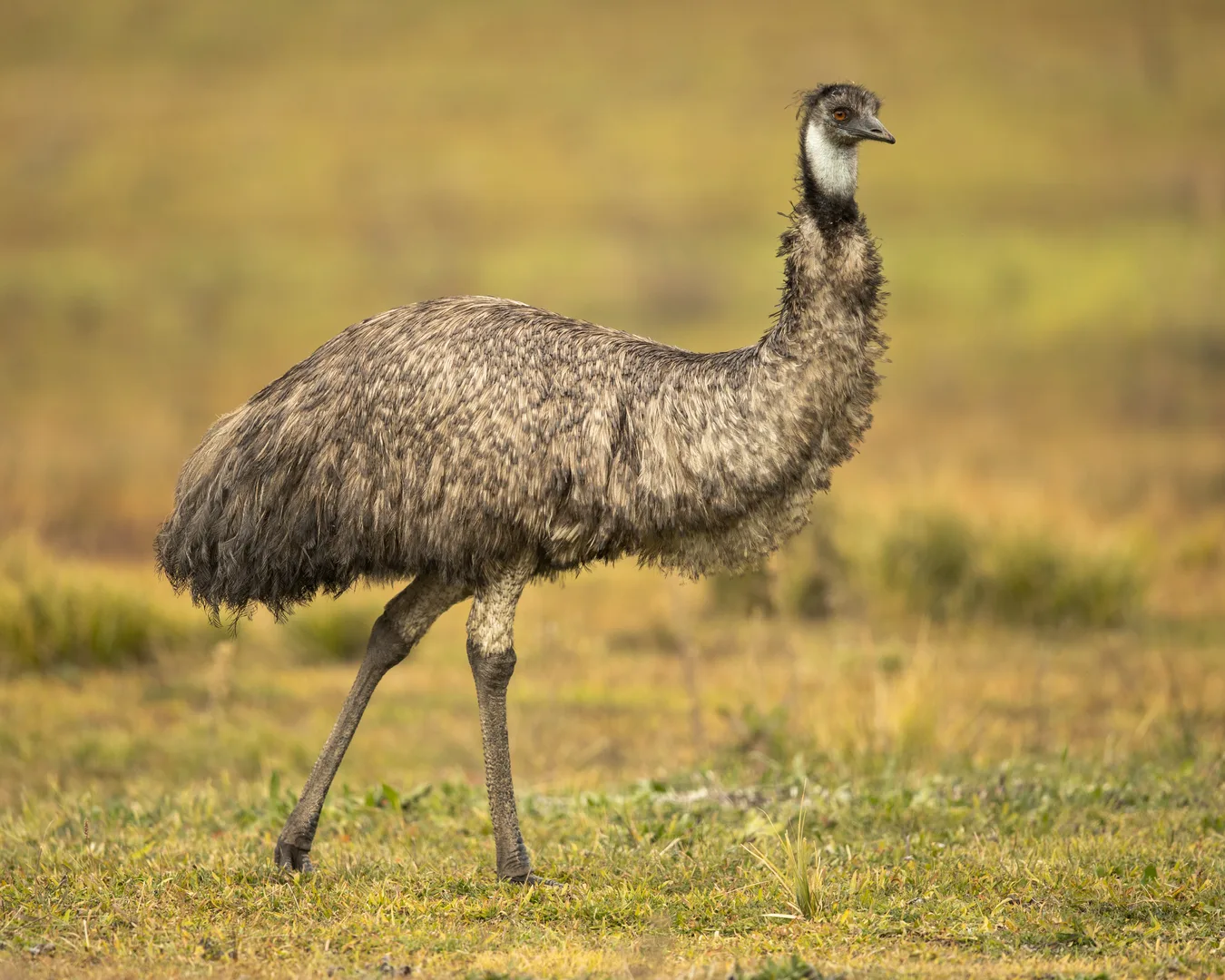
Emu ( Dromaius novaehollandiae ), Tidbinbilla, Australian Capital Territory, Australia
Field
notes
Built to run, armed to kick
The emu is the second-largest living bird, after the ostrich. An adult stands 1.5 to 1.9 m tall. Females are larger and heavier than males: the Smithsonian puts males at 50 to 55 kg and females about 5 kg more. The wings are tiny, under 20 cm long, and useless for flight. The legs do the work. Each foot has three toes and fewer bones and muscles than a flying bird’s, and an emu can sprint at 48 km/h for quite a distance. One stride can be almost 2.7 m long. An emu can also jump 2.1 m straight up.
If it must defend itself, it strikes and rips with heavy feet and nails. A hiss warns off dingoes, and it can rattle its stiff tail feathers to scare predators away.
Two shafts per follicle Feathers grow from follicles, just like hairs. Most birds grow one feather per follicle, but an emu grows a double-shafted feather from each one. Its barbs sit far apart and lack the usual hooks that attach to the other barbs. Each hangs loose and gives the plumage a hairlike look.
The dad who sits for eight weeks
The female lays 5 to 15 dark green eggs in a nest of twigs, leaves and grass on the ground, then wanders off. One egg equals 10 to 12 chicken eggs in weight and volume.
The male does the sitting. For about eight weeks he gets up only to turn the eggs and tidy the nest. During incubation he does not eat, drink or defecate, and he can lose up to one-third of his body weight. He stays alive on stored fat. The chicks hatch striped in black, brown and cream, which helps them blend into long grass, and they can walk minutes after hatching. The father stays with them for about five to seven months.
Following the rain
Emus live across most of mainland Australia and nowhere else. They use eucalyptus forest, woodland, heathland, shrubland and sand plains, and reach deserts only after heavy rain. They eat fruit, seeds, young shoots, insects, small animals and even animal droppings. They also swallow pebbles of up to 45 g, which help grind food.
Flocks often travel long distances for food and water. Emus can move hundreds of kilometres, sometimes 15 to 25 km a day, and they seem to steer mainly by the sight of rain-bearing clouds. Seeds swallowed whole often come out whole. Wandering emus spread the seeds of many low-growing plants as they go.
They talk with a pouch in the throat that is part of the windpipe. Inflated, it makes deep booming and drumming sounds that carry up to 2 km.
In the wild an emu lives five to ten years, and longer in human care.
Published
Traits
Intel
& FAQ
Guess
first
How big is a Emu, really? Slide, lock in, and see what the sources say. Every answer is a figure from this page, quoted from where it came from.
Sources
- 01Emu. San Diego Zoo Wildlife Alliance.
- 02Emu. Smithsonian's National Zoo and Conservation Biology Institute.
- 03Boles. Emu. Australian Museum.
- 04Shorter. Dromaius novaehollandiae (emu). Animal Diversity Web, University of Michigan.
- 05Dromaius novaehollandiae. The IUCN Red List of Threatened Species 2018: e.T22678117A131902466.
What the sources say: 70 claims checked word for word against these sources →