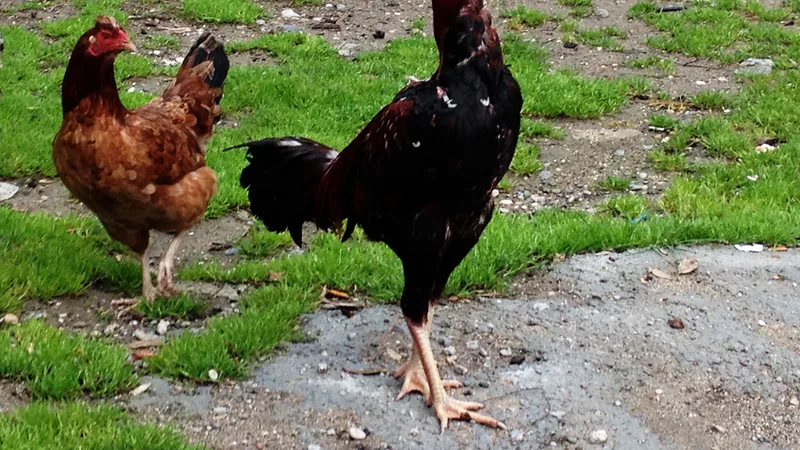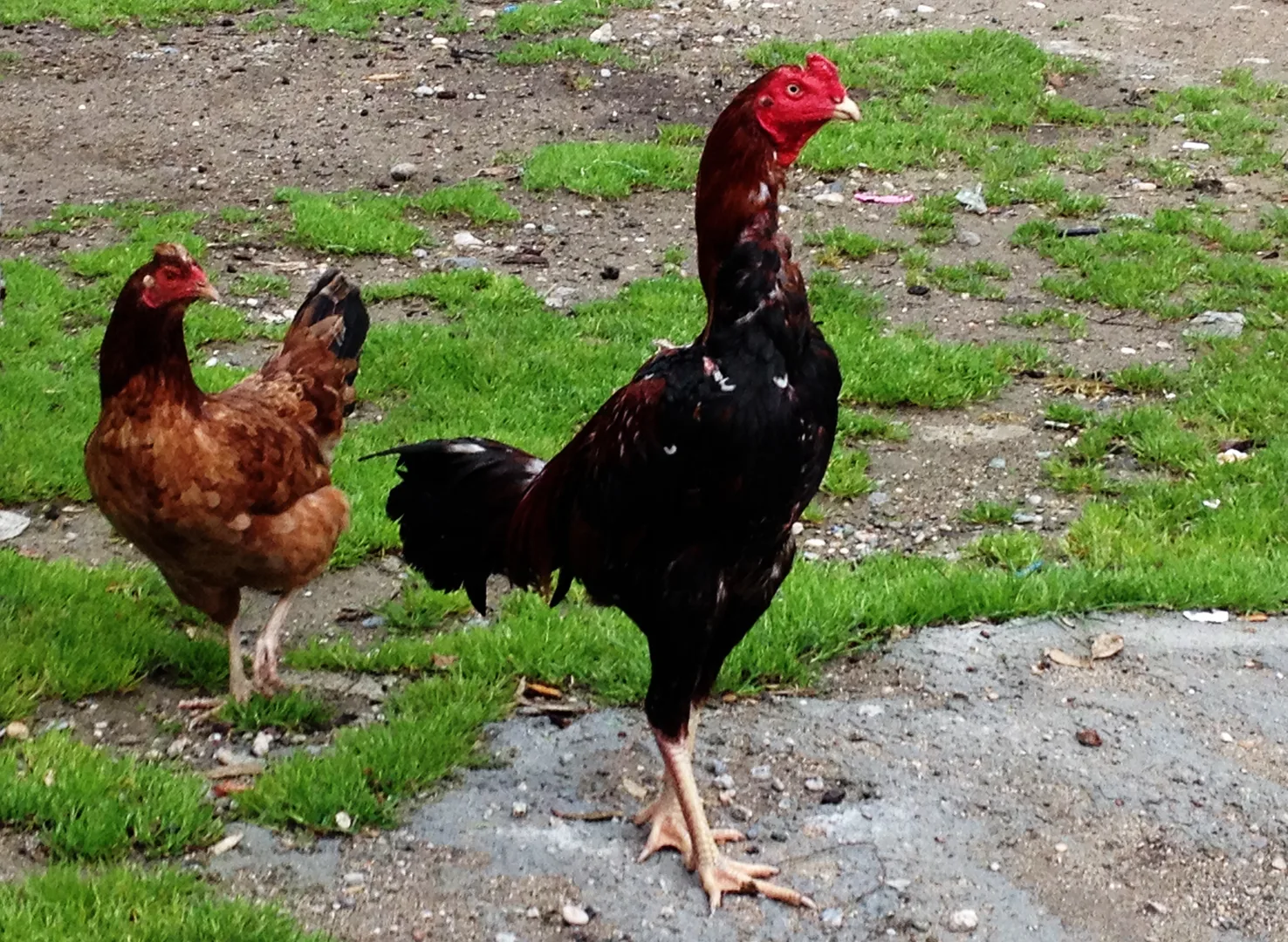
A hen and chicken of local breeds in Sarıçam - Adana, Turkey.
Field
notes
A Toothless Bird That Chews With Muscle
The chicken (Gallus gallus domesticus) has no teeth. Its gizzard, a stomach chamber made of two sets of strong muscles, acts as the bird’s teeth. Free-ranging chickens typically eat small stones, and the gizzard grinds them into tiny pieces. Grains such as corn, wheat and barley are important sources of the carbohydrates in poultry diets. Chickens have four claws on each foot, used to scratch into the earth to find food.
Exact size varies greatly among breeds. Raised with good care, the fastest-growing meat birds, the Cornish Cross (a Cornish chicken crossed with a White Rock), weigh 4 to 6 pounds at about seven weeks and 6 to 10 pounds at eight to 12 weeks. The average lifespan of a chicken is seven to eight years.
The 26-hour egg clock A hen usually lays one egg every 26 hours. Ovulation, the ovary’s release of an egg cell, almost never happens after 3:00 p.m. A hen that lays too late in the day skips a day.
Ruled by a Pecking Order
Chickens are diurnal, meaning active by day, and social. A flock is one rooster with several hens. Chicks typically show no competitive behavior until after three days of age, and fighting to set the pecking order, the flock’s social ladder, begins by 16 days.
The ladder even decides who crows first. In a 2015 study of small groups, the top-ranking rooster almost always started to crow first each morning, followed by lower-ranking roosters in descending order of rank. A rooster’s crow is a shrill call used to communicate territory to other males. Hens will not crow, but may cluck to talk to chicks or after laying an egg.
From Junglefowl to Farmyard
Domestic chickens are a subspecies of the red junglefowl, a species native to southern Asia. One of the most striking selective sweeps, where a favourable gene variant spreads through a population, was found in all domestic chickens. It sits at the locus for the thyroid stimulating hormone receptor, which is involved in metabolic regulation and photoperiod (day-length) control of reproduction.
People spread the birds themselves. Ancient DNA from directly dated chicken bones, about 1000 years old in Europe and about 3000 years old in the Pacific, indicates multiple prehistoric dispersals from a single Asian centre. A Polynesian origin for pre-Columbian chickens found in Chile has been proposed, and questioned by some.
Chickens now live in backyard flocks and on farms, and a 2020 study put the commercial sector at more than 65 billion raised each year for meat. There are more chickens on Earth than any other bird species.
Published
Traits
Intel
& FAQ
Guess
first
How big is a Chicken, really? Slide, lock in, and see what the sources say. Every answer is a figure from this page, quoted from where it came from.
Sources
- 01Ohio 4-H Poultry Resource. Ohio State University Extension.
- 02Chicken. Smithsonian's National Zoo and Conservation Biology Institute.
- 03Rubin et al. (2010). Whole-genome resequencing reveals loci under selection during chicken domestication. Nature.
- 04Eriksson et al. (2008). Identification of the Yellow Skin Gene Reveals a Hybrid Origin of the Domestic Chicken. PLoS Genetics.
- 05Shimmura, Ohashi & Yoshimura (2015). The highest-ranking rooster has priority to announce the break of dawn. Scientific Reports.
- 06Storey et al. (2012). Investigating the Global Dispersal of Chickens in Prehistory Using Ancient Mitochondrial DNA Signatures. PLoS ONE.
- 07Lawal et al. (2020). The wild species genome ancestry of domestic chickens. BMC Biology.
What the sources say: 53 claims checked word for word against these sources →