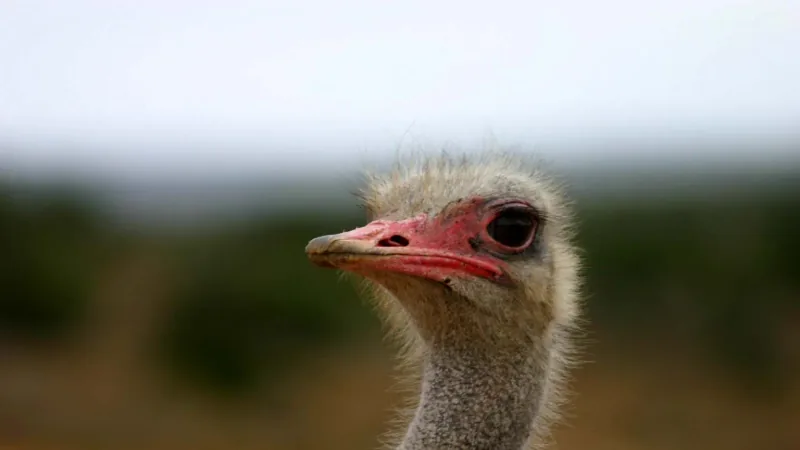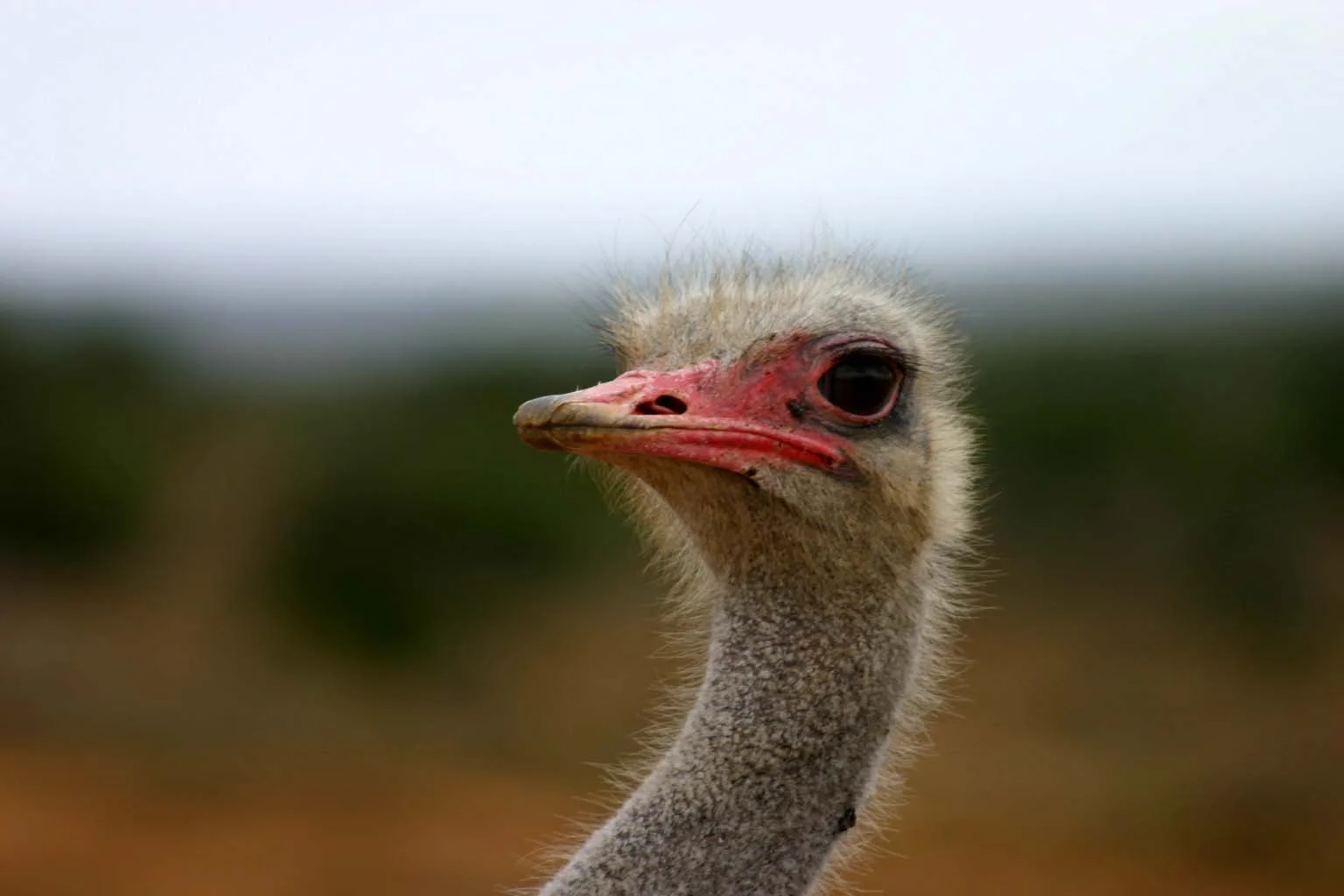
A wild ostrich in Addo Elephant National Park, South Africa.
Field
notes
The Fastest Thing on Two Legs
The Common Ostrich (Struthio camelus) is completely flightless, but the Smithsonian’s National Zoo calls these birds “the fastest two-legged animals on Earth.” A dissection study of ten ostriches found the leg’s greatest force-generating capacity in the muscles that extend the ankle, many of them in series with long tendons and so “functionally suited to elastic energy storage”, stretching and recoiling like springs. An ostrich sprints in short bursts of up to 43 miles per hour (70 kilometers per hour), maintains a steady 31 miles per hour (50 kilometers per hour), and covers 10 to 16 feet (3 to 5 meters) in a single stride. Chicks can run at speeds approaching 35 miles per hour at just a month old.
A Giant Built on Two Toes
Adult ostriches stand up to nine feet tall and weigh between 200 and 300 pounds (90 to 136 kilograms), making them the tallest and heaviest living bird. Every other bird has three or more toes on each foot; the ostrich has two, which San Diego Zoo Wildlife Alliance says are there “for greater speed.” Those feet end in a long, sharp claw on each toe, and when an adult ostrich is threatened, it “attacks with a clawed foot that delivers a kick powerful enough to kill a lion.” Common ostriches are found mostly in the grasslands, savanna and shrublands of southern and eastern Africa, and can survive in deserts and open woodlands too, living up to 30 or 40 years in the wild and almost 70 in human care.
Sleeps With Its Eyes Wide Open In deep slow-wave sleep, an ostrich typically sits motionless with both eyes open, looking more like an alert bird than a sleeping one. Only when it shifts into REM sleep do its eyes close and its head droop, and those episodes can last up to five minutes, the longest reported for any bird.
Not Actually Hiding in the Sand
Ostriches do not bury their heads in the sand. From a distance it can look that way: an ostrich that senses danger and cannot run away flops to the ground and remains still, head and neck flat in front of it. Its pale head and neck blend in with the color of the soil, so only the body stays visible. Running is the real escape, and when danger threatens an ostrich can get away pretty easily.
Published Updated
Traits
Intel
& FAQ
Guess
first
How big is a Common Ostrich, really? Slide, lock in, and see what the sources say. Every answer is a figure from this page, quoted from where it came from.
Sources
- 01Ostrich. San Diego Zoo Wildlife Alliance.
- 02Ostrich. Smithsonian's National Zoo and Conservation Biology Institute.
- 03Lesku et al. (2011). Ostriches Sleep like Platypuses. PLoS ONE.
- 04Smith et al. (2006). Muscle architecture and functional anatomy of the pelvic limb of the ostrich (Struthio camelus). Journal of Anatomy.
- 05Struthio camelus. The IUCN Red List of Threatened Species 2025: e.T45020636A280828427.
What the sources say: 51 claims checked word for word against these sources →