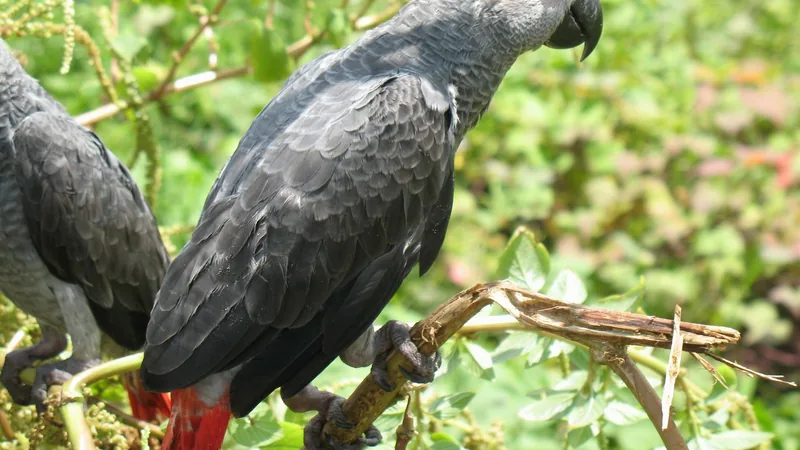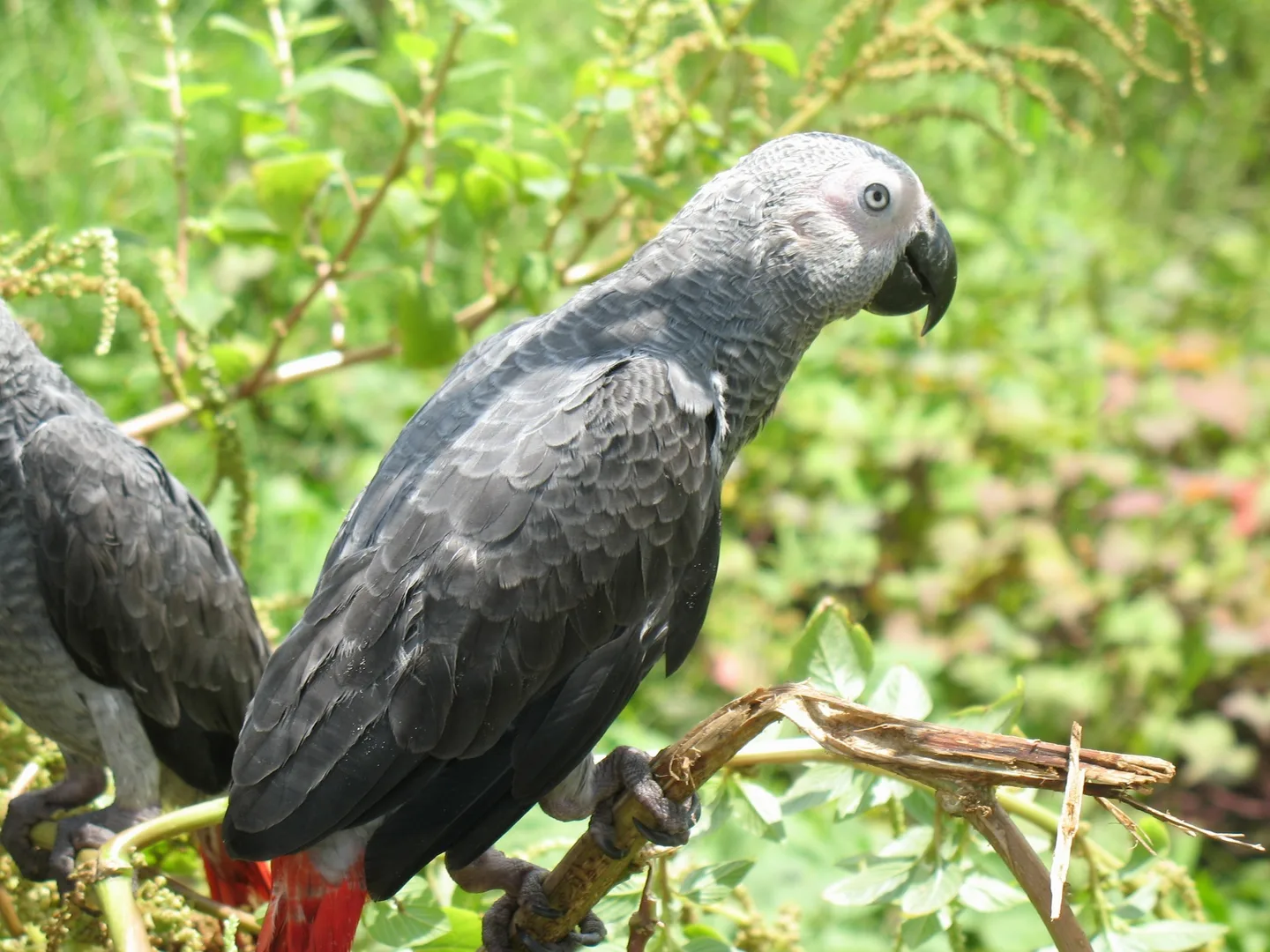
Wild grey parrots in Cameroon.
Field
notes
Griffin versus the cups
A grey parrot named Griffin took on a classic animal-intelligence test. In the two-cup version, a reward is hidden in one of two cups. The subject is then shown that one cup is empty. Picking the other cup is thought to show inference by exclusion, which means reasoning that if it is not in A, it must be in B.
The Harvard team added more complicated versions with three and four cups. In the three-cup test, one reward sits under a single cup and another under one of two cups beside it, so the single cup is the only sure win. Young children fail similar tasks until they are about 2 and a half years old. The same goes for apes. Griffin outperformed even 5-year-olds, and passed the four-cup test too. To check he had not simply learned to pick whichever cup sat next to the empty one, the researchers forced him to gamble on a 50-50 cup. He hated it, but he did it on every trial in that subset.
Saying none Another grey parrot was asked “What color/object [number]?” about piles of blocks, keys and corks. Accuracy was greater than 80%, and he also used “none” to designate zero.
Silver coat, scarlet tail
The plumage is various shades of grey, finished with a very distinctive red tail. The Maryland Zoo describes an extraordinary vocal range: it squawks, whistles, shrieks, screams and mimics. Animal Diversity Web says they typically measure 33 cm from head to tail, and the Maryland Zoo puts the weight at about 1 lb. The zoo gives an average lifespan of 50 years.
Flocks in the canopy
They live in Central and West Africa, in lowland forest including rainforest, woodlands and wooded savannah. At night they roost together in flocks sometimes numbering in the thousands, then split into much smaller groups to feed. They eat fruits, berries, nuts and seeds, and are particularly attracted to the fruit of the oil palm tree.
Each foot has two toes facing forward and two facing back, which helps with balance, and the beak works as a third foot for climbing. Snakes and large cats are the main predators, and a parrot will fly off or fight back with its powerful beak.
Lonely is costly
Telomeres are the caps on the ends of chromosomes, and ageing and chronic stress are suspected of wearing them down. In a study of 45 captive grey parrots, birds housed alone had significantly shorter telomeres than pair-housed birds, even at similar ages. The Red List now calls the species Endangered, and the Maryland Zoo blames its decline primarily on excessive trapping for the international pet trade.
Published
Traits
Intel
& FAQ
Guess
first
How big is a Grey Parrot, really? Slide, lock in, and see what the sources say. Every answer is a figure from this page, quoted from where it came from.
Sources
- 01African Grey Parrot. The Maryland Zoo.
- 02Psittacus erithacus (grey parrot). Animal Diversity Web, University of Michigan.
- 03Study shows parrots can pass classic test of intelligence. Harvard Gazette.
- 04Pepperberg & Gordon (2005). Number Comprehension by a Grey Parrot (Psittacus erithacus), Including a Zero-Like Concept. Journal of Comparative Psychology.
- 06Psittacus erithacus. The IUCN Red List of Threatened Species 2021: e.T22724813A154428817.
What the sources say: 47 claims checked word for word against these sources →