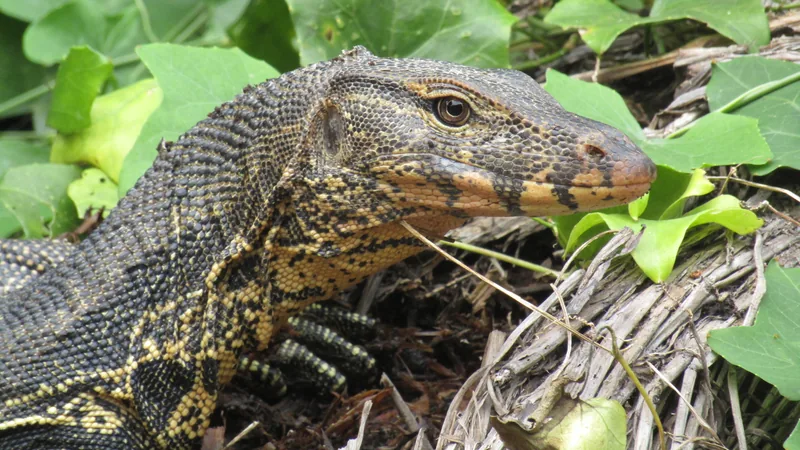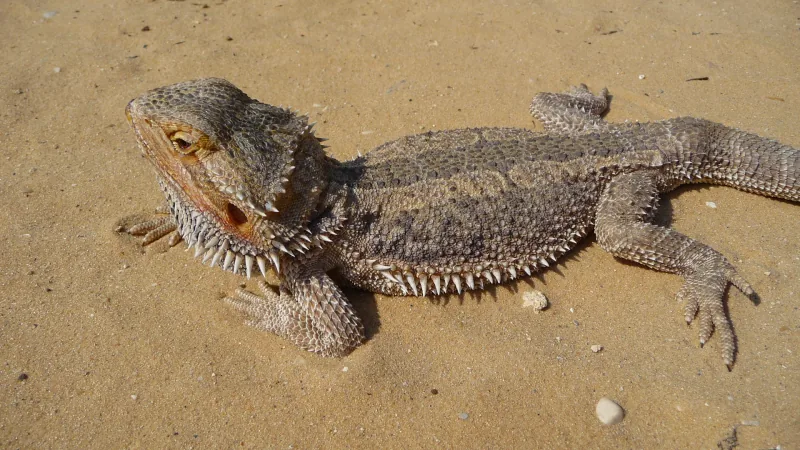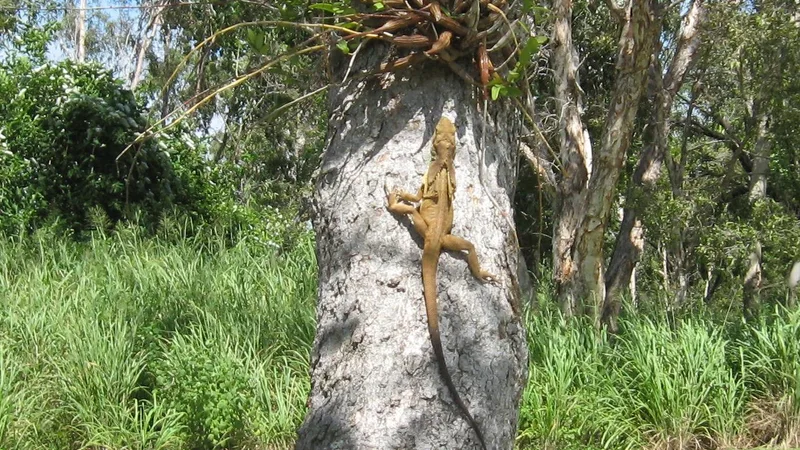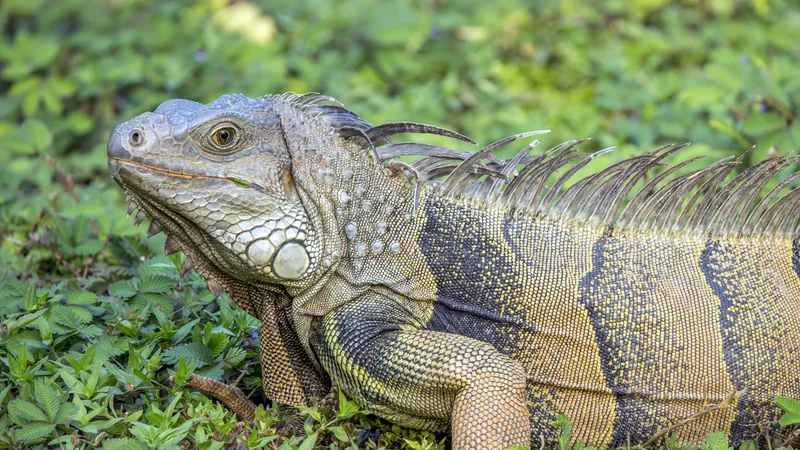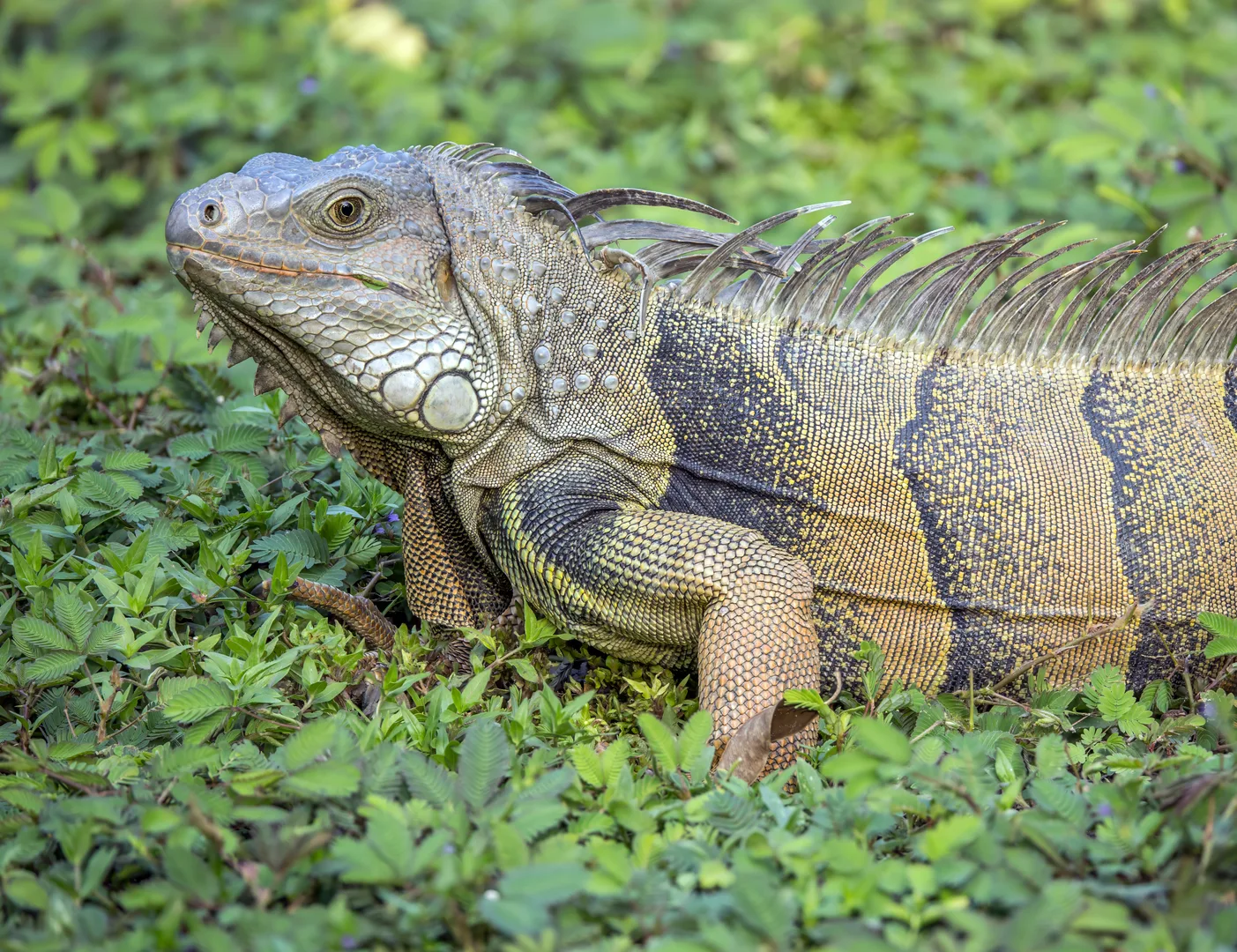
Green iguana in Antioquia, Colombia.
Field
notes
The sensor on its skull
Green iguanas (Iguana iguana) live high in the tree canopy, and hawks and other large birds are potential predators of the young. Look at the top of an iguana’s head, behind its ordinary eyes. There sits a parietal eye. It is not a true eye. It serves as a meter for solar energy.
Shadow detector The visual effect of the parietal eye is mostly limited to the detection of predatory shadows from above.
Their colouring matches so much of the green around them that an iguana can stay still when it spots a predator and go unnoticed. Their colour can shift with the day. In the morning, when body temperature is low, skin is darker and helps the lizard absorb heat. At hot midday the skin turns paler and helps reflect the sun’s rays.
Twelve grams to a kilogram in three years
Within three years, a young 12 gram hatchling can become a 1 kg adult. The AnAge database puts the average adult at 1,530 g. Some in South America can reach up to 8 kg with a proper diet. Head to tail they can reach around 2 m. AnAge lists a maximum longevity of 19.8 years in captivity.
The native range runs from Sinaloa and Veracruz in Mexico south to the Tropic of Capricorn in Paraguay and southeast Brazil. They have also been introduced into southern Florida and Hawaii.
Escape artists
Iguanas prefer to bask on tree limbs that overhang water, so when a predator threatens they can dive in and swim swiftly away. If they are caught, they can shed a large portion of the tail. A new one regrows within a year, though not to the length it was before.
During displays of combat an iguana can produce a loud hissing sound, or a cough from a sudden burst of exhaling.
After a hurricane in 1995, at least 15 iguanas rafted on trees from Guadeloupe until they reached the coast of Anguilla, some 200 miles away.
A leaf eater that runs on gut microbes
Green iguanas are primarily herbivorous, and green leafy plants or ripe fruits are their preferred foods. They bite off small pieces to swallow, with little or no chewing. Most digestion happens in the sacculated colon, where microflora (gut microbes) break down the cellulose. Hatchlings are inclined to eat feces from adults, which may be an adaptation for acquiring this much needed microflora.
Young iguanas have a higher need for protein and are more likely to eat insects and eggs than adults are. Basking is an important aid to digestion.
Published
Traits
Intel
& FAQ
Guess
first
How big is a Green Iguana, really? Slide, lock in, and see what the sources say. Every answer is a figure from this page, quoted from where it came from.
Sources
- 01Bock et al. (2022). Iguana iguana. The IUCN Red List of Threatened Species 2022: e.T174481A218317281.
- 02Iguana iguana (common green iguana). Animal Diversity Web, University of Michigan.
- 03AnAge entry for Iguana iguana. AnAge, Human Ageing Genomic Resources.
- 04Iguana iguana (Green Iguana). The Online Guide to the Animals of Trinidad and Tobago, University of the West Indies.
- 05Falcón, Ackerman & Daehler (2012). March of the Green Iguana: Non-native Distribution and Predicted Geographic Range of Iguana iguana in the Greater Caribbean Region. Reptiles & Amphibians.
What the sources say: 41 claims checked word for word against these sources →