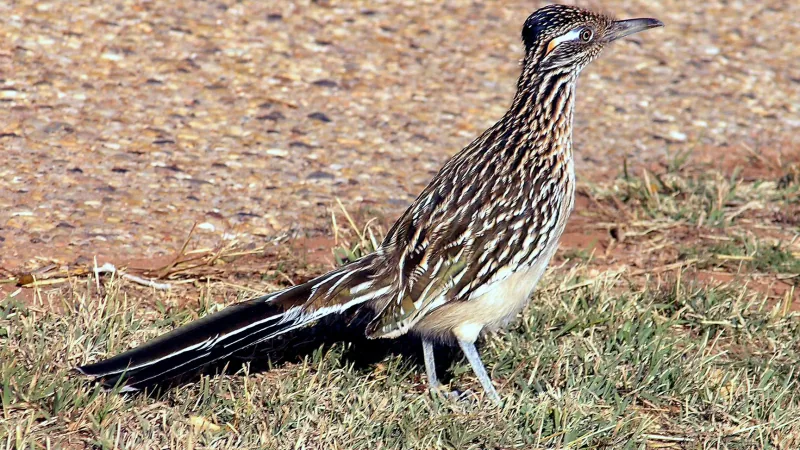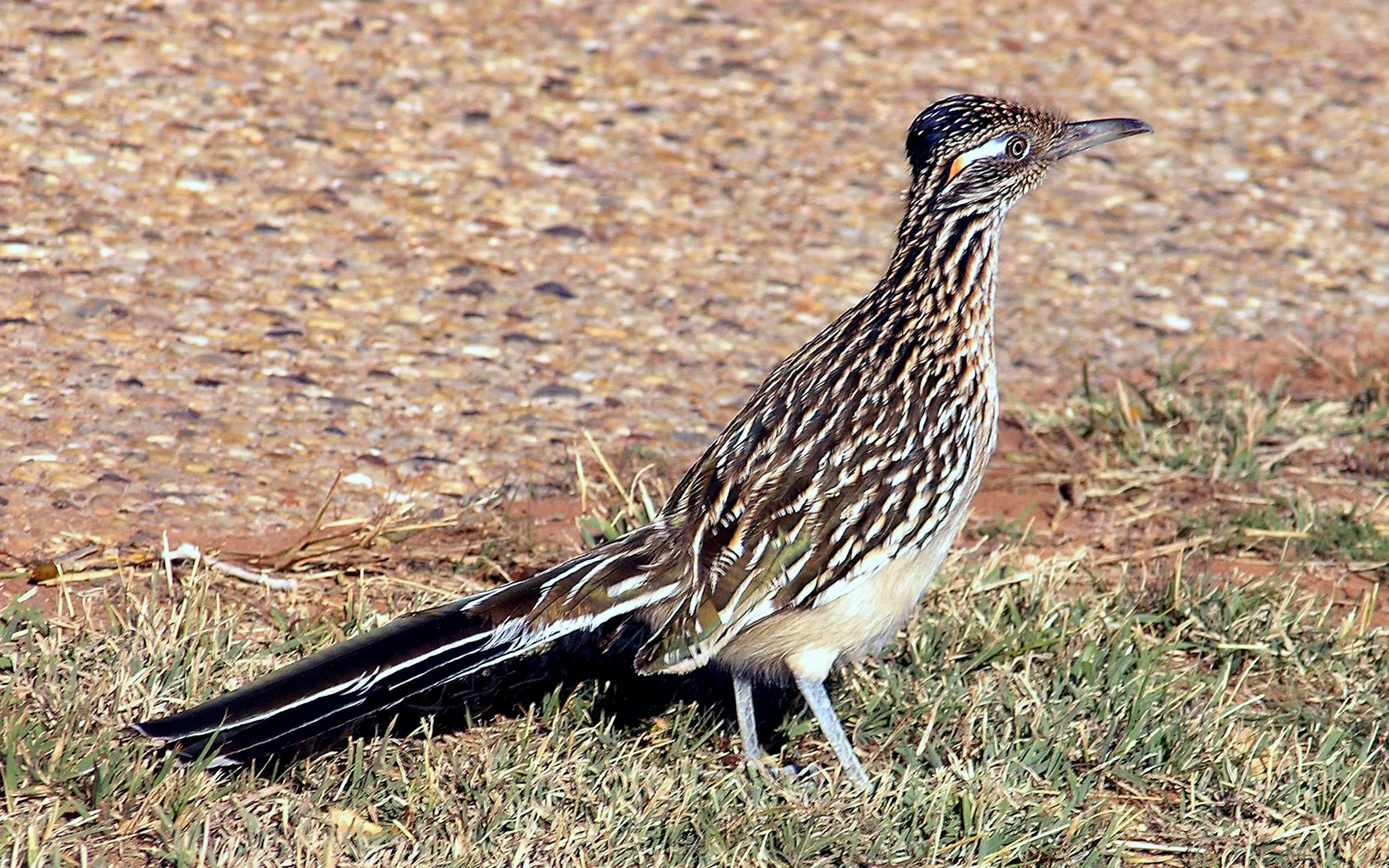
A Great Roadrunner (Geococcyx californianus) in the Caprock Canyons State Park and Trailway along the Caprock in West Texas (USA)
Field
notes
Mostly a bird of the southwestern United States, the Greater Roadrunner (Geococcyx californianus) is a member of the cuckoo family that would rather run than fly. It weighs 227 to 341 grams (0.5 to 0.75 lb), grows up to 58 cm (23 in) long, and stands about 25 to 30 cm (10 to 12 in) tall, with a wingspan of 43 to 61 cm. The oldest banded wild bird recovered was 7 years old. It ranges from California, Nevada and Utah east to Kansas, Arkansas and Louisiana, and south into Mexico, favoring arid desert with scattered brush for cover and open grassy areas for foraging.
It will fly only when it absolutely has to, and even then it stays airborne for only a few seconds. On the ground it is a different story. It can hit speeds of up to 20 miles per hour, using its long tail for steering, braking, and balance. That speed is its main defense: coyotes, hawks, house cats, skunks and raccoons prey on it, and it relies largely on its swiftness to outrun them.
An Opportunist With a Rock for a Weapon
The roadrunner eats pretty much anything it can catch: large insects, scorpions, tarantulas, centipedes, lizards, snakes, and mice, plus birds and eggs, and it also feeds on prickly pear cactus where it’s available. Rattlesnakes have been known to end up on the menu too, although this is rare. When hunting, the bird walks fast, scanning for prey, then dashes forward to make the catch, sometimes jumping into the air to snatch a passing insect. To kill something like a rodent, it smashes the prey’s body and head against a rock and then swallows it whole. Birds of the World adds that it beats snakes and other prey repeatedly against a hard surface before eating them.
Running Cold, Running Hot
At night it enters hypothermia to conserve energy. In the morning and on cooler days, it positions its scapular feathers so the black skin underneath can absorb sunlight and warm the body.
Basking saves energy Under artificial sunlight, sunning roadrunners kept a normal resting metabolism at air temperatures as low as 9°C. Basking saved them an average of 551 calories an hour, where a calorie is the small unit scientists use: about half of one food Calorie.
Midday heat brings the opposite problem, and one way the bird copes is by cutting its activity by 50%.
How to Spot One
Its feet have two toes pointing forward and two pointing back, which leaves a distinctive X-shaped track. A crest of black feathers rises and falls at will, and a bare streak of blue and red skin runs behind each eye. Listen for it too: roadrunners are often mistaken for mourning doves, because of their cooing call, usually six to eight coos that drop in pitch.
Published Updated
Traits
Intel
& FAQ
Guess
first
How big is a Greater Roadrunner, really? Slide, lock in, and see what the sources say. Every answer is a figure from this page, quoted from where it came from.
Sources
- 01Geococcyx californianus (greater roadrunner). Animal Diversity Web, University of Michigan.
- 02Greater Roadrunner. White Sands National Park, National Park Service.
- 03Hughes (2020). Greater Roadrunner (Geococcyx californianus). Birds of the World, Cornell Lab of Ornithology.
- 04Ohmart & Lasiewski (1971). Roadrunners: Energy Conservation by Hypothermia and Absorption of Sunlight. Science.
- 05Geococcyx californianus. AnAge: The Animal Ageing and Longevity Database, Human Ageing Genomic Resources.
- 06Geococcyx californianus. The IUCN Red List of Threatened Species 2022: e.T22684458A152321922.
What the sources say: 48 claims checked word for word against these sources →