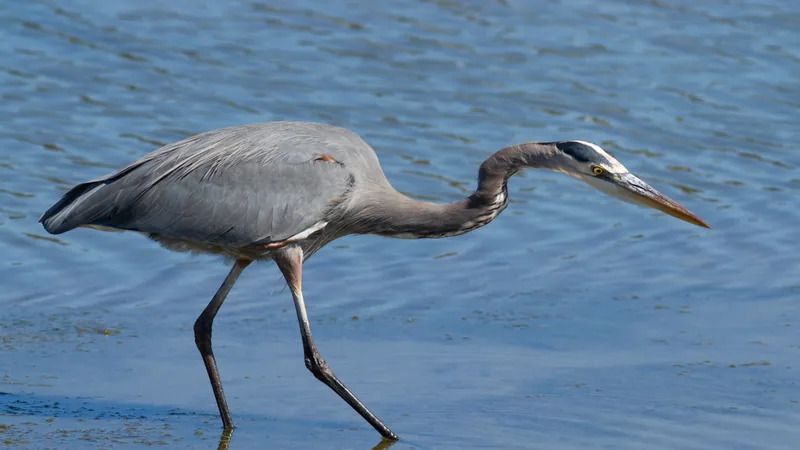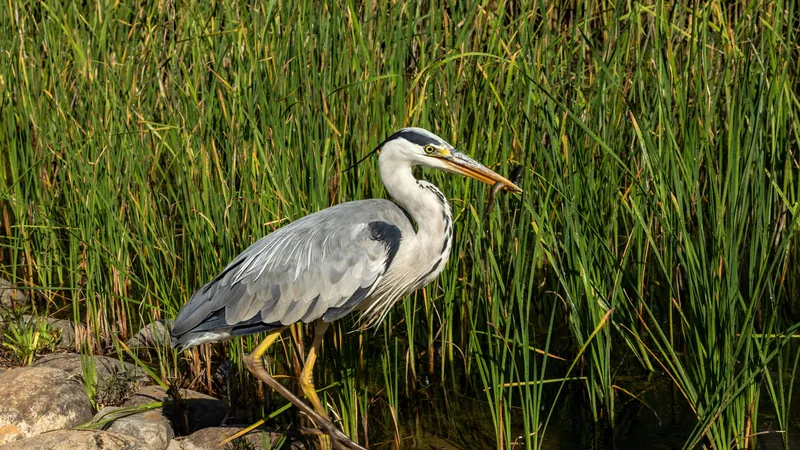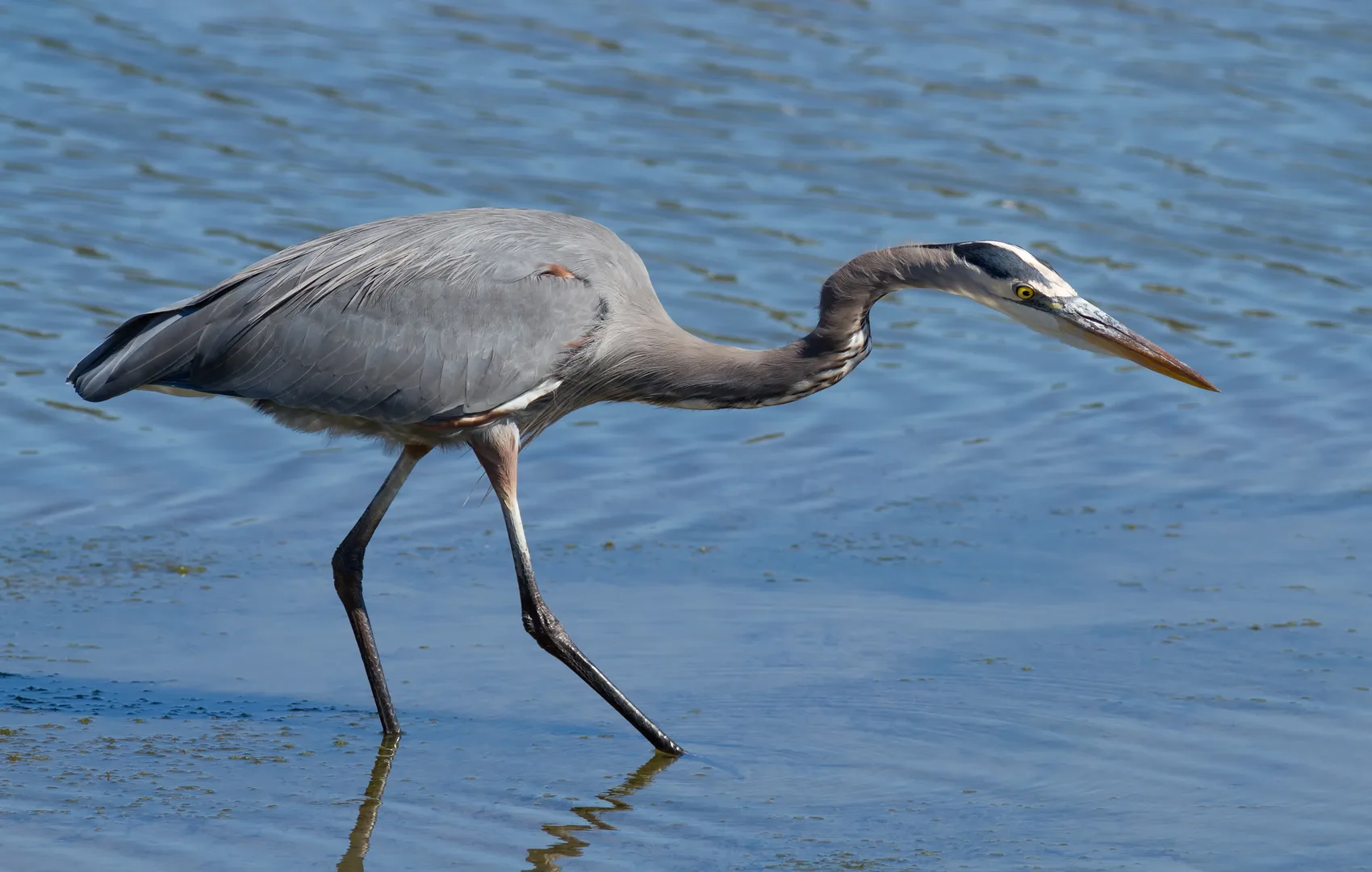
Hunting in the shallows.
Field
notes
The patient spear
The great blue heron fishes by waiting. It mostly stands still, or walks very slowly, in shallow water until a fish swims close. Then it strikes with a rapid thrust of its bill. It is a stalk-and-strike hunter that spots prey by sight, and most of its activity happens around dawn and dusk.
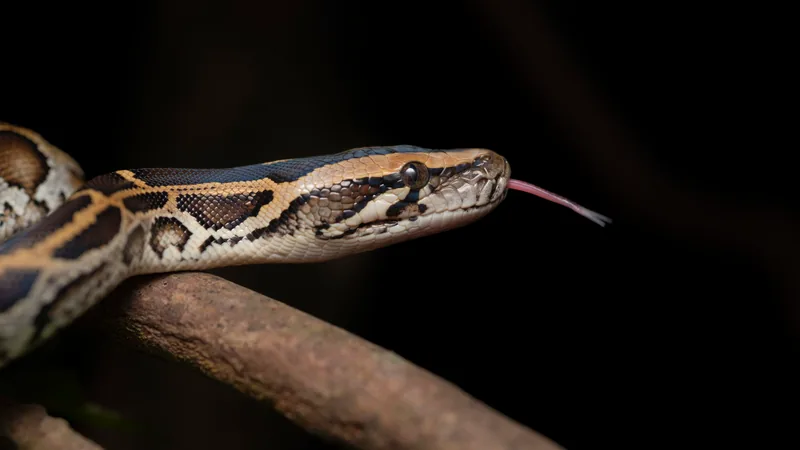
It eats mainly fish, but also frogs, salamanders, turtles, snakes, insects, rodents and birds. It has even been seen stalking voles and gophers in fields.
Eyes bigger than its throat Herons usually swallow their food whole, and they have been known to choke on prey that is too large.
The biggest heron in North America
This is the largest heron in North America. An adult is 1.0 to 1.4 meters (3 feet 2 inches to 4 feet 6 inches) long, with a wingspan of 1.7 to 2.0 meters (5 feet 6 inches to 6 feet 7 inches). It weighs 2.1 to 2.5 kilograms (4 pounds 10 ounces to 5 pounds 8 ounces).
In flight it beats its wings slowly, with its head hunched back onto its shoulders. In parts of Florida there is also an overall white form, which averages about 10 percent larger than the darker one.
Fishing from Alaska to the Galapagos
Great blue herons breed throughout North and Central America, the Caribbean, southern Canada and the Galapagos. Audubon says they thrive around all kinds of waters, from subtropical mangrove swamps to desert rivers to the coast of southern Alaska. Northern birds east of the Rockies migrate, some as far as the Caribbean, Central America or northern South America. With its variable diet, it can winter farther north than most herons, even where most waters freeze.
Rookeries and a short list of years
Great blue herons often nest in colonies called rookeries, many of them made up of this species alone. The male picks a nest site and displays there. His displays include stretching his neck up with the bill pointing at the sky, flying circles over the colony, and snapping his bill shut. The nest is usually in a tree 20 to 60 feet above the ground or water.
A clutch holds 3 to 5 pale blue eggs, sometimes as few as 2 or as many as 7. Both parents incubate them for 25 to 30 days and feed the chicks by regurgitation. The young can fly at about 60 days.
More than half of the herons born in a year die before they are a year old. AnAge lists a maximum longevity of 24.5 years in the wild. The Red List rates the species Least Concern.
Published
Traits
Intel
& FAQ
Guess
first
How big is a Great Blue Heron, really? Slide, lock in, and see what the sources say. Every answer is a figure from this page, quoted from where it came from.
Sources
- 01Ardea herodias. The IUCN Red List of Threatened Species 2020: e.T181500967A181565357.
- 02Great Blue Heron. Audubon Guide to North American Birds.
- 03Ardea herodias (great blue heron). Animal Diversity Web, University of Michigan.
- 04Ardea herodias (great blue heron). AnAge: The Animal Ageing and Longevity Database, Human Ageing Genomic Resources.
What the sources say: 42 claims checked word for word against these sources →