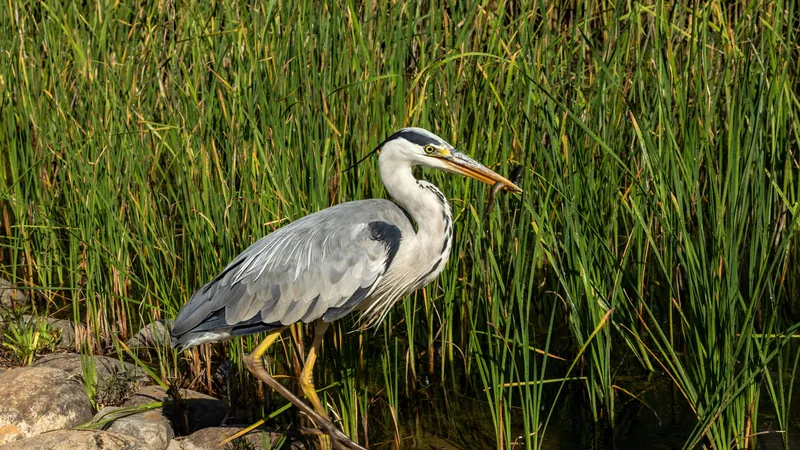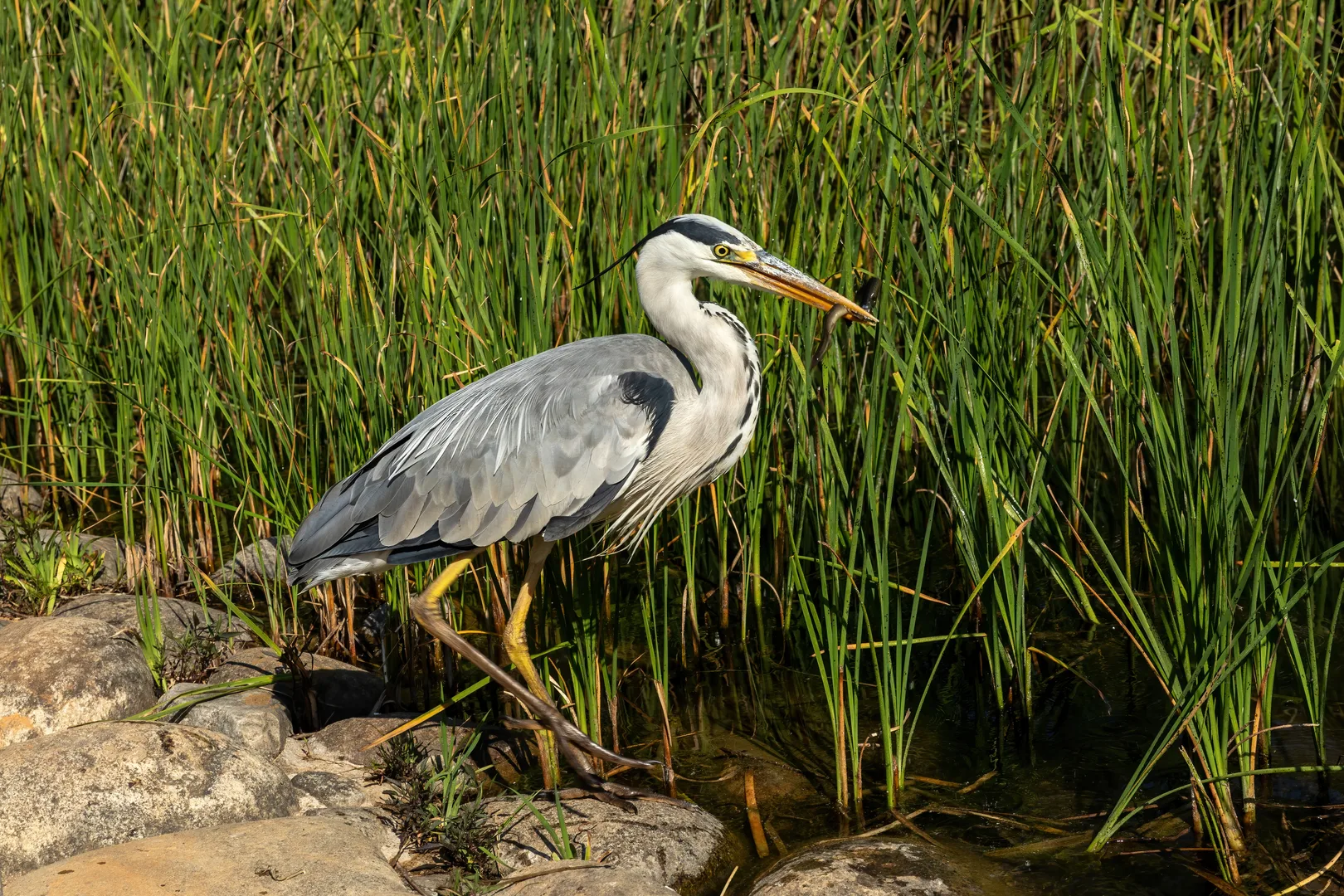
Waiting among the reeds.
Field
notes
The Statue That Strikes
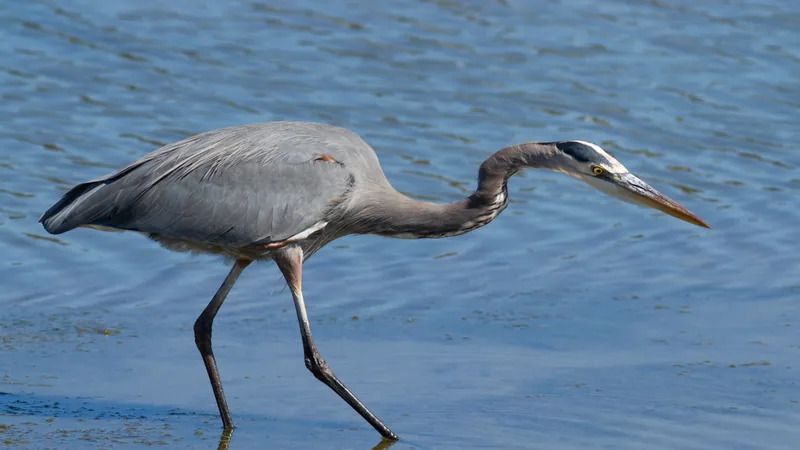
A grey heron usually hunts by doing almost nothing. It wades through shallow water or walks on land, then typically waits for prey to come within striking range. When one does, the heron seizes it with its bill, and the catch generally goes down whole in one quick gulp. Where the water is deeper, the usual pose is on one leg, and the wait sometimes stretches on for a long time. Their best hunting is thought to happen by moonlight.
Fish are the main course, which makes it a piscivore (a fish-eater). Insects, crustaceans, frogs and small mammals count as food too, and it sometimes takes tiny birds.
Aiming high The biggest bird species a grey heron has been recorded trying to eat is the white-throated rail. How often it succeeds is not clear, but injuries have been noted after the attempts.
Wingspan and Range
Body length typically runs from 84 to 102 cm, and the wingspan from 155 to 175 cm. BirdFacts, from the British Trust for Ornithology, gives a weight of 1.5 kg. In the air, a heron pulls its head back toward its body and trails its legs behind it. Cranes fly with the neck extended, which sets the two apart.
Grey herons live across Eurasia and Africa, and they need shallow water to fish in. That can include freshwater rivers, streams, lakes and marshes, saltwater or brackish inlets and estuaries, and even fish farms.
Treetop Heronries
Grey herons are mostly solitary, but at breeding time they come together to nest in treetop colonies known as heronries. Some sites have stayed in use for many decades, and the UK has monitored them since 1928 through the Heronries Census. The UK breeding population is rated stable from 1929 to 2024, at 11 thousand pairs in 2013 to 2017.
Eggs typically take 25 to 26 days to hatch, and the chicks fledge (leave the nest) after about 50 days. Hatchlings compete for food and commonly push one another out of the nest. When food runs short, the smallest or weakest chick is sometimes killed by its siblings.
Short Odds, Long Records
A grey heron that reaches breeding age typically lives 5 years, according to BTO’s ringing data. Just 0.26 of juveniles, about a quarter, survive to age 2. The oldest ringed bird on BTO’s record, set in 2003, reached 23 years, 9 months and 2 days.
Published
Traits
Intel
& FAQ
Guess
first
How big is a Grey Heron, really? Slide, lock in, and see what the sources say. Every answer is a figure from this page, quoted from where it came from.