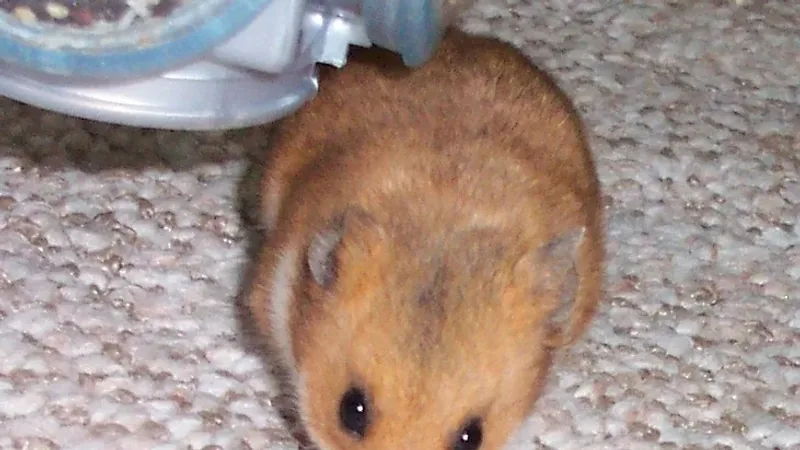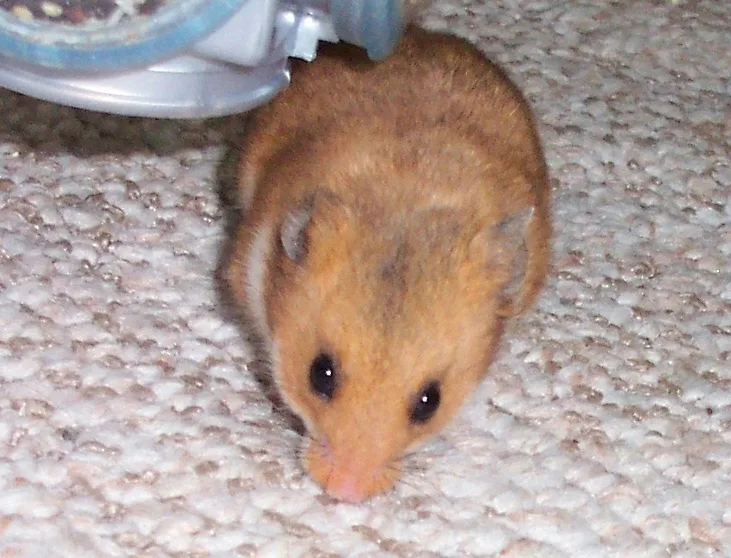
Pet golden hamster (Mesocricetus auratus)
Field
notes
Night Shift in the Lab, Day Shift for Wild Females
In the laboratory, the golden hamster (Mesocricetus auratus) keeps such consistent nocturnal hours that it became a prime model animal for studying circadian rhythms, the body clocks that set a daily cycle of sleep and activity.
Then scientists checked wild ones.
Lab versus wild. Female hamsters in the wild were almost exclusively diurnal, which means active by day. Lab hamsters are nocturnal.
Lab and wild hamsters are the same species, but a result from one may not hold for the other.
Small, Fast, and Short-Lived
An adult golden hamster weighs 100 to 125 g and is about 13 to 13.5 cm long. A database of animal ageing gives an average adult weight of 105 g.
Its pregnancy lasts 16 days, the shortest among eutherian mammals. Eutherians are the placental mammals, the group that includes us. A birth brings 8 to 12 young, born with their eyes closed. They open them at 12 to 14 days and are weaned at 19 to 21 days. Females are sexually mature at 26 to 30 days on average, males at 42 days.
In the wild, a golden hamster lives 1.5 to 2 years on average. In captivity a typical life is 2 to 2.5 years, and the ageing database’s maximum for captivity is 3.9 years.
A Loner With a Burrow
Wild golden hamsters live mainly on the Aleppo plateau in Syria, with reports from eastern Turkey. A field survey near Aleppo found most burrows on farm fields, especially in legume crops. Burrows were 36 to 106 cm deep, with one vertical entrance leading to a nesting chamber and at least one food chamber. None of the inhabited burrows held more than one adult.
Golden hamsters are solitary and highly territorial, and they eat seeds, nuts and insects, caching food in the burrow. They are aggressive toward each other except when mating. Teeth chattering, a sign of aggression, was recorded in 92 percent of male-to-male meetings. Foxes, mustelids, birds of prey and snakes are among its predators, and it avoids them by sheltering in its burrow and staying alert.
Endangered in the Wild, Worldwide as a Pet
The Red List rates the species Endangered. Animal Diversity Web says wild populations are restricted to a small area of the Middle East and describes wild golden hamsters as crop pests. Because golden hamsters are widely used as pets and research animals, it says the species is in no danger of dying out fully. The wild populations are the ones under threat.
Published Updated
Traits
Intel
& FAQ
Guess
first
How big is a Golden Hamster, really? Slide, lock in, and see what the sources say. Every answer is a figure from this page, quoted from where it came from.
Sources
- 01Mesocricetus auratus (golden hamster). Animal Diversity Web, University of Michigan.
- 02AnAge entry for Mesocricetus auratus. Human Ageing Genomic Resources, AnAge database.
- 03Gattermann et al. (2008). Golden hamsters are nocturnal in captivity but diurnal in nature. Biology Letters.
- 04Gattermann et al. (2001). Notes on the current distribution and the ecology of wild golden hamsters (Mesocricetus auratus). Journal of Zoology.
- 05Kennerley & Middleton (2022). Mesocricetus auratus. The IUCN Red List of Threatened Species 2022: e.T13219A107411865.
What the sources say: 49 claims checked word for word against these sources →