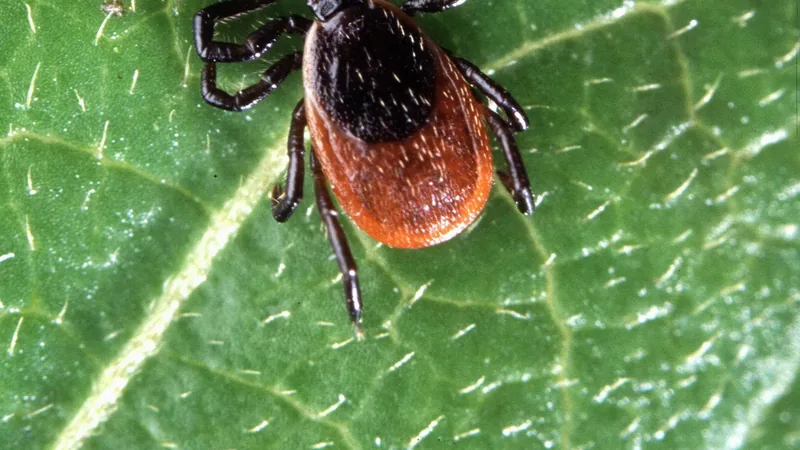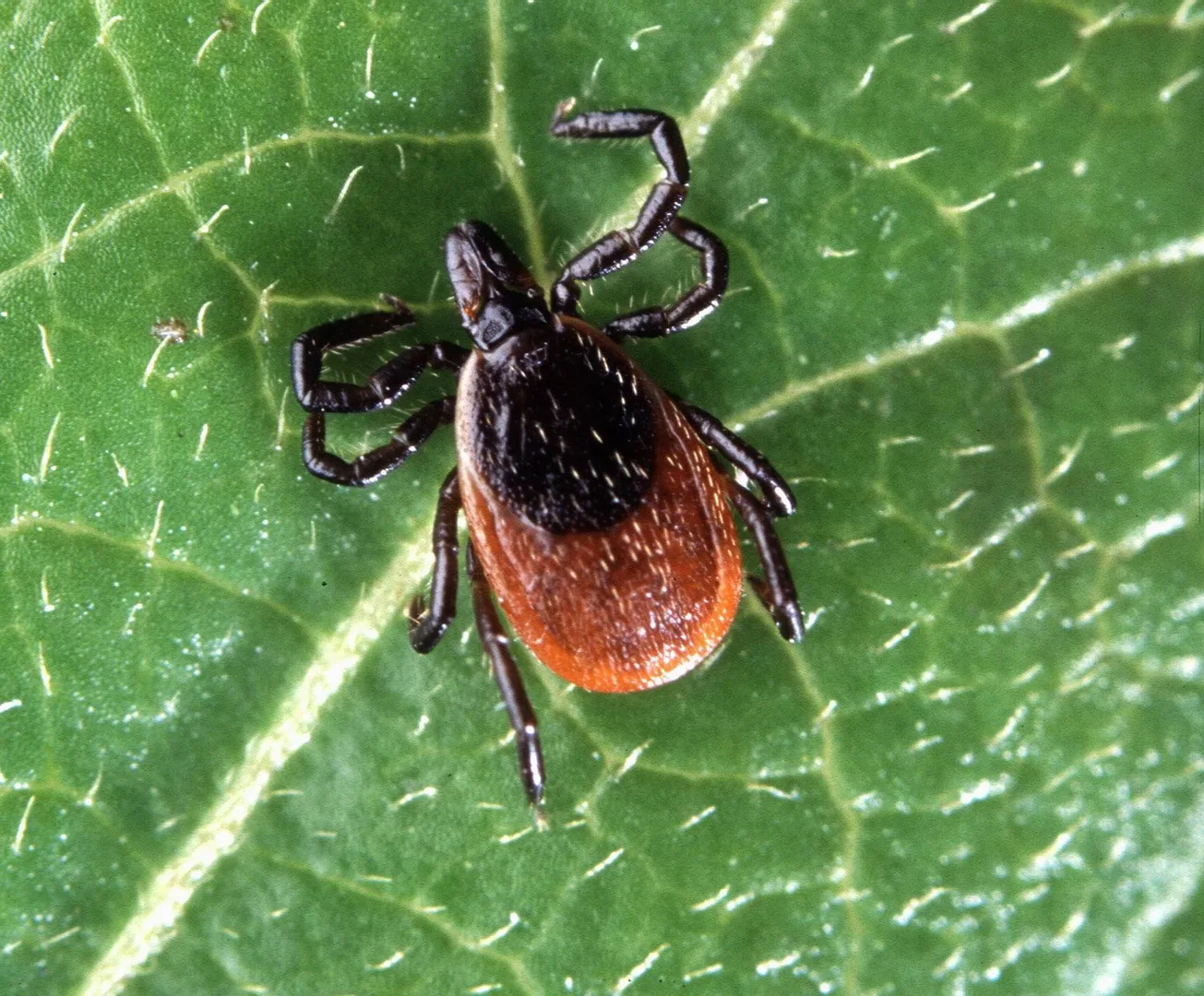
Deer tick, also called the blacklegged tick (Ixodes scapularis)
Field
notes
Ambush from the vegetation
The deer tick, also called the blacklegged tick, is an arachnid. Adults and nymphs (the stage between larva and adult) both have eight legs. An adult is about 3 mm long, and a nymph is 1 to 2 mm, about the size of a poppy seed.
It does not chase anything. It waits on vegetation or on the ground until a host brushes past, generally catching it by the legs. Scientists call this waiting game “questing”.
Three hosts, three meals
This is a three-host tick: larva, nymph and adult each need a blood meal from a host. Larvae and nymphs then drop to the ground to molt, which means shedding the outer skin to grow. Larvae feed mostly on white-footed mice. Adult females feed on a white-tailed deer for five to seven days. Males rarely feed at all.
Built to swell A meal lasts several days. As it feeds, the tick builds new, flexible cuticle (its outer shell), and that stretchy layer lets it swell up with blood.
Its host list is very wide. One guide lists hosts from 57 bird species, 41 mammal species and 11 lizard species.
Two years, then breed and die
In the north-east and upper Midwest of the United States, where adults feed mostly on deer, the life cycle runs over two years. Animal Diversity Web puts its lifespan in the wild at about two years. Males die after mating, and females die after laying their eggs, typically on the forest floor.
Mate-finding is largely run by pheromones, chemical signals that draw ticks together. Its genome is 2.1 billion base pairs of DNA, which is large and packed with repeated sequences.
Following the deer north
Its home is eastern North America, from the eastern United States west towards Texas and north into Minnesota and southeastern Canada. Moisture rules where it lives: it is extremely sensitive to drying out, and it suits deciduous forest with enough ground cover to keep the air very humid.
During the 20th century it spread through most of the eastern United States and into southern Canada, following forest regrowth and the return of white-tailed deer. A 2018 review cited an advance of about 46 km a year in Ontario.
Its bite matters because it carries Borrelia burgdorferi, the cause of Lyme disease. A 2018 review calls it a vector of seven human pathogens in the United States.
Published Updated
Traits
Intel
& FAQ
Guess
first
How big is a Deer Tick, really? Slide, lock in, and see what the sources say. Every answer is a figure from this page, quoted from where it came from.
Sources
- 01Ixodes scapularis (black legged tick). Animal Diversity Web, University of Michigan.
- 02Gulia-Nuss et al. (2016). Genomic insights into the Ixodes scapularis tick vector of Lyme disease. Nature Communications.
- 03Sonenshine (2018). Range Expansion of Tick Disease Vectors in North America: Implications for Spread of Tick-Borne Disease. International Journal of Environmental Research and Public Health.
- 04Eisen & Eisen (2018). The Blacklegged Tick, Ixodes scapularis : An Increasing Public Health Concern. Trends in Parasitology.
- 05Hill & MacDonald. The Biology and Medical Importance of Ticks in Indiana (E-243-W). Purdue Extension, Department of Entomology.
- 06Boulanger et al. (2025). Ticks and tick-borne diseases in the northern hemisphere affecting humans. Frontiers in Microbiology.
What the sources say: 61 claims checked word for word against these sources →