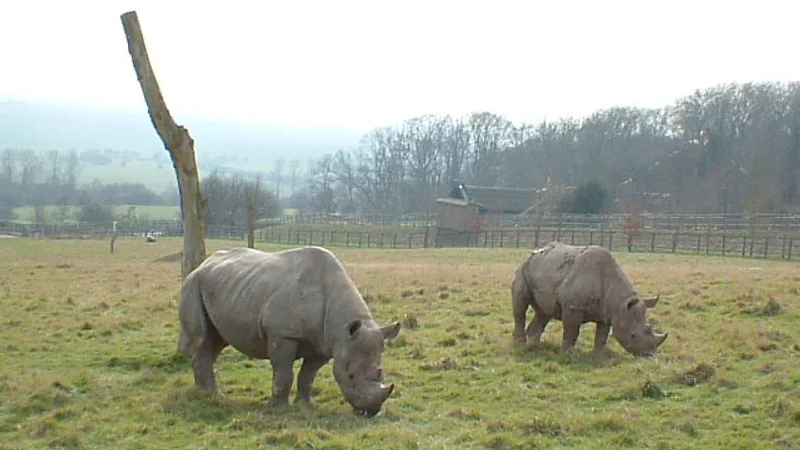
Black rhinoceros (Diceros bicornis) contemplating sunset at the Okaukuejo waterhole in Etosha National Park, Namibia
Field
notes
A Hooked Lip for Browsing
The black rhinoceros (Diceros bicornis) is a browser that eats trees, bushes and shrubs, unlike the grass-grazing white rhino. A black rhino weighs 1,000 to 1,800 kilograms, with a body 2.9 to 3.75 meters long and a shoulder height of 1.4 to 1.8 meters. It once lived across Africa south of the Sahara, apart from the Congo Basin. Today it lives in southern and eastern Africa, in countries including Kenya, Tanzania, Namibia, South Africa and Zimbabwe.
The clearest way to tell it from a white rhino is its hooked lip; a white rhino’s is flat. That upper lip is prehensile, meaning it can grip: it grabs plants and guides them into the mouth. It has no incisors, the front biting teeth. It eats an average of 23.6 kilograms of food a day.
Sharp Nose, Curious Charges
Black rhinos have poor eyesight and cannot easily spot a person standing more than 30 meters away, but their senses of smell and hearing are excellent. Yet a 2008 study of one rhino’s retina found no support for its weak-sighted reputation. It put the rhino’s sharpness of vision at 6 cycles per degree, comparable to a rabbit’s, and calculated that, against the right background, a black rhino could readily pick out a 30-centimeter-wide person about 200 meters away.
A startled black rhino tends to run away. Once the scare passes, curiosity kicks in and it investigates with charges. Many charges at people and their vehicles turn out harmless, but some can cause injury or death. Black rhinos have been recorded at up to 55 kilometers an hour (34 mph). Lions sometimes attack adults, and lions and spotted hyenas sometimes prey on young rhinos, but humans are the most important predator.
Horns Without Bone Both horns grow continually from the skin at their base throughout a rhino’s life. They have no bony core and are not shed. Each is made of thousands of compressed hair-like strands of keratin, like the fibers in hair and fingernails.
A Mostly Solitary Life
Depending on the habitat, black rhinos can be solitary and territorial or semi-social. Adult males tend to live alone except when courting, and females are usually found only with their latest calf. The BBC’s Africa series even filmed a group gathering socially at a waterhole. Home ranges run from 2.6 to 133 square kilometers. Rhinos mark their ground by spraying urine, leaving dung piles called middens, and rubbing a scent gland on their skin against a rock or tree. Oxpeckers, birds often seen with rhinos, remove their ticks and raise the alarm when danger approaches.
Back From About 2,400
In the 19th century, black rhinos numbered several hundred thousand and were hunted relentlessly. By 1970 an estimated 65,000 were left. Poaching rose through the 1970s and 1980s with demand for rhino horn in Asia and the Middle East, and between 1970 and 1992 numbers fell 96 percent, to as low as around 2,400. Save the Rhino now puts the population at 6,788. Black rhinos live up to 30 to 35 years in the wild and 35 to 45 years or more in captivity. AnAge’s longevity record is a wild-born female that was about 57 when she died in captivity at a sanctuary in Ngorongoro. The species is Critically Endangered, and Save the Rhino names poaching and a lack of safe habitat as its most significant threats.
Published Updated
Traits
Intel
& FAQ
Guess
first
How big is a Black Rhinoceros, really? Slide, lock in, and see what the sources say. Every answer is a figure from this page, quoted from where it came from.
Sources
- 01Black Rhinoceros (Diceros bicornis) Fact Sheet: Physical Characteristics. San Diego Zoo Wildlife Alliance Library.
- 02Black rhino. Save the Rhino International.
- 03Diceros bicornis (black rhinoceros). Animal Diversity Web, University of Michigan.
- 04AnAge entry for Diceros bicornis. AnAge: The Animal Ageing and Longevity Database.
- 05Pettigrew & Manger (2008). Retinal ganglion cell density of the black rhinoceros (Diceros bicornis): Calculating visual resolution. Visual Neuroscience.
- 06Emslie (2020). Diceros bicornis. The IUCN Red List of Threatened Species 2020: e.T6557A152728945.
What the sources say: 51 claims checked word for word against these sources →