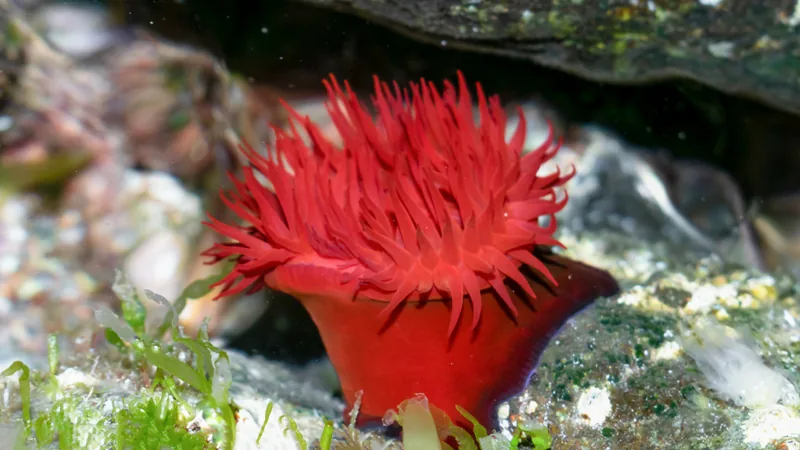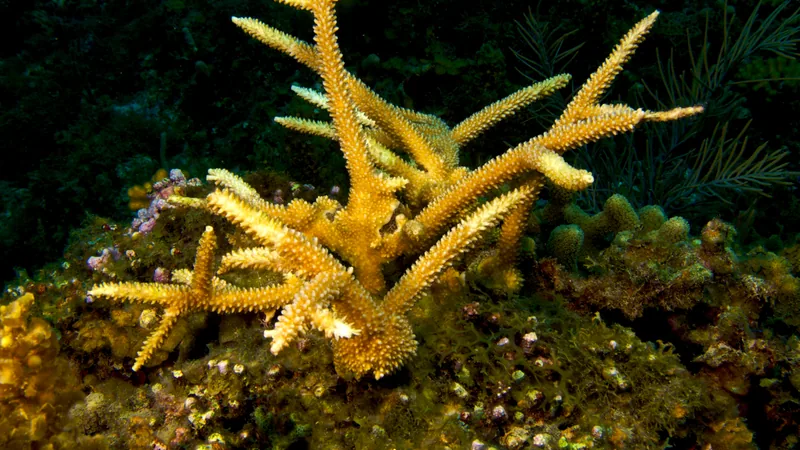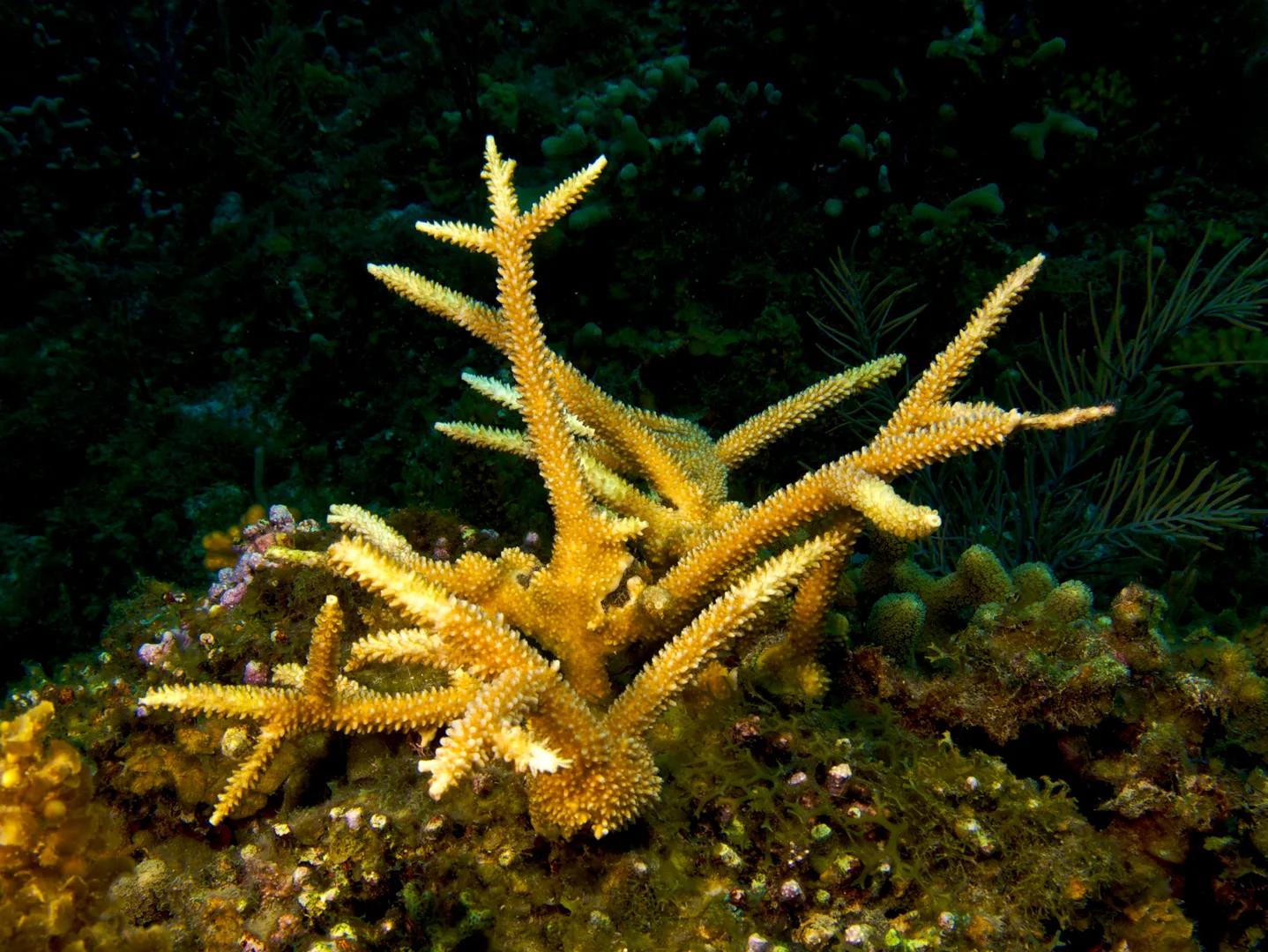
Acropora cervicornis (Staghorn Coral - Haiti)
Field
notes
Antlers made of animals
A staghorn coral looks like a stag’s antlers: its branches typically stem from a central trunk and angle upward, and are typically 1 to 3 inches thick. Colonies are golden tan or pale brown with white tips, and a single colony can grow to at least 4 feet tall and 6 feet across.
It is not one creature. Each colony is made of many individual polyps, and each polyp is an exact copy of the others in the same colony. The colour comes from algae living inside its tissue.
Fast, and in no hurry to die
Staghorn coral is one of the fastest growing corals: when healthy, it can add up to 8 inches of branch length a year. It reaches reproductive maturity at about 7 inches tall. Each colony makes both eggs and sperm, but usually does not fertilize itself. Once a year, after the full moon in late summer, it releases eggs and sperm into the open water, called “broadcast spawning”. NOAA lists its lifespan as up to hundreds of years.
Reef tumbleweed NOAA compares staghorn corals to prairie tumbleweeds: they are often dislodged and tumble to a new place on the reef, where they can re-attach and keep growing.
Where it lives and what it eats
You typically find it in clear, shallow water, 15 to 60 feet down, on reefs throughout the Bahamas, Florida and the Caribbean. Palm Beach County, Florida, is the northern edge of its range. It gets food in two ways. Photosynthetic algae inside its cells feed it, and its polyps also capture plankton with their tentacles. Dense groups called thickets provide important habitat for other reef animals, especially fish.
A reef zone that nearly vanished
Staghorn coral was once so abundant that an entire reef zone is named for it. Starting in the 1980s, white band disease, which kills the coral’s tissue, cut the population by 97 percent. Now it is rated Critically Endangered on the IUCN Red List. NOAA’s species page lists it as Threatened under the US Endangered Species Act and as CITES Appendix II. NOAA has also designated four critical areas for it, off Florida, Puerto Rico and the US Virgin Islands. NOAA calls ocean warming the greatest threat: it makes corals release their algae, which usually causes death.
Published
Traits
Intel
& FAQ
Guess
first
How big is a Staghorn Coral, really? Slide, lock in, and see what the sources say. Every answer is a figure from this page, quoted from where it came from.
Sources
- 01Staghorn Coral. NOAA Fisheries.
- 02Crabbe et al. (2022). Acropora cervicornis. The IUCN Red List of Threatened Species 2022: e.T133381A165860142.
- 03Vollmer & Kline (2008). Natural Disease Resistance in Threatened Staghorn Corals. PLoS ONE.
What the sources say: 37 claims checked word for word against these sources →