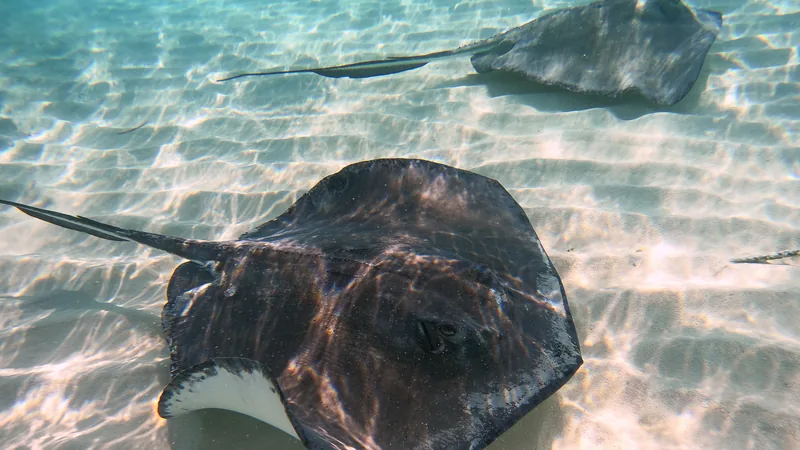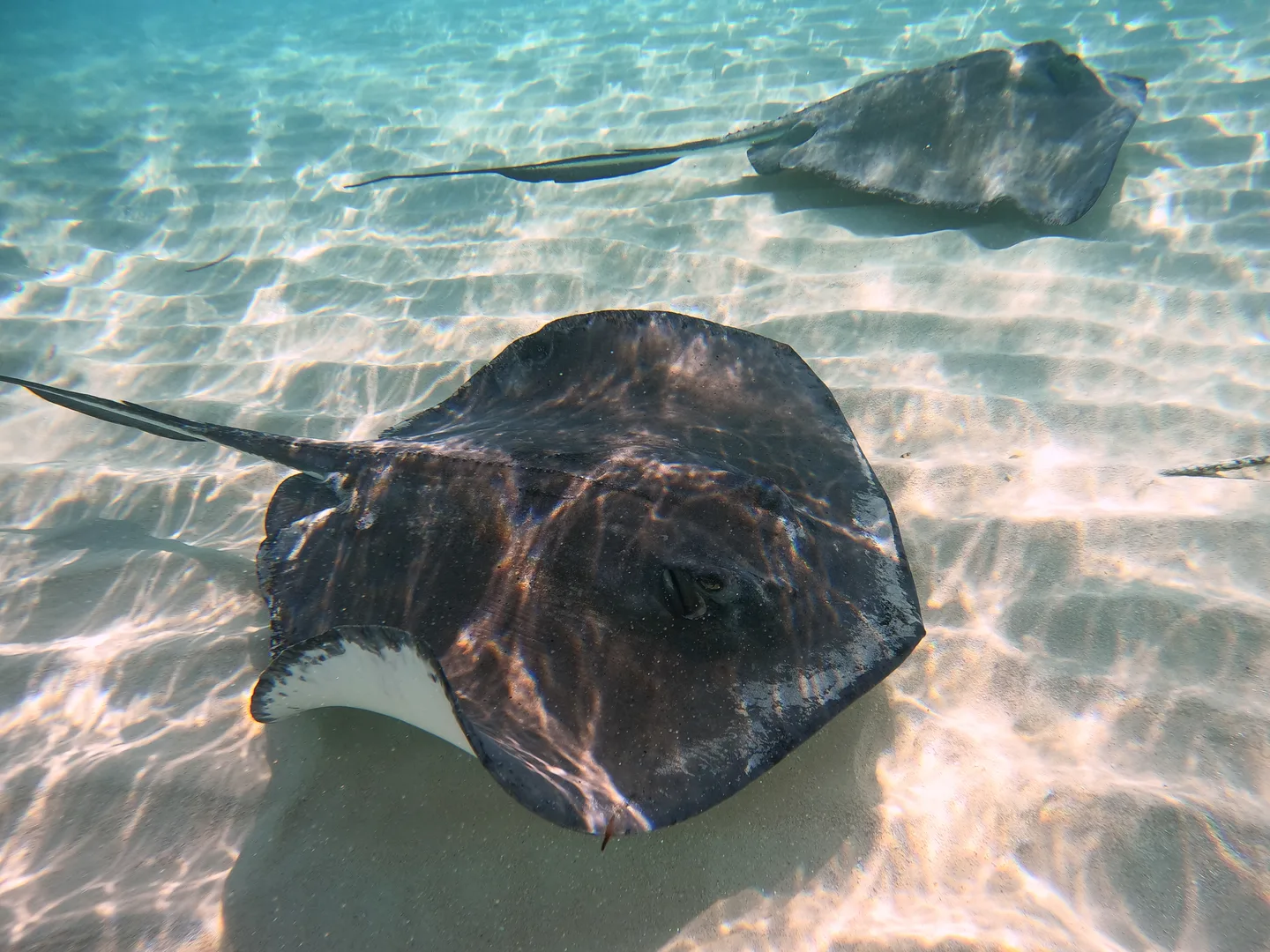
Southern Stingray ( Hypanus americanus ) in the Cayman Islands
Field
notes
Digging Up Dinner
The southern stingray hunts by excavating. It flaps its pectoral fins (the flattened fins that form its disc) and jets water from its mouth to disturb the sand and uncover prey that is usually buried. Sight is unlikely to help it find that prey. Its eyes sit on top of its head and are likely used to spot predators rather than food. Instead it has thousands of ampullae of Lorenzini, sensors on its underside, concentrated around the head, that pick up the electric field of buried animals.
Its raised head has spiracles that let it take in water while it lies on the seabed. It eats mostly bivalves and worms, along with shrimps, crabs and small fishes.
A Diamond With a Spine
The disc is diamond-shaped and about 1.2 times as broad as it is long. FishBase gives a maximum disc width of 200 cm and a common width of 90 cm, and its heaviest published weight is 135.6 kg. The tail can be up to twice as long as the body, and it carries a sharp, venomous spine with 52 to 80 teeth on either side.
Spine for defense The southern stingray is a non-aggressive animal, posing little threat to humans, but it uses its spine in defense when stepped on.
FishBase lists 28 years as the oldest reported age, though the Florida Museum says little is known about its average lifespan.
Followers, Cleaners and Foes
A digging stingray often stirs up more than its own meal. In shallow water, double-crested cormorants dive in and swim behind it to feed on the snappers and grunts it disturbs. Southern stingrays have also been seen visiting cleaner wrasse cleaning stations, for periods of 1 to 26 minutes. Great hammerhead sharks are a predator, and the shape of their heads helps them hold a stingray down. It often hides from predators by burying itself in the sand.
Sound matters to it too. In a field study, females tested with low tones of 50 to 500 Hz changed their swimming at 140 dB, while males did not change until 160 dB.
Where It Lives
FishBase gives the range as the western Atlantic, from New Jersey and the northern Gulf of Mexico to southern Brazil, including the Antilles, at depths from 0 to 53 m. The Florida Museum says it is most abundant near Florida and the Bahamas. Litters hold 2 to 10 pups, with an average of 4, after a gestation of 4 to 11 months. The IUCN Red List lists the species as Near Threatened, as assessed in 2019.
Published
Traits
Intel
& FAQ
Guess
first
How big is a Southern Stingray, really? Slide, lock in, and see what the sources say. Every answer is a figure from this page, quoted from where it came from.
Sources
- 01Carlson et al. (2020). Hypanus americanus. The IUCN Red List of Threatened Species 2020: e.T181244884A104123787.
- 02Southern Stingray (Hypanus americanus). Florida Museum of Natural History, Discover Fishes.
- 03Hypanus americanus summary page. FishBase.
- 04Dasyatis americana (kit). Animal Diversity Web, University of Michigan.
- 05Mickle, Pieniazek & Higgs (2020). Field assessment of behavioural responses of southern stingrays (Hypanus americanus) to acoustic stimuli. Royal Society Open Science.
What the sources say: 52 claims checked word for word against these sources →