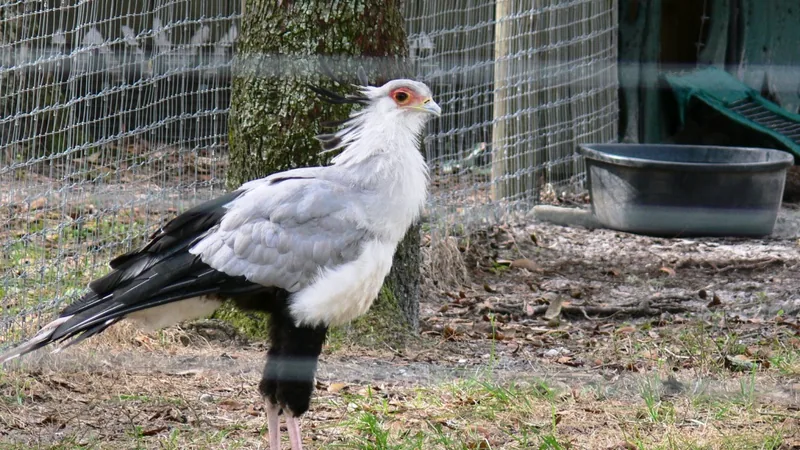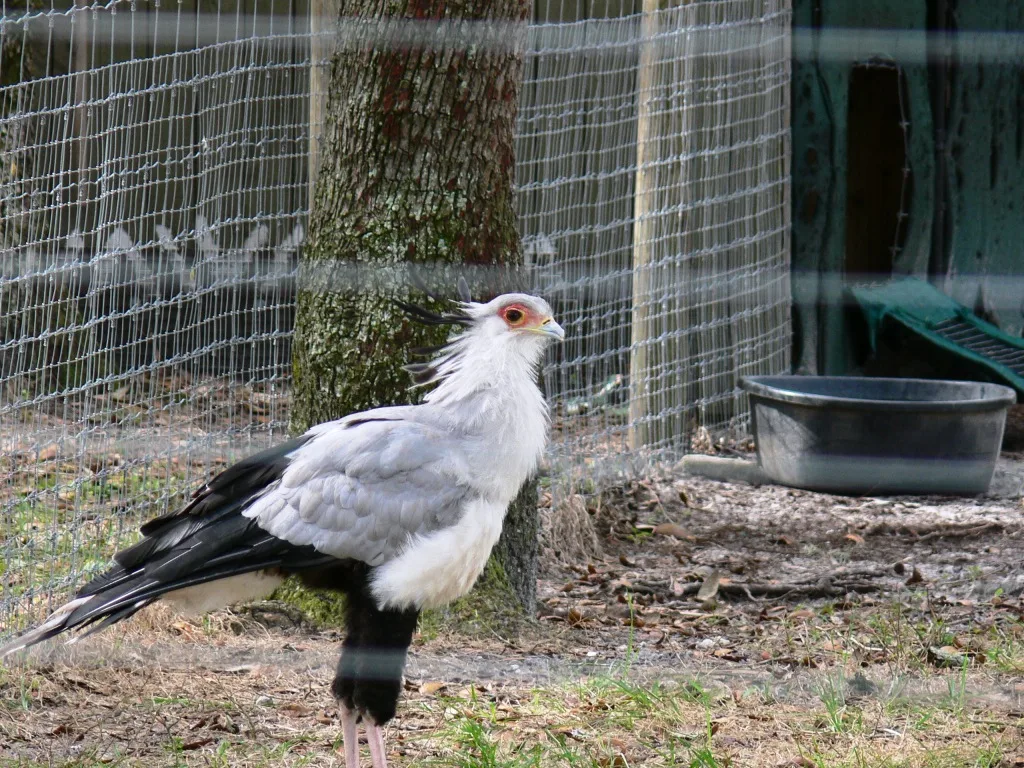
Secretarybird at Itala Game Reserve, KwaZulu-Natal, South Africa.
Field
notes
Stilts That Stomp
The secretarybird (Sagittarius serpentarius) is the tallest bird of prey alive, standing 1.2 to 1.5 meters (4.1 to 4.9 feet) tall on the longest legs of any raptor, with a wingspan around 2.1 meters (6.9 feet) and a body weight of 2.2 to 4.3 kilograms (5 to 9.5 pounds). It can live 10 to 15 years, and up to 19 in a zoo.
Its feet are built for walking, with little grip, and it hunts on foot. To measure its kick, researchers pulled a rubber snake across a force plate hidden under artificial grass in the enclosure of Madeleine, a captive male trained to attack it. His kicks peaked at an average of 195 newtons, equal to five times his own body weight, and his foot touched the snake for an average of just 15 milliseconds.
A Tenth of a Blink Madeleine’s foot stayed on the snake for about a tenth of the time it takes to blink, which lasts around 150 milliseconds. The researchers concluded that a contact that brief, on legs that long, is too fast to steer by feel, so the bird aims by eye and plans each kick in advance. Once a kick starts it can’t be adjusted, so a miss can only be corrected with the next one.
From Grasshoppers to Cobras
A secretarybird often kills by kicking and stamping on its prey’s head until the animal is stunned or dead, especially a larger lizard or a venomous snake. Small prey it simply catches in its bill. Its menu runs from grasshoppers, beetles and scorpions to mice, hares, small birds, lizards and small tortoises, plus snakes, often adders and cobras, though snakes make up a smaller share of its diet than its reputation suggests.
Heavy scales on its lower legs may help protect it while it walks through brush or attacks prey. A venomous snake may bite at its flapping feathers, but they make safe targets, because a bite to a hollow feather does not hurt the bird at all.
A Raptor That Would Rather Walk
A secretarybird flies well, often at great heights, but it would rather walk. It patrols the grass on foot for roughly 20 to 30 kilometers (12 to 18 miles) a day, walking at a steady pace and searching for movement, then roosts high in an acacia tree at night. It lives in open savannas and grasslands south of the Sahara, from Senegal and Somalia down to South Africa, usually in a pair or family group, sometimes alone. It is the only living member of its own bird family, Sagittariidae.
A Species in Decline
The IUCN lists the secretarybird as Endangered. Numbers are falling across much of its range, and it has vanished from some areas entirely. Habitat loss is a huge problem: overgrazed land leaves little cover for its prey, and other land is cleared for farms and settlements. A young secretarybird can fall prey to owls or ravens, but an adult is rarely hunted by anything.
Published Updated
Traits
Intel
& FAQ
Guess
first
How big is a Secretarybird, really? Slide, lock in, and see what the sources say. Every answer is a figure from this page, quoted from where it came from.
Sources
- 01Secretarybird. The Peregrine Fund.
- 02Secretary Bird. San Diego Zoo Wildlife Alliance.
- 03Sagittarius serpentarius. Animal Diversity Web, University of Michigan.
- 04Portugal et al. (2016). The fast and forceful kicking strike of the secretary bird. Current Biology.
- 05Snake-hunting secretary birds use the force of five times their body weight to stamp on and kill their prey. Royal Holloway, University of London (via Phys.org), 2016.
- 06Sagittarius serpentarius. The IUCN Red List of Threatened Species 2020: e.T22696221A173647556.
What the sources say: 50 claims checked word for word against these sources →