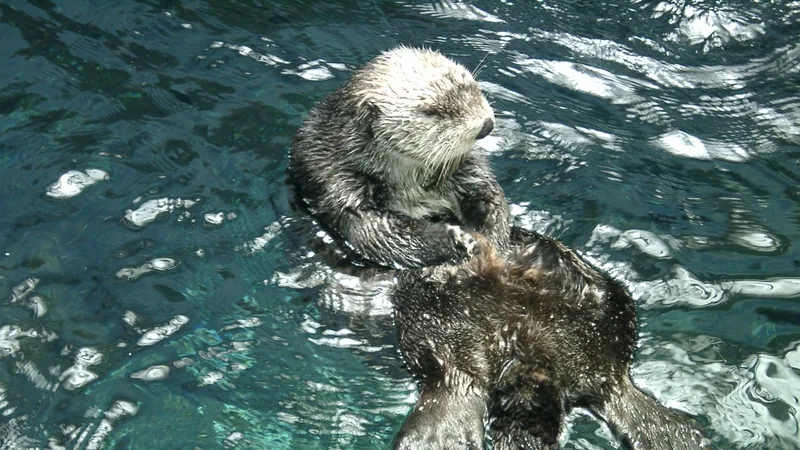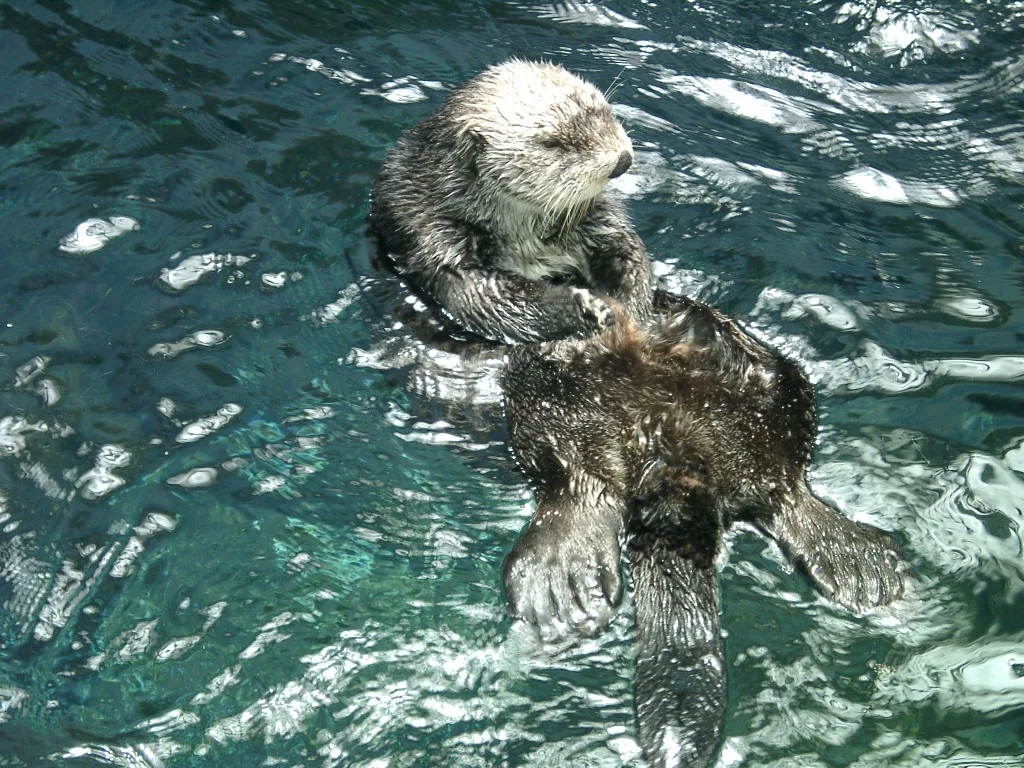
A sea otter floats with a pup on its chest in Morro Bay, California.
Field
notes
No Blubber, No Problem
The sea otter (Enhydra lutris) is the largest member of the weasel family, growing up to 5 feet (1.5 m) long. Males weigh 80 to 100 pounds (36 to 45 kg) and can weigh more, while females are smaller at 50 to 70 pounds (23 to 32 kg). Wild sea otters live between 15 and 20 years. Unlike most marine mammals, which have thick layers of fat to keep warm, a sea otter has no insulating fat at all. It relies on a high metabolism and its plush coat instead: a dense underfur that a top layer of long, waterproof guard hairs helps keep dry. The fur traps air, which provides 4 times as much insulation as the same thickness of fat would.
The Densest Fur of Any Mammal A sea otter’s underfur has 1 million hairs per square inch, while a human head holds about 100,000 hairs in total. The otter grooms almost continuously, somersaulting, twisting and rubbing its fur to trap air bubbles against its skin.
A Rock Tucked Under One Arm
A sea otter dives to the bottom to catch its prey. Its front paws find and grab it, while its whiskers feel the movement of prey animals in murky water. Its main prey include sea urchins, crabs, clams, mussels, octopus and fish. It tucks each catch into a pocket of loose skin under a foreleg and carries it up to eat. At the surface it rolls onto its back, sets the food on its chest, and may crack a shell open with a rock it stored under its “armpit” during the dive. Dives generally last one to two minutes, though an otter can hold its breath for more than five. It usually feeds in water no deeper than 60 feet, but can dive to 300 feet or more if needed.
Researchers call the sea otter the smallest marine mammal. A foraging dive burns nearly twice the energy predicted for a seal, partly because of the otter’s buoyancy and swimming style. Its metabolism also runs at two to three times the rate of other mammals its size, so it needs to eat about a quarter of its own weight every day.
The Otter That Saves a Forest
Sea otters are considered a keystone species: they play a major role in their community by controlling plant-eating invertebrates. By preying on sea urchins, otters stop the urchins from overgrazing kelp forests, which lets the kelp thrive and adds to the variety of sea life. Individual otters tend to specialize; one may eat only urchins and crabs while another eats mostly fish, depending on its skills and the food nearby. The variety in the sea otter’s diet also reduces competition among the seafloor grazers it eats and supports greater diversity in those species. In one estuary exposed to extreme nutrient pollution from farming, sea otters helped eelgrass, a seagrass, grow and spread, counteracting the harm those nutrients do.
Hunted to the Brink
Russian explorers began the sea otter fur trade in the 1700s. By the turn of the 20th century, hunting had left between 1,000 and 2,000 sea otters worldwide. The 1911 International Fur Seal Treaty banned the hunt, and the population rebounded dramatically in the 20th century. The 1989 Exxon Valdez oil spill killed anywhere from 1,000 to several thousand sea otters in Alaska’s Prince William Sound and the central Gulf of Alaska. The latest IUCN Red List assessment, published in 2021, lists the sea otter as Endangered.
Published Updated
Traits
Intel
& FAQ
Guess
first
How big is a Sea Otter, really? Slide, lock in, and see what the sources say. Every answer is a figure from this page, quoted from where it came from.
Sources
- 01Sea Otter Species Profile. Alaska Department of Fish and Game.
- 02Sea otter. Oregon Zoo.
- 03Enhydra lutris (sea otter). Animal Diversity Web, University of Michigan.
- 04Hughes et al. (2013). Recovery of a top predator mediates negative eutrophic effects on seagrass. Proceedings of the National Academy of Sciences.
- 05Yeates, Williams & Fink (2007). Diving and foraging energetics of the smallest marine mammal, the sea otter (Enhydra lutris). Journal of Experimental Biology.
- 06Ballachey et al. (2014). 2013 update on sea otter studies to assess recovery from the 1989 Exxon Valdez oil spill, Prince William Sound, Alaska. U.S. Geological Survey Open-File Report 2014-1030.
- 07Doroff, Burdin & Larson (2021). Enhydra lutris. The IUCN Red List of Threatened Species 2021: e.T7750A219377647.
What the sources say: 58 claims checked word for word against these sources →