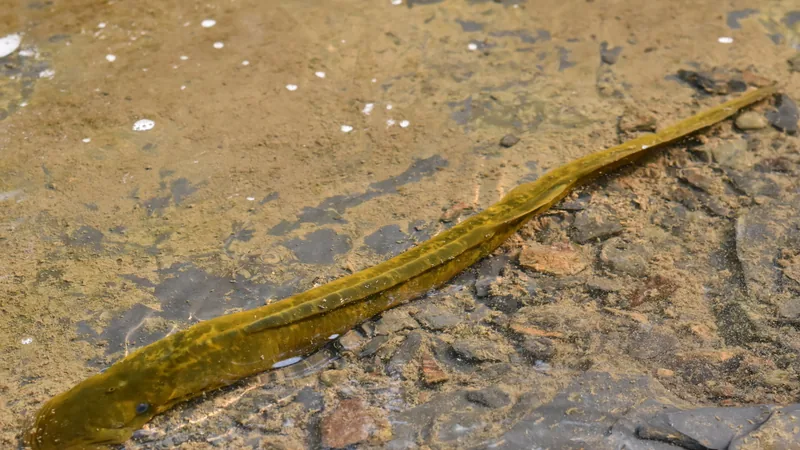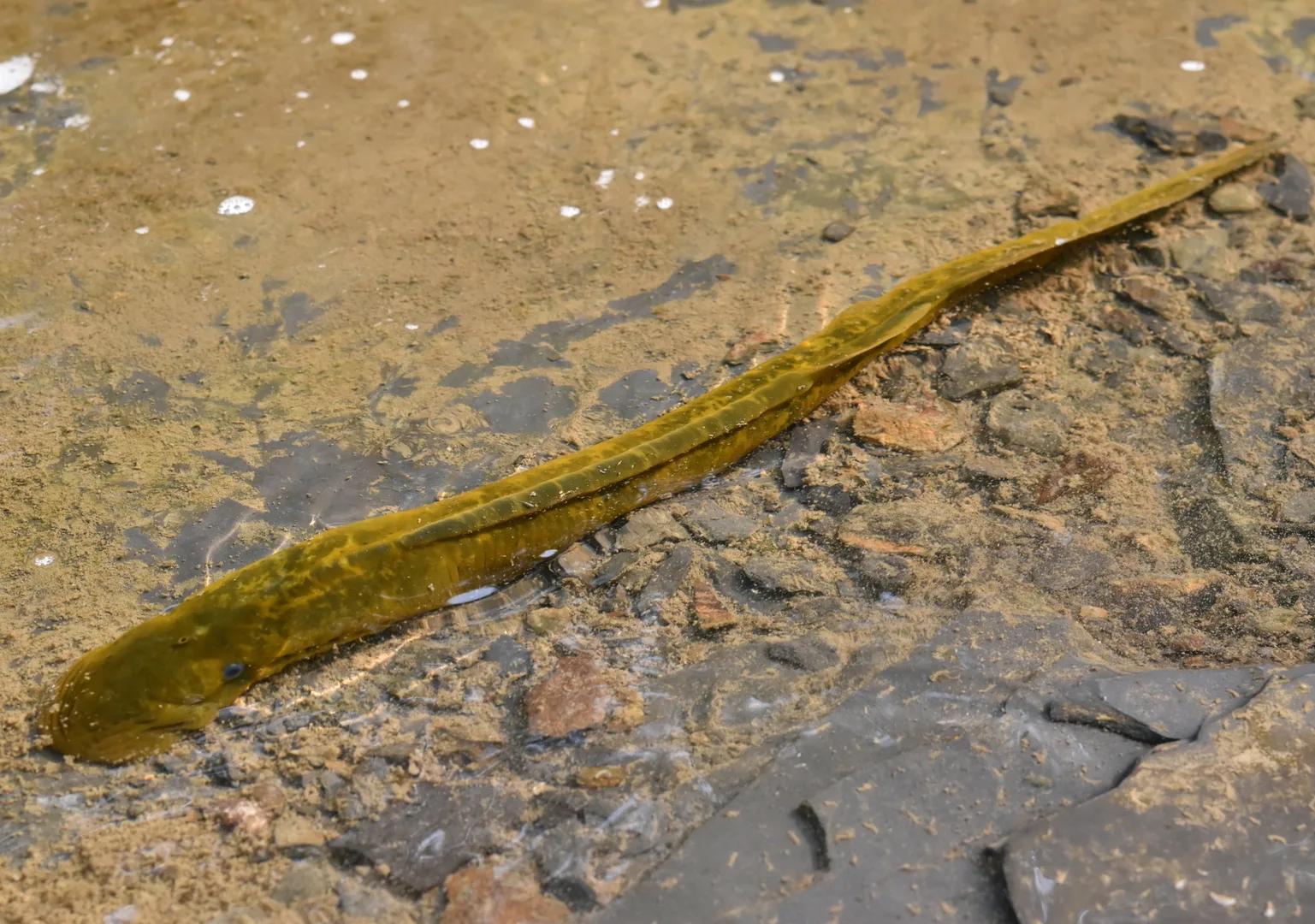
Sea lamprey (Petromyzon marinus) in a stream in the United States.
Field
notes
An Ancient Jawless Branch
Sea lampreys are living members of an ancient vertebrate lineage that split from the branch leading to us roughly 500 million years ago. They have no jaws. Instead they carry a round, sucker-like mouth ringed with small, sharp teeth that work like a rasp, plus a file-like tongue. Sea-run adults can reach 120 centimetres (about four feet), while landlocked lampreys such as those in North America’s Great Lakes reach 64 centimetres, and adults can weigh up to 2.5 kilograms. Sea lampreys are native to North America’s Atlantic coast from the Gulf of St. Lawrence to Florida, and to Europe’s Atlantic coast and the Mediterranean.
A Mouth That Rasps
Lampreys attach to a host fish with that sucker mouth and suck its blood for days. Paired glands in their mouths secrete compounds that stop the host’s blood from clotting. The sea lamprey does not seem to prefer any one host, and its recorded hosts range from salmon and lake trout to whitefish and walleye.
A shark’s armor is no obstacle In the Bay of Fundy, researchers observed ten sea lampreys feeding on basking sharks, the world’s second-largest fish. The sea lamprey can get through a shark’s armor of dermal denticles, its tooth-like scales, then rapidly excrete the large volumes of urea it swallows with shark blood.
Blind for Years Before It Grows Eyes
A sea lamprey’s life starts as a blind, worm-like larva called an ammocoete, which burrows into a stream bottom, usually silt or sand, and filter-feeds on algae and detritus. It may stay a larva for anywhere from three to seventeen years. As it matures it grows eyes and its sucker mouth, then spends twelve to twenty months feeding on host fish before swimming upstream to spawn. Spawning is its last act. Its digestive system disintegrates and it cannot feed, and both sexes die soon after the female lays 30,000 to 100,000 eggs and the male fertilizes them.
The Invasion That Collapsed a Fishery
Niagara Falls once kept sea lampreys out of Lake Erie and the lakes beyond. The Welland Canal, opened in 1829, gave them a route around the falls, and they turned up in Lake Erie by 1921, Lake Michigan by 1936, Lake Huron by 1937 and Lake Superior by 1946. Their arrival caused a collapse in commercial fisheries in many parts of the Great Lakes in the 1940s and 1950s: Lake Huron’s lake trout catch fell from 3.4 million pounds in 1937 to virtual failure in 1947. A binational control program began in the 1950s, using barriers, traps and a lampricide that kills larvae in their streams. By 2009, lamprey numbers were reported at less than 10% of their mid-20th-century peak, and a 2007 estimate put the yearly cost of control, monitoring and research at $14 million.
Published Updated
Traits
Intel
& FAQ
Guess
first
How big is a Sea Lamprey, really? Slide, lock in, and see what the sources say. Every answer is a figure from this page, quoted from where it came from.
Sources
- 01Petromyzon marinus (eel sucker). Animal Diversity Web, University of Michigan.
- 02Petromyzon marinus Linnaeus, 1758. USGS Nonindigenous Aquatic Species Database / NOAA Great Lakes Aquatic Nonindigenous Species Information System.
- 03Ford (2024). Petromyzon marinus. The IUCN Red List of Threatened Species 2024: e.T16781A221272455.
- 04Smith et al. (2013). Sequencing of the sea lamprey (Petromyzon marinus) genome provides insights into vertebrate evolution. Nature Genetics.
- 05Chi et al. (2009). Suppression of neuronal excitability by the secretion of the lamprey (Lampetra japonica) provides a mechanism for its evolutionary stability. Pflügers Archiv - European Journal of Physiology.
- 06Wilkie et al. (2004). Lamprey parasitism of sharks and teleosts: high capacity urea excretion in an extant vertebrate relic. Comparative Biochemistry and Physiology Part A: Molecular & Integrative Physiology.
What the sources say: 60 claims checked word for word against these sources →