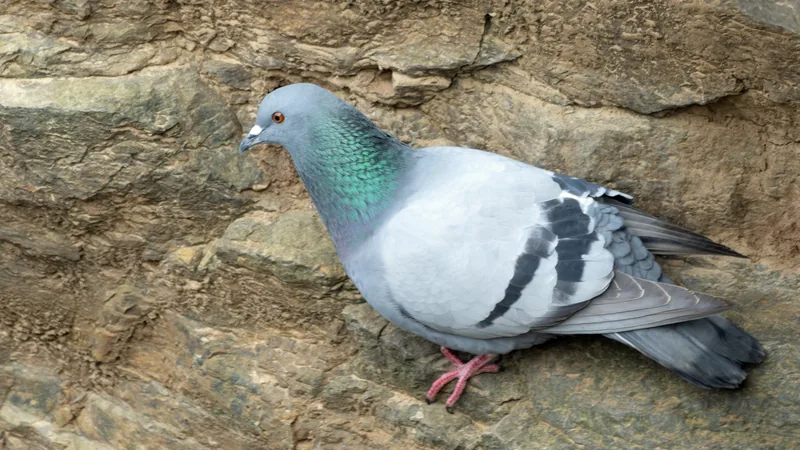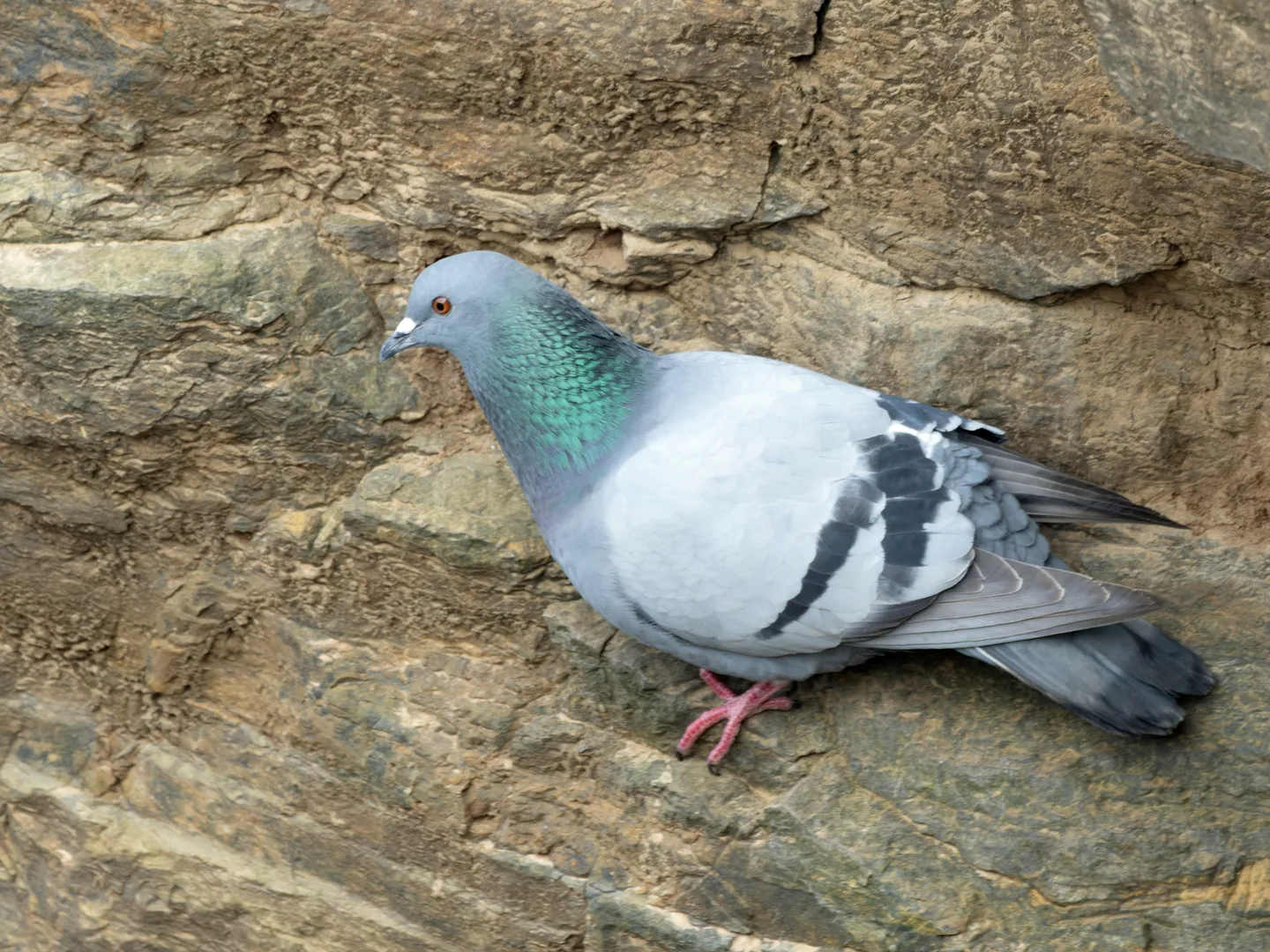
A wild rock dove at Duncansby Head, Caithness, Scotland.
Field
notes
Pigeon milk and fast families
Rock dove chicks get a strange meal. Both parents feed their young “pigeon milk.” The chicks leave the nest at about 25 to 32 days, or later in cold weather, and a pair may raise up to 5 or more broods in a year. Pairs may mate for life. In courtship the male spreads his tail, puffs up his chest and struts, often in circles around the female, repeatedly bowing and cooing.
Finding home
Homing instinct If displaced from its nesting area, the rock dove has good homing ability, and trained homing pigeons can return to their home loft from long distances away.
The long-distance part belongs to trained homing pigeons, which are domestic birds: people domesticated the species and trained it for homing, racing and carrying messages. Domestic and feral pigeons are among the most intensively studied of all birds. Work on orientation and navigation has depended heavily on research using domestic and feral rock pigeons, and prolactin, a hormone (a chemical messenger in the blood), was discovered through work with pigeons.
From sea cliffs to skyscrapers
The wild rock dove is native to Europe, North Africa, and western, southwestern, west-central and southern Asia. In that range it nested on cliffs along coasts and in inland mountains and gorges. Domestic pigeons descend from it, and the species now lives in a wild or semi-wild condition in cities all over the world, including most of North America.
Wild and city birds are hard to tell apart, because the wild pattern keeps turning up in feral birds. A 2022 genetic study of rock doves in the British Isles found the Outer Hebrides populations had the least gene flow with domestic pigeons. The food fits both lives: mostly seeds, with waste grain and sometimes berries away from cities, while city birds may live largely on bread crumbs and popcorn.
Size and lifespan
An adult is about 34 cm long, and AnAge gives an adult weight of 358.7 g. In captivity, one bird reportedly lived to 35 years. AnAge notes an oddity of age: unlike most mammals, older pigeons have larger and heavier brains than younger ones. The IUCN Red List rated the species Least Concern in its 2025 assessment.
Published
Traits
Intel
& FAQ
Guess
first
How big is a Rock Dove, really? Slide, lock in, and see what the sources say. Every answer is a figure from this page, quoted from where it came from.
Sources
- 01Columba livia. The IUCN Red List of Threatened Species 2025: e.T22690066A281965783.
- 02Lowther & Johnston (2020). Rock Pigeon (Columba livia). Birds of the World.
- 03Smith et al. (2022). Limited domestic introgression in a final refuge of the wild pigeon. iScience.
- 04Rock Pigeon. Audubon Guide to North American Birds.
- 05Columba livia (rock dove). AnAge: The Animal Ageing and Longevity Database.
What the sources say: 39 claims checked word for word against these sources →