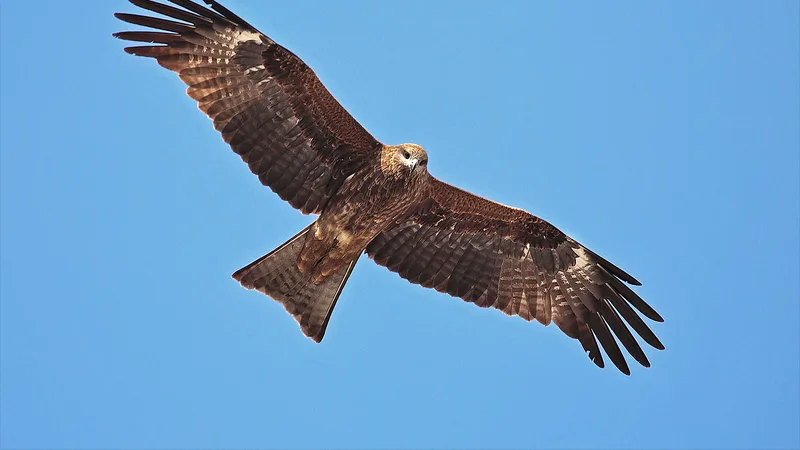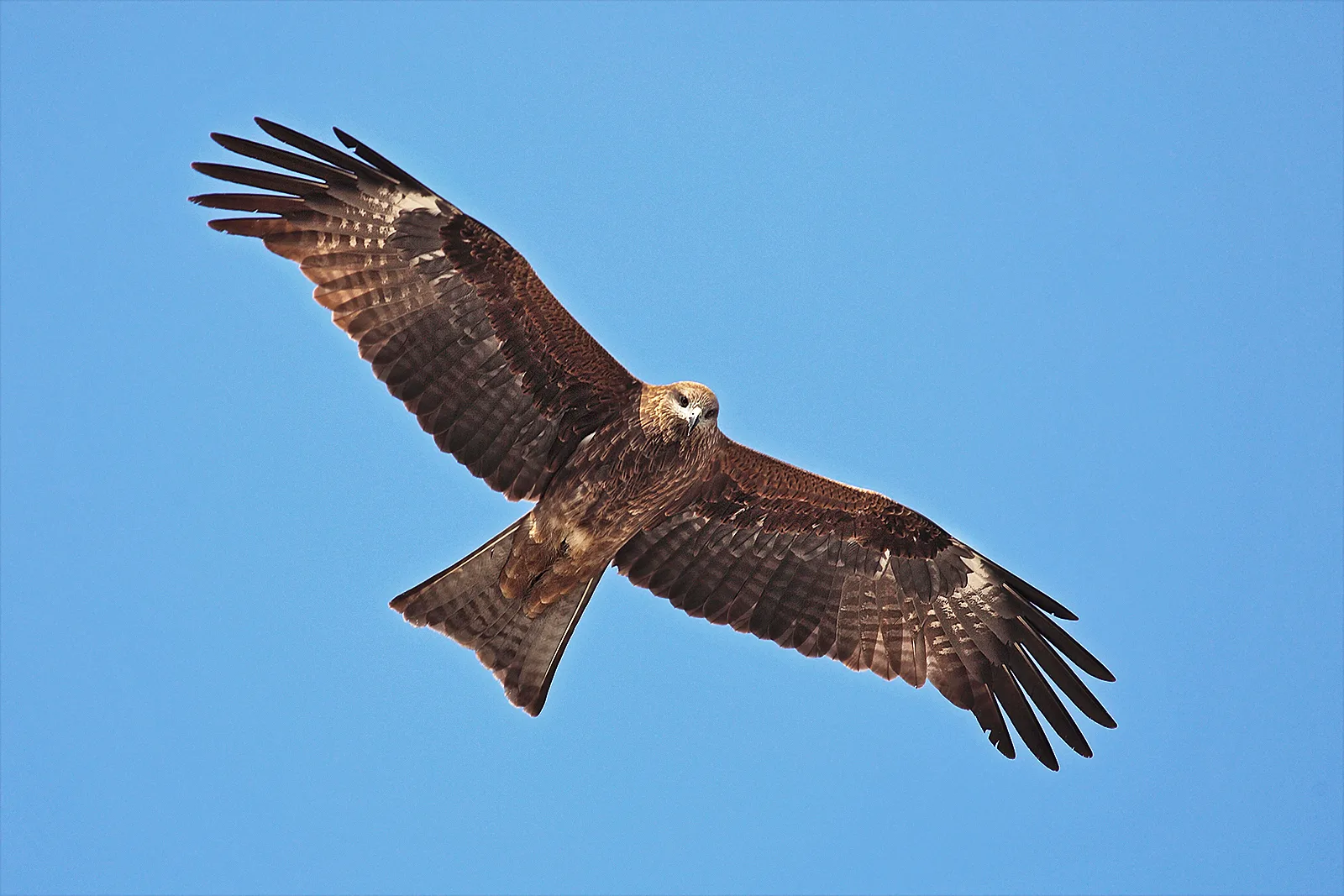
Red kite in flight over Bernwood Meadows, Buckinghamshire
Field
notes
A Tail That Steers Like a Rudder
The red kite (Milvus milvus) is endemic to the western Palearctic, in Europe and northwest Africa. It carries a wingspan between 175 and 195 centimetres (5.7 to 6.4 feet). Females are generally the larger sex, weighing 1 to 1.3 kilograms against a male’s 0.8 to 1.2 kilograms. Its long, deeply forked tail is distinctive, and when soaring the bird constantly adjusts the tail’s angle to steer while barely moving its wings. The oldest ringed red kite in BTO records reached 25 years and 8 months, and one in captivity reached 38.
A Scavenger First
Compared with many other birds of prey, red kites have relatively weak talons, so they mainly eat carrion and are often seen soaring over roads looking for roadkill. When they do hunt, especially while raising young, they take rabbits, voles and field mice, along with birds, worms, insects and other invertebrates. In Shakespeare’s day, red kites were common even in cities, catching rodents and scavenging scraps of meat from the streets. Goshawks are the only known natural predator of an adult red kite. When a predator appears, a female signals her fledglings to play dead, and they can fool a fox into leaving them, meaning to return for them later.
Back From the Brink
Persecution drove red kites to the point of extinction in Britain. By the end of the 19th century they were extinct in England, Scotland and Ireland, and by the 1930s and 1940s fewer than ten breeding pairs remained, concentrated in a small part of mid-Wales. In July 1990, two Welsh birds and eleven Spanish birds from Navarra were released in the Chiltern Hills. With a sister project on Scotland’s Black Isle and conservation work in Wales, those releases helped the population recover: the UK’s breeding population grew by more than 2,600 percent between 1995 and 2024, and the UK is now home to about 13 percent of the world’s red kites. Worldwide, the IUCN Red List rates the species Least Concern.
A Nest Lined With Odd Finds
Red kites nest in large, mature trees, generally 10 to 15 metres up, and line their nests with wool, grass and twigs, but they also collect other objects that catch their eye. Nests have been found holding gloves, novelty sunglasses and cuddly toys.
A Wardrobe Raid on the Bank One Scottish red kite lined its nest with underwear that skinny-dippers had left behind on a bank.
Published Updated
Traits
Intel
& FAQ
Guess
first
How big is a Red Kite, really? Slide, lock in, and see what the sources say. Every answer is a figure from this page, quoted from where it came from.
Sources
- 01Milvus milvus (red kite). Animal Diversity Web, University of Michigan.
- 02Red Kite. BTO BirdFacts, British Trust for Ornithology.
- 03Red Kite. RSPB.
- 04Milvus milvus. AnAge: The Animal Ageing and Longevity Database.
- 05A conservation success story: the reintroduction of red kites 30 years ago. Natural England.
- 06Westrip (2022). Milvus milvus. The IUCN Red List of Threatened Species 2022: e.T22695072A210523277.
What the sources say: 35 claims checked word for word against these sources →