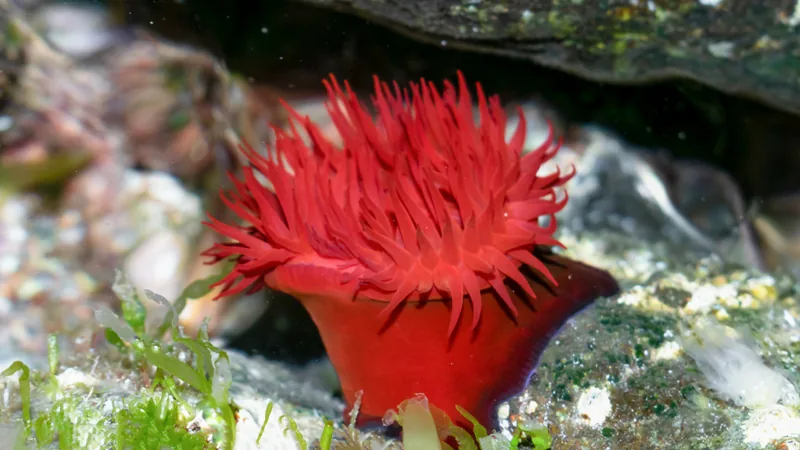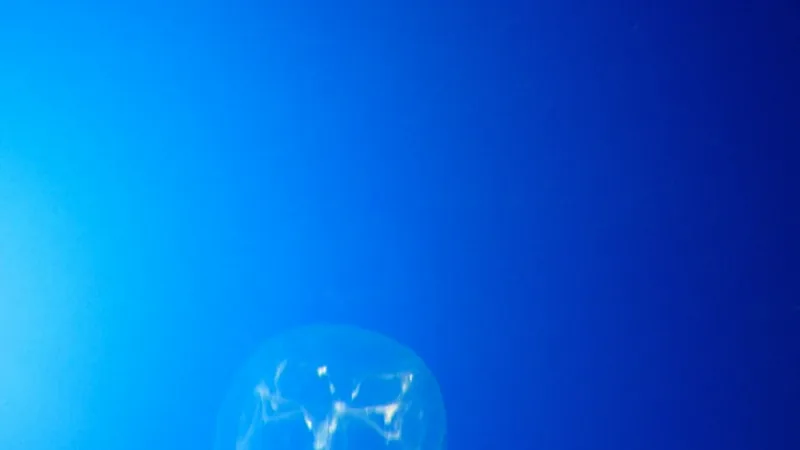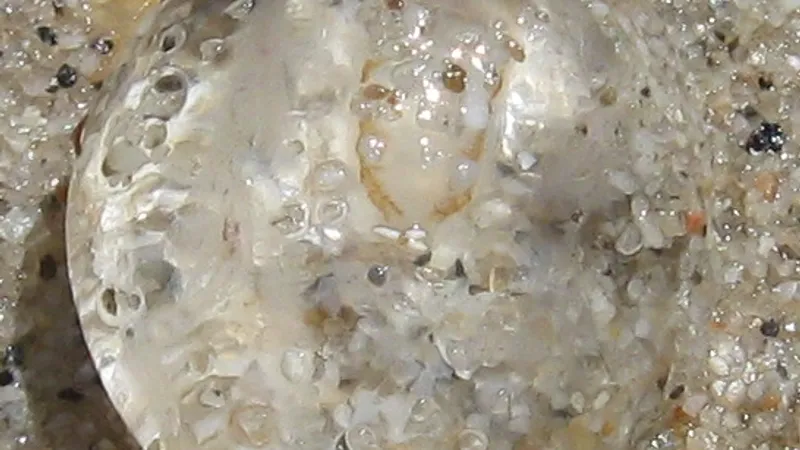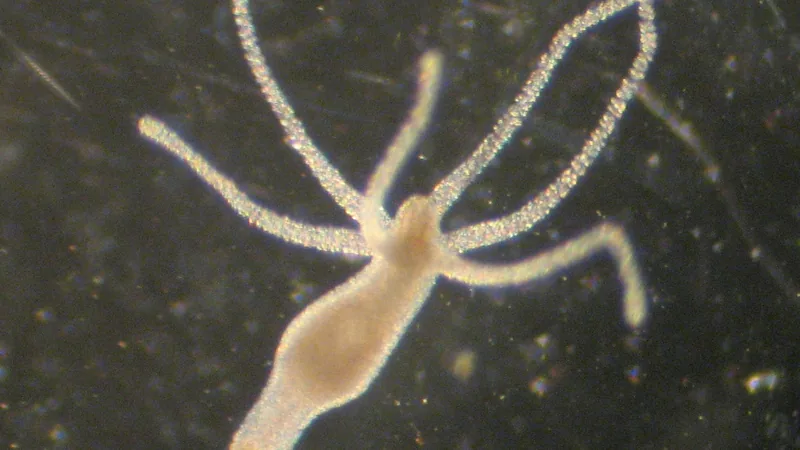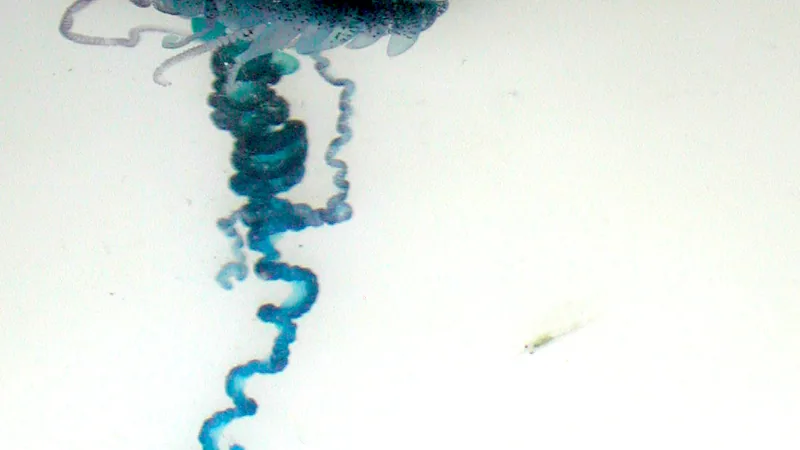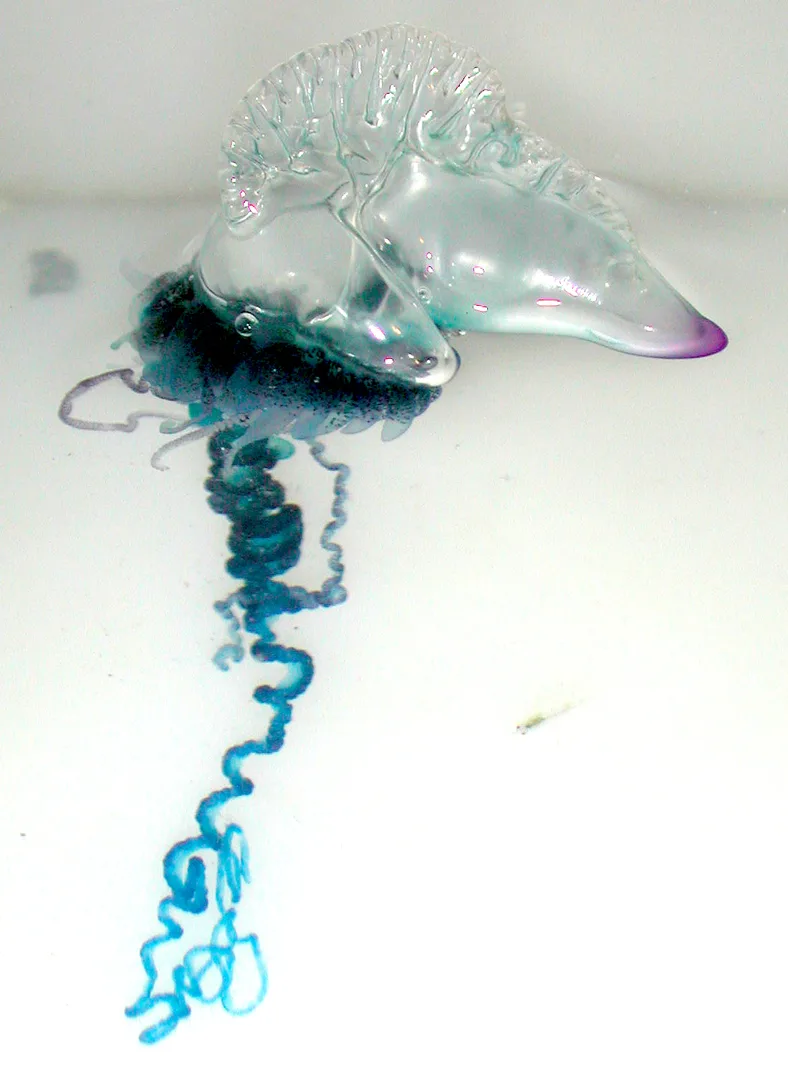
Portuguese man o' war (Physalia physalis) on Iguana Island, Guna Yala, San Blas archipelago, Panama, in February 2012.
Field
notes
A Colony Wearing a Jellyfish Costume
The Portuguese man o’ war looks like a single balloon-topped jellyfish drifting the sea surface. It isn’t one animal at all. It is a colony of specialized, genetically identical individuals called zooids. Its four specialized parts are a gas-filled float, the pneumatophore, that catches the wind; tentacles that hunt; digestive polyps that feed the whole colony; and reproductive polyps. The float, tentacles, digestive polyps, and reproductive polyps are so specialized that they cannot live without each other. The float can be up to 15 centimeters above the water and is around 15 centimeters in size, with some reported at up to 30 centimeters. The hunting tentacles can extend up to 30 meters, nearly 100 feet.
Fishing As It Drifts
As the colony drifts, its tentacles trail behind it like fishing lines, with microscopic stinging capsules called nematocysts covering much of their surface. They carry a single type of nematocyst, able to penetrate only soft-bodied prey. Injected into fish muscle, an extract of the toxin causes general paralysis, hitting the nervous system and the centers that control breathing, and at high doses it kills. Fish and fish larvae make up 70 to 90 percent of the colony’s diet, along with shrimp and other crustaceans. Once prey is snared and hauled up toward the float, the digestive polyps take over: researchers have watched upward of 50 of them completely cover a 10-centimeter fish, their mouths spread out across its surface.
A venom that pops cells like balloons Physalitoxin, one of several proteins in the venom, appears to be responsible for both its hemolytic (blood-cell-bursting) and lethal activities: it proved lethal to mice in lab tests. In cultured cells, low doses make calcium build up inside, and the results imply the venom produces pore-like structures in cell membranes, which make the cells swell and then burst.
Left-Handed and Right-Handed Sailors
The float is a sail. Every colony is either “left-handed” or “right-handed,” its float leaning one way or the other. Left-handed colonies drift to the right of the wind and right-handed ones to the left. In a 2021 model with no current, a left-handed Atlantic man o’ war would drift 51.5 degrees clockwise from the wind rather than straight downwind. Because the two forms drift in different directions, when strong winds blow man o’ war into shallow coastal waters, half are blown away from shore, where they are more likely to survive.
Enemies That Steal Its Weapons
Being a raft of stinging cells doesn’t make the man o’ war untouchable. Sea turtles eat it. The blue glaucus, a sea slug, eats its tentacles, stores the stinging capsules intact, and redeploys them in its own defense. Young Tremoctopus violaceus octopuses carry man o’ war tentacles along the rows of suckers on their upper arms, and the tentacles are thought to help them both fend off attackers and catch prey. In 2019 there was only one recognized species of Physalia, the man o’ war genus, but a 2025 study of whole genomes concluded there are at least four, each split into regional subpopulations that line up with the prevailing currents and winds.
Published Updated
Traits
Intel
& FAQ
Guess
first
How big is a Portuguese Man o' War, really? Slide, lock in, and see what the sources say. Every answer is a figure from this page, quoted from where it came from.
Sources
- 01Physalia physalis (Portuguese man-of-war). Animal Diversity Web, University of Michigan.
- 02What is a Portuguese Man o' War? National Ocean Service, NOAA.
- 03The Portuguese man-of-war (Physalia physalis). Southeastern Regional Taxonomic Center, South Carolina Department of Natural Resources.
- 04Portuguese Man o' War. Oceana.
- 05Munro et al. (2019). Morphology and development of the Portuguese man of war, Physalia physalis. Scientific Reports.
- 06Lee, Schaeffer & Groeskamp (2021). Drifting dynamics of the bluebottle (Physalia physalis). Ocean Science.
- 07Tamkun & Hessinger (1981). Isolation and partial characterization of a hemolytic and toxic protein from the nematocyst venom of the Portuguese man-of-war, Physalia physalis. Biochimica et Biophysica Acta (BBA) - Protein Structure.
- 08Edwards, Whitter & Hessinger (2002). Apparent membrane pore-formation by portuguese Man-of-war (Physalia physalis) venom in intact cultured cells. Toxicon.
- 09Burnett & Gable (1989). A fatal jellyfish envenomation by the Portuguese man-o'war. Toxicon.
- 10Church et al. (2025). Population genomics of a sailing siphonophore reveals genetic structure in the open ocean. Current Biology.
What the sources say: 61 claims checked word for word against these sources →